这里是差集:Docling 全量解析 text block 减去最终会进入正文的 block。优先人工检查 risk=high / medium。
layout_review.html excluded_blocks.json excluded_blocks.tsv final_body_blocks.tsv visual_assets.tsv original.pdf
{
  "parsed_text_blocks": 149,
  "final_body_blocks": 9,
  "excluded_blocks": {
    "count": 140,
    "by_reason": {
      "after_back_matter_stop": 109,
      "first_page_metadata": 8,
      "first_page_author_or_affiliation": 5,
      "docling_page_footer": 3,
      "docling_page_header": 3,
      "body_heading": 2,
      "first_page_front_matter_heading": 2,
      "outside_body_flow_caption": 2,
      "back_matter_heading": 1,
      "document_ui": 1,
      "document_web_address": 1,
      "first_page_summary": 1,
      "front_matter_author_line": 1,
      "implicit_abstract": 1
    },
    "by_role_guess": {
      "reference": 42,
      "body_candidate_excluded": 20,
      "page_footer": 15,
      "page_header": 13,
      "unknown_text": 13,
      "metadata": 11,
      "affiliation": 7,
      "back_matter_heading": 5,
      "caption": 5,
      "body_heading": 4,
      "abstract_candidate": 2,
      "title_candidate": 2,
      "back_matter_text": 1
    },
    "by_risk_level": {
      "low": 115,
      "medium": 25
    },
    "high_risk_count": 0,
    "medium_risk_count": 25
  },
  "char_counts": {
    "parsed_text_chars": 36458,
    "final_body_chars": 7680,
    "excluded_chars": 28778
  }
}
{
  "truncated": true,
  "message": "Body extraction stopped at page 3 block #/texts/38: Supporting Information Figure S9). Before the cell is charged to ca. 3.1 V, a solid-solution reaction occurs with negligible variation of cell parameters (Li2MoO3 → Li1.75MoO3 + 0.25Li + ).. 109 following text blocks were excluded as after_back_matter_stop.",
  "stop_trigger": {
    "ref": "#/texts/38",
    "page": 3,
    "layout_order": 39,
    "role_guess": "back_matter_heading",
    "body_decision_reason": "back_matter_heading",
    "text_preview": "Supporting Information Figure S9). Before the cell is charged to ca. 3.1 V, a solid-solution reaction occurs with negligible variation of cell parameters (Li2MoO3 → Li1.75MoO3 + 0.25Li + )."
  },
  "first_truncated_block": {
    "ref": "#/texts/39",
    "page": 3,
    "layout_order": 40,
    "role_guess": "body_candidate_excluded",
    "body_decision_reason": "after_back_matter_stop",
    "text_preview": "As the cell is further charged to ca. 3.6 V, the (003) di ff raction peak shifts to lower angles and gradually becomes broader. Meanwhile, the intensities of the other peaks indexed to Li2MoO3 decrease while those of ne…"
  },
  "truncated_block_count": 109,
  "truncated_pages": [
    3,
    4,
    5,
    6,
    7
  ],
  "by_role_guess": {
    "reference": 42,
    "body_candidate_excluded": 20,
    "unknown_text": 13,
    "page_footer": 10,
    "page_header": 9,
    "back_matter_heading": 4,
    "metadata": 4,
    "caption": 3,
    "body_heading": 2,
    "affiliation": 1,
    "back_matter_text": 1
  }
}
这些框显示被排除块,同时叠加真实图表资产框。青色虚线表示该 text block 被图表资产 caption 吸收;红色 STOP 是截断触发点,红色框是截断后被排除的块。
这是实际图表资产输出,不是审计层重新推断。
| # | type | label | page | caption source | suppressed | duplicate reason | rescue reason | group | confidence | bbox | caption |
|---|---|---|---|---|---|---|---|---|---|---|---|
| 1 | figure | Docling Figure 1 | 1 | missing_caption | 0.55 | [325.65, 312.98, 233.3, 103.99] | |||||
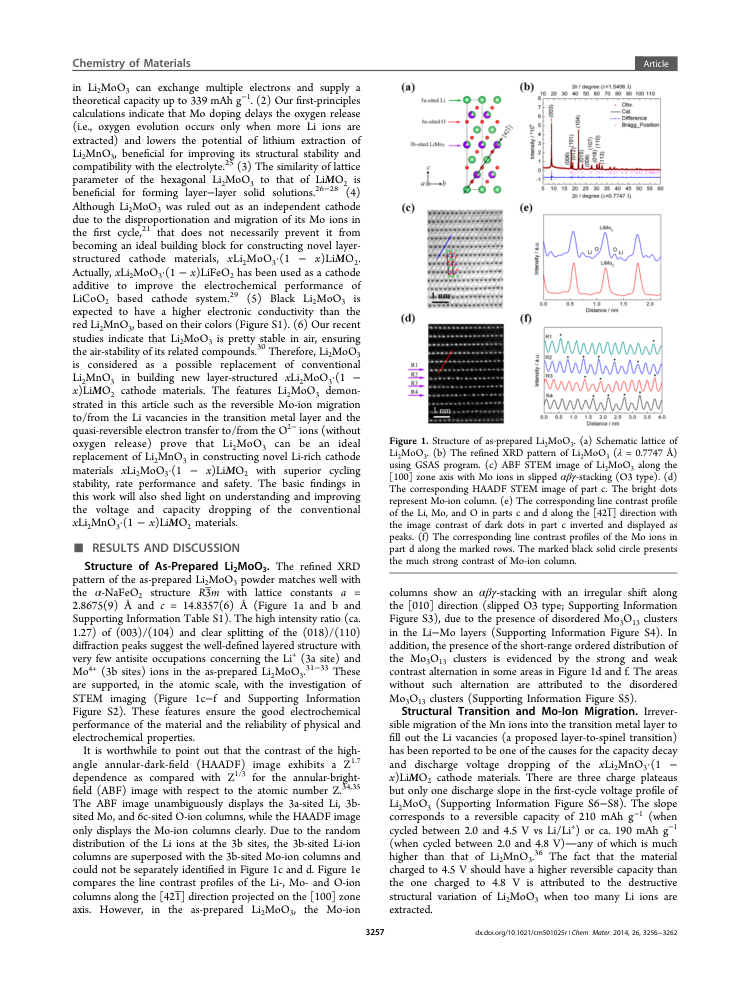
| 2 | figure | Fig. 1 | 2 | direct_caption_ref | 0.82 | [332.68, 66.19, 221.74, 288.41] | Figure 1. Structure of as-prepared Li 2 MoO3. (a) Schematic lattice of Li2MoO3. (b) The re fi ned XRD pattern of Li2MoO3 ( λ = 0.7747 Å) using GSAS program. (c) ABF STEM image of Li2MoO3 along the [100] zone axis with Mo ions in slipped αβγ -stacking (O3 type). (d) The corresponding HAADF STEM image of part c. The bright dots represent Mo-ion column. (e) The corresponding line contrast pro fi le of the Li, Mo, and O in parts c and d along the [421 ̅ ] direction with the image contrast of dark dots in part c inverted and displayed as peaks. (f) The corresponding line contrast pro fi les of the Mo ions in part d along the marked rows. The marked black solid circle presents the much strong contrast of Mo-ion column. | ||||
| 3 | figure | Fig. 2 | 3 | direct_caption_ref | 0.82 | [65.66, 113.14, 228.85, 257.59] | Figure 2. Structural evolution of Li2MoO3 during the initial delithiation and lithiation. (a) In situ XRD patterns of Li2 -x MoO3 (0 ≤ x ≤ 2) electrodes while a Li 2 MoO3/Li cell is charged and discharged at a current density of 10 mA g -1 between 2.0 and 4.8 V. (b) Schematic structures of Li 2 -x MoO3 (0 ≤ x ≤ 2) (V representing atomic vacancy) during the initial charge and discharge process. | ||||
| 4 | figure | Fig. 3 | 3 | direct_caption_ref | 0.82 | [328.79, 188.34, 229.37, 254.46] | Figure 3. Detection of Mo-ion migration in atomic scale. (a) HAADF image of the as-prepared Li 2 MoO3 along the [100] zone axis. (c and e) HAADF images of the charged and discharged Li2MoO3 along the [1 ̅ 00] zone axis, respectively. The Mo ions at 3a and 3b sites in the HAADF images are presented with pink and yellow solid circles, respectively. (b , d , and f) Corresponding line contrast pro fi les of Mo ions along the marked rows in the HAADF images. The much strong contrast of Mo ions is marked with black solid circle in the line contrast pro fi les. | ||||
| 5 | figure | Fig. 4 | 4 | direct_caption_ref | 0.82 | [65.84, 277.25, 227.83, 284.16] | Figure 4. Charge compensation of Li2MoO3 during the initial delithiation and lithiation. (a) XANES spectra of Mo K-edge of Li2MoO3 at di ff erent delithiation and lithiation states. (b) Fouriertransformed Mo K-edge EXAFS spectra of Li2MoO3 corresponding to part a. (c) ABF imaging of Li2MoO3 at di ff erent delithiation and lithiation states showing the variation of the Mo -O distances, indicating the distortion of the MoO 6 octahedra during Li + extraction and insertion. (d) PEY mode and (e) FY mode of O K-edge soft XAS spectra of Li 2 MoO3 at di ff erent delithiation and lithiation states. | ||||
| 6 | figure | Fig. 5 | 5 | direct_caption_ref | 0.82 | [334.57, 63.57, 219.99, 172.71] | Figure 5. Structural transition of Li2MoO3 in the initial electrochemical (de)lithiation process. The lattice structure variation demonstrates that solid-solution reaction and two-phase reaction occur in consequence. |
| risk | page | order | label | role | reason | parser reason | production usage | trunc | body region | region | bg | bbox | raw text | cleaned text |
|---|---|---|---|---|---|---|---|---|---|---|---|---|---|---|
| medium | 1 | 3 | text | affiliation | front_matter_author_line | front_matter_author_line | p1:body_region:0 | p1:front_matter:column_1_of_2:white | [255, 255, 255] white | [60.49, 156.08, 504.0, 32.21] | Jun Ma, † , ⊥ Yong-Ning Zhou, ‡ , ⊥ Yurui Gao, † Xiqian Yu, ‡ Qingyu Kong, * , § Lin Gu, ∥ Zhaoxiang Wang, * , † Xiao-Qing Yang, * , ‡ and Liquan Chen † | Jun Ma, † , ⊥ Yong-Ning Zhou, ‡ , ⊥ Yurui Gao, † Xiqian Yu, ‡ Qingyu Kong, * , § Lin Gu, ∥ Zhaoxiang Wang, * , † Xiao-Qing Yang, * , ‡ and Liquan Chen † | ||
| medium | 1 | 4 | footnote | affiliation | first_page_author_or_affiliation | first_page_author_or_affiliation | p1:body_region:0 | p1:front_matter:column_1_of_2:white | [255, 255, 255] white | [60.49, 193.44, 503.98, 35.77] | † Key Laboratory for Renewable Energy, Chinese Academy of Sciences; Beijing Key Laboratory for New Energy Materials and Devices; Beijing National Laboratory for Condensed Matter Physics; Institute of Physics, Chinese Academy of Sciences, PO Box 603, Beijing 100190, China | † Key Laboratory for Renewable Energy, Chinese Academy of Sciences; Beijing Key Laboratory for New Energy Materials and Devices; Beijing National Laboratory for Condensed Matter Physics; Institute of Physics, Chinese Academy of Sciences, PO Box 603, Beijing 100190, China | ||
| medium | 1 | 8 | footnote | affiliation | first_page_author_or_affiliation | first_page_author_or_affiliation | p1:body_region:0 | p1:front_matter:column_1_of_2:white | [255, 255, 255] white | [60.49, 257.79, 503.96, 24.37] | ∥ Laboratory for Advanced Materials & Electron Microscopy, Beijing National Laboratory for Condensed Matter Physics, Institute of Physics, Chinese Academy of Sciences, PO Box 603, Beijing 100190, China | ∥ Laboratory for Advanced Materials & Electron Microscopy, Beijing National Laboratory for Condensed Matter Physics, Institute of Physics, Chinese Academy of Sciences, PO Box 603, Beijing 100190, China | ||
| medium | 1 | 10 | text | abstract_candidate | implicit_abstract | implicit_abstract | p1:body_region:0 | p1:front_matter:front_panel:colored | [255, 247, 213] colored | [69.45, 315.0, 249.52, 111.16] | ABSTRACT: Layer-structured x Li2MnO3 · (1 -x )Li M O2 are promising cathode materials for high energy-density Li-ion batteries because they deliver high capacities due to the stabilizing e ff ect of Li2MnO3. However, the inherent disadvantages of Li 2 MnO3 make these materials su ff er from drawbacks such as fast energy-density decay, poor rate performance and safety hazard. In this paper, we propose to replace Li2MnO3 with Li2MoO3 for constructing novel Li-rich cathode materials and evaluate its feasibility. Comprehensive studies by X-ray di ff raction, X-ray absorption spectroscopy, and spherical-aberration-corrected scan- | ABSTRACT: Layer-structured x Li2MnO3 · (1 -x )Li M O2 are promising cathode materials for high energy-density Li-ion batteries because they deliver high capacities due to the stabilizing e ff ect of Li2MnO3. However, the inherent disadvantages of Li 2 MnO3 make these materials su ff er from drawbacks such as fast energy-density decay, poor rate performance and safety hazard. In this paper, we propose to replace Li2MnO3 with Li2MoO3 for constructing novel Li-rich cathode materials and evaluate its feasibility. Comprehensive studies by X-ray di ff raction, X-ray absorption spectroscopy, and spherical-aberration-corrected scan- | ||
| medium | 1 | 11 | text | abstract_candidate | first_page_summary | first_page_summary | p1:body_region:0 | p1:front_matter:front_panel:colored | [255, 247, 213] colored | [69.45, 426.58, 486.03, 55.79] | ning transmission electron microscopy clarify its lithium extraction/insertion mechanism and shows that the Mo 4+ /Mo 6+ redox couple in Li 2 MoO3 can accomplish the task of charge compensation upon Li removal. Other properties of Li2MoO3 such as the nearly reversible Mo-ion migration to/from the Li vacancies, absence of oxygen evolution, and reversible phase transition during initial (de)lithiation indicate that Li2MoO3 meets the requirements to an ideal replacement of Li2MnO3 in constructing Li 2 MoO3-based Li-rich cathode materials with superior performances. | ning transmission electron microscopy clarify its lithium extraction/insertion mechanism and shows that the Mo 4+ /Mo 6+ redox couple in Li 2 MoO3 can accomplish the task of charge compensation upon Li removal. Other properties of Li2MoO3 such as the nearly reversible Mo-ion migration to/from the Li vacancies, absence of oxygen evolution, and reversible phase transition during initial (de)lithiation indicate that Li2MoO3 meets the requirements to an ideal replacement of Li2MnO3 in constructing Li 2 MoO3-based Li-rich cathode materials with superior performances. | ||
| medium | 3 | 40 | text | body_candidate_excluded | after_back_matter_stop | after_back_matter_stop | after_stop | p3:body_region:0 | p3:page_body:column_1_of_2:white | [255, 255, 255] white | [60.49, 501.37, 240.04, 206.83] | As the cell is further charged to ca. 3.6 V, the (003) di ff raction peak shifts to lower angles and gradually becomes broader. Meanwhile, the intensities of the other peaks indexed to Li2MoO3 decrease while those of new peaks indexed to Li0.91MoO3 phase ( R 3 ̅ m ; a = 2.906 Å, c = 14.904 Å; Supporting Information Figure S10) at ca. 18.0 ° and 21.4 ° become increasingly stronger. 21 The phase transition from Li2MoO3 to Li 0.91 MoO3 is fi nished at ca. 4.0 V (Li1.75MoO3 → Li0.75MoO3 + 1.00 Li + ), suggesting that Li-ion vacancies appear at both the 3a and 3b sites and that some 3b-sited Mo ions have migrated to fi ll the 3a sites (Figure 2b). Above 4.0 V, the position shifting of the Li 0.91 MoO3 peaks stops though more Li ions are extracted (Li0.75MoO3 → Li 0.53MoO3 + 0.22Li + ). Instead, they become broader and their intensities decrease gradually. This implies the start of another solid-solution reaction with degraded crystallinity and/or reduced crystallite size, consistent with the destruction of the lattice fringe in the high resolution transmission electron microscopy (HRTEM) images (Supporting Information Figure S11). | As the cell is further charged to ca. 3.6 V, the (003) di ff raction peak shifts to lower angles and gradually becomes broader. Meanwhile, the intensities of the other peaks indexed to Li2MoO3 decrease while those of new peaks indexed to Li0.91MoO3 phase ( R 3 ̅ m ; a = 2.906 Å, c = 14.904 Å; Supporting Information Figure S10) at ca. 18.0 ° and 21.4 ° become increasingly stronger. 21 The phase transition from Li2MoO3 to Li 0.91 MoO3 is fi nished at ca. 4.0 V (Li1.75MoO3 → Li0.75MoO3 + 1.00 Li + ), suggesting that Li-ion vacancies appear at both the 3a and 3b sites and that some 3b-sited Mo ions have migrated to fi ll the 3a sites (Figure 2b). Above 4.0 V, the position shifting of the Li 0.91 MoO3 peaks stops though more Li ions are extracted (Li0.75MoO3 → Li 0.53MoO3 + 0.22Li + ). Instead, they become broader and their intensities decrease gradually. This implies the start of another solid-solution reaction with degraded crystallinity and/or reduced crystallite size, consistent with the destruction of the lattice fringe in the high resolution transmission electron microscopy (HRTEM) images (Supporting Information Figure S11). | |
| medium | 3 | 41 | text | body_candidate_excluded | after_back_matter_stop | after_back_matter_stop | after_stop | p3:body_region:0 | p3:bottom_margin:column_1_of_2:white | [255, 255, 255] white | [60.49, 710.4, 239.96, 53.96] | In the subsequent Li-ion insertion process, these di ff raction peaks keep unchanged at fi rst (Li0.53MoO3 + 0.44Li + → Li 0.97 MoO3) and then continuously shift to higher di ff raction angles very close to that of Li2MoO3 (Li0.97MoO3 + 0.53Li + → Li 1.50 MoO3). Meanwhile, the intensities of the peaks increase | In the subsequent Li-ion insertion process, these di ff raction peaks keep unchanged at fi rst (Li0.53MoO3 + 0.44Li + → Li 0.97 MoO3) and then continuously shift to higher di ff raction angles very close to that of Li2MoO3 (Li0.97MoO3 + 0.53Li + → Li 1.50 MoO3). Meanwhile, the intensities of the peaks increase | |
| medium | 3 | 43 | text | body_candidate_excluded | after_back_matter_stop | after_back_matter_stop | after_stop | p3:body_region:1 | p3:page_body:column_2_of_2:white | [255, 255, 255] white | [324.45, 69.37, 240.02, 63.8] | with Li-ion insertion. Interestingly, the insertion of Li ions to Li0.53MoO3 and Li0.97MoO3 seems to be a solid-solution reaction, di ff erent from that in the charge process. These indicate that the structure of Li2MoO3 can mostly be restored though the recovery is not along a reverse path of Li-ion extraction. | with Li-ion insertion. Interestingly, the insertion of Li ions to Li0.53MoO3 and Li0.97MoO3 seems to be a solid-solution reaction, di ff erent from that in the charge process. These indicate that the structure of Li2MoO3 can mostly be restored though the recovery is not along a reverse path of Li-ion extraction. | |
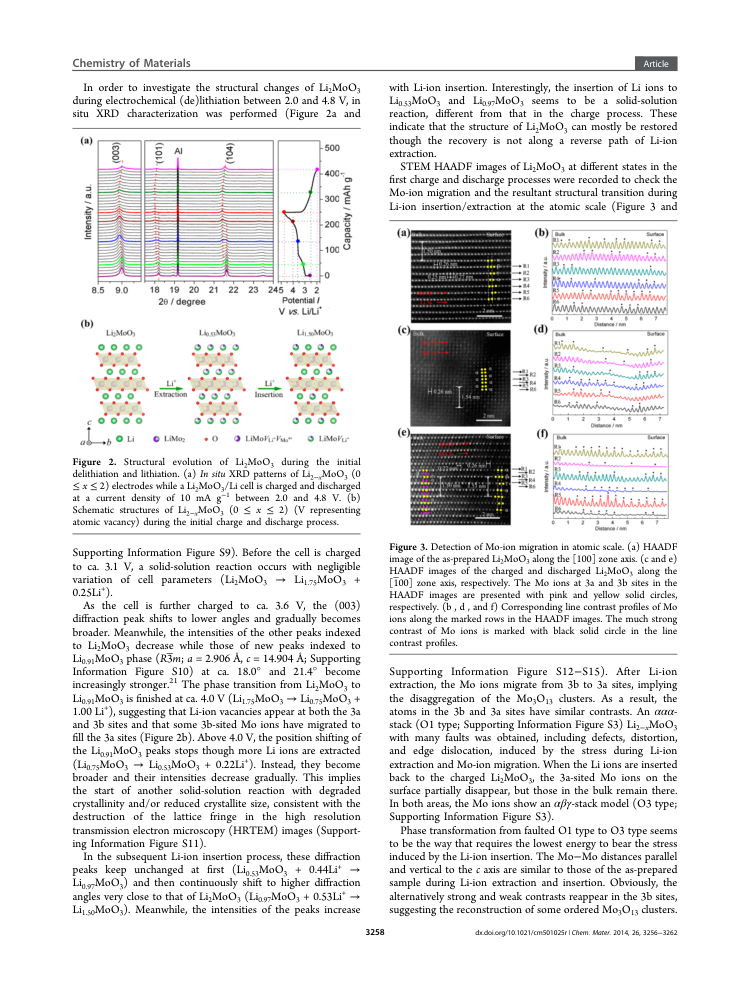
| medium | 3 | 44 | text | body_candidate_excluded | after_back_matter_stop | after_back_matter_stop | after_stop | p3:body_region:1 | p3:page_body:column_2_of_2:white | [255, 255, 255] white | [324.45, 135.36, 240.0, 41.8] | STEM HAADF images of Li2MoO3 at di ff erent states in the fi rst charge and discharge processes were recorded to check the Mo-ion migration and the resultant structural transition during Li-ion insertion/extraction at the atomic scale (Figure 3 and | STEM HAADF images of Li2MoO3 at di ff erent states in the fi rst charge and discharge processes were recorded to check the Mo-ion migration and the resultant structural transition during Li-ion insertion/extraction at the atomic scale (Figure 3 and | |
| medium | 3 | 47 | text | body_candidate_excluded | after_back_matter_stop | after_back_matter_stop | after_stop | p3:body_region:1 | p3:bottom_margin:column_2_of_2:white | [255, 255, 255] white | [324.45, 688.4, 239.99, 75.96] | Phase transformation from faulted O1 type to O3 type seems to be the way that requires the lowest energy to bear the stress induced by the Li-ion insertion. The Mo -Mo distances parallel and vertical to the c axis are similar to those of the as-prepared sample during Li-ion extraction and insertion. Obviously, the alternatively strong and weak contrasts reappear in the 3b sites, suggesting the reconstruction of some ordered Mo3O13 clusters. | Phase transformation from faulted O1 type to O3 type seems to be the way that requires the lowest energy to bear the stress induced by the Li-ion insertion. The Mo -Mo distances parallel and vertical to the c axis are similar to those of the as-prepared sample during Li-ion extraction and insertion. Obviously, the alternatively strong and weak contrasts reappear in the 3b sites, suggesting the reconstruction of some ordered Mo3O13 clusters. | |
| medium | 4 | 51 | text | body_candidate_excluded | after_back_matter_stop | after_back_matter_stop | after_stop | p4:body_region:0 | p4:page_body:column_1_of_2:white | [255, 255, 255] white | [60.49, 69.37, 239.97, 87.01] | The di ff erence between surface and bulk might be originated from the inhomogeneous insertion of the Li ions. Therefore, the partially reversible migration of the Mo ions and the partial recovery of the Mo3O13 clusters are responsible for the partially reversible phase transition, consistent with the above in situ XRD results. These features would have signi fi cant impact on the structural and cycling stability of the to-be-prepared x Li2MoO3 · (1 -x )Li M O2 composites. | The di ff erence between surface and bulk might be originated from the inhomogeneous insertion of the Li ions. Therefore, the partially reversible migration of the Mo ions and the partial recovery of the Mo3O13 clusters are responsible for the partially reversible phase transition, consistent with the above in situ XRD results. These features would have signi fi cant impact on the structural and cycling stability of the to-be-prepared x Li2MoO3 · (1 -x )Li M O2 composites. | |
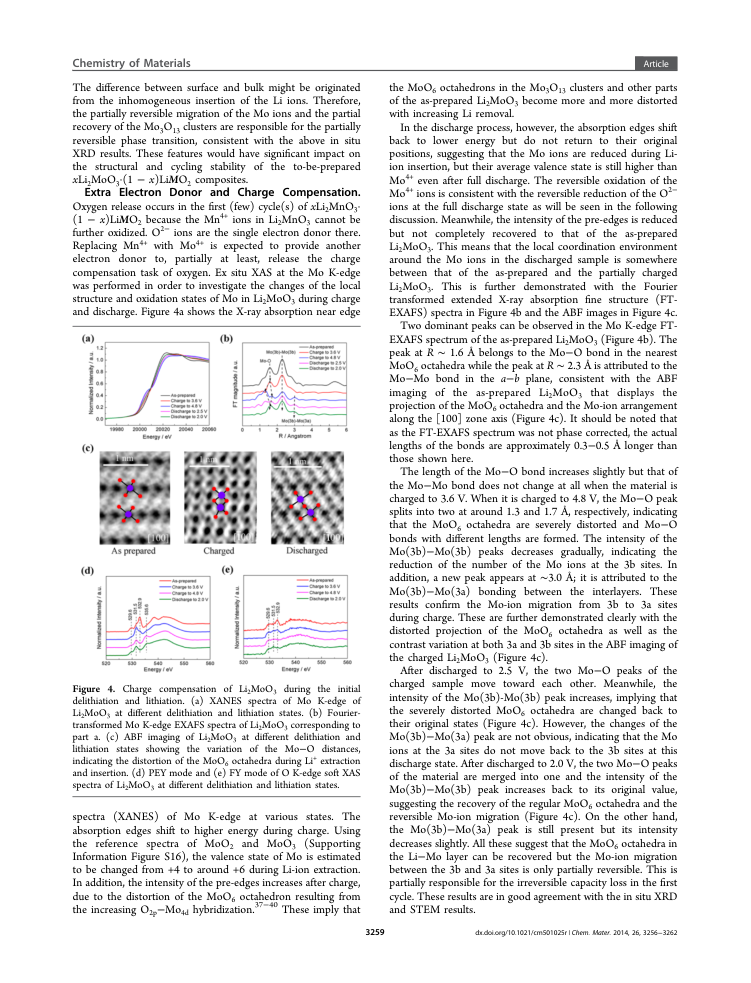
| medium | 4 | 52 | text | body_candidate_excluded | after_back_matter_stop | after_back_matter_stop | after_stop | p4:body_region:0 | p4:page_body:column_1_of_2:white | [255, 255, 255] white | [60.49, 156.93, 239.99, 108.28] | Extra Electron Donor and Charge Compensation. Oxygen release occurs in the fi rst (few) cycle(s) of x Li2MnO3 · (1 -x )Li M O2 because the Mn 4+ ions in Li2MnO3 cannot be further oxidized. O 2 -ions are the single electron donor there. Replacing Mn 4+ with Mo 4+ is expected to provide another electron donor to, partially at least, release the charge compensation task of oxygen. Ex situ XAS at the Mo K-edge was performed in order to investigate the changes of the local structure and oxidation states of Mo in Li2MoO3 during charge and discharge. Figure 4a shows the X-ray absorption near edge | Extra Electron Donor and Charge Compensation. Oxygen release occurs in the fi rst (few) cycle(s) of x Li2MnO3 · (1 -x )Li M O2 because the Mn 4+ ions in Li2MnO3 cannot be further oxidized. O 2 -ions are the single electron donor there. Replacing Mn 4+ with Mo 4+ is expected to provide another electron donor to, partially at least, release the charge compensation task of oxygen. Ex situ XAS at the Mo K-edge was performed in order to investigate the changes of the local structure and oxidation states of Mo in Li2MoO3 during charge and discharge. Figure 4a shows the X-ray absorption near edge | |
| medium | 4 | 54 | text | body_candidate_excluded | after_back_matter_stop | after_back_matter_stop | after_stop | p4:body_region:0 | p4:bottom_margin:column_1_of_2:white | [255, 255, 255] white | [60.49, 677.35, 239.99, 87.01] | spectra (XANES) of Mo K-edge at various states. The absorption edges shift to higher energy during charge. Using the reference spectra of MoO2 and MoO3 (Supporting Information Figure S16), the valence state of Mo is estimated to be changed from +4 to around +6 during Li-ion extraction. In addition, the intensity of the pre-edges increases after charge, due to the distortion of the MoO6 octahedron resulting from the increasing O 2p -Mo4d hybridization. 37 -40 These imply that | spectra (XANES) of Mo K-edge at various states. The absorption edges shift to higher energy during charge. Using the reference spectra of MoO2 and MoO3 (Supporting Information Figure S16), the valence state of Mo is estimated to be changed from +4 to around +6 during Li-ion extraction. In addition, the intensity of the pre-edges increases after charge, due to the distortion of the MoO6 octahedron resulting from the increasing O 2p -Mo4d hybridization. 37 -40 These imply that | |
| medium | 4 | 57 | text | body_candidate_excluded | after_back_matter_stop | after_back_matter_stop | after_stop | p4:body_region:1 | p4:page_body:column_2_of_2:white | [255, 255, 255] white | [324.45, 102.48, 240.04, 163.52] | In the discharge process, however, the absorption edges shift back to lower energy but do not return to their original positions, suggesting that the Mo ions are reduced during Liion insertion, but their average valence state is still higher than Mo 4+ even after full discharge. The reversible oxidation of the Mo 4+ ions is consistent with the reversible reduction of the O 2 -ions at the full discharge state as will be seen in the following discussion. Meanwhile, the intensity of the pre-edges is reduced but not completely recovered to that of the as-prepared Li 2 MoO3. This means that the local coordination environment around the Mo ions in the discharged sample is somewhere between that of the as-prepared and the partially charged Li2MoO3. This is further demonstrated with the Fourier transformed extended X-ray absorption fi ne structure (FTEXAFS) spectra in Figure 4b and the ABF images in Figure 4c. | In the discharge process, however, the absorption edges shift back to lower energy but do not return to their original positions, suggesting that the Mo ions are reduced during Liion insertion, but their average valence state is still higher than Mo 4+ even after full discharge. The reversible oxidation of the Mo 4+ ions is consistent with the reversible reduction of the O 2 -ions at the full discharge state as will be seen in the following discussion. Meanwhile, the intensity of the pre-edges is reduced but not completely recovered to that of the as-prepared Li 2 MoO3. This means that the local coordination environment around the Mo ions in the discharged sample is somewhere between that of the as-prepared and the partially charged Li2MoO3. This is further demonstrated with the Fourier transformed extended X-ray absorption fi ne structure (FTEXAFS) spectra in Figure 4b and the ABF images in Figure 4c. | |
| medium | 4 | 58 | text | body_candidate_excluded | after_back_matter_stop | after_back_matter_stop | after_stop | p4:body_region:1 | p4:page_body:column_2_of_2:white | [255, 255, 255] white | [324.45, 268.2, 240.02, 119.36] | Two dominant peaks can be observed in the Mo K-edge FTEXAFS spectrum of the as-prepared Li2MoO3 (Figure 4b). The peak at R ∼ 1.6 Å belongs to the Mo -O bond in the nearest MoO6 octahedra while the peak at R ∼ 2.3 Å is attributed to the Mo -Mo bond in the a -b plane, consistent with the ABF imaging of the as-prepared Li2MoO3 that displays the projection of the MoO6 octahedra and the Mo-ion arrangement along the [100] zone axis (Figure 4c). It should be noted that as the FT-EXAFS spectrum was not phase corrected, the actual lengths of the bonds are approximately 0.3 -0.5 Å longer than those shown here. | Two dominant peaks can be observed in the Mo K-edge FTEXAFS spectrum of the as-prepared Li2MoO3 (Figure 4b). The peak at R ∼ 1.6 Å belongs to the Mo -O bond in the nearest MoO6 octahedra while the peak at R ∼ 2.3 Å is attributed to the Mo -Mo bond in the a -b plane, consistent with the ABF imaging of the as-prepared Li2MoO3 that displays the projection of the MoO6 octahedra and the Mo-ion arrangement along the [100] zone axis (Figure 4c). It should be noted that as the FT-EXAFS spectrum was not phase corrected, the actual lengths of the bonds are approximately 0.3 -0.5 Å longer than those shown here. | |
| medium | 4 | 59 | text | body_candidate_excluded | after_back_matter_stop | after_back_matter_stop | after_stop | p4:body_region:1 | p4:page_body:column_2_of_2:white | [255, 255, 255] white | [324.45, 386.38, 240.04, 166.89] | The length of the Mo -O bond increases slightly but that of the Mo -Mo bond does not change at all when the material is charged to 3.6 V. When it is charged to 4.8 V, the Mo -O peak splits into two at around 1.3 and 1.7 Å, respectively, indicating that the MoO6 octahedra are severely distorted and Mo -O bonds with di ff erent lengths are formed. The intensity of the Mo(3b) -Mo(3b) peaks decreases gradually, indicating the reduction of the number of the Mo ions at the 3b sites. In addition, a new peak appears at ∼ 3.0 Å; it is attributed to the Mo(3b) -Mo(3a) bonding between the interlayers. These results con fi rm the Mo-ion migration from 3b to 3a sites during charge. These are further demonstrated clearly with the distorted projection of the MoO6 octahedra as well as the contrast variation at both 3a and 3b sites in the ABF imaging of the charged Li2MoO3 (Figure 4c). | The length of the Mo -O bond increases slightly but that of the Mo -Mo bond does not change at all when the material is charged to 3.6 V. When it is charged to 4.8 V, the Mo -O peak splits into two at around 1.3 and 1.7 Å, respectively, indicating that the MoO6 octahedra are severely distorted and Mo -O bonds with di ff erent lengths are formed. The intensity of the Mo(3b) -Mo(3b) peaks decreases gradually, indicating the reduction of the number of the Mo ions at the 3b sites. In addition, a new peak appears at ∼ 3.0 Å; it is attributed to the Mo(3b) -Mo(3a) bonding between the interlayers. These results con fi rm the Mo-ion migration from 3b to 3a sites during charge. These are further demonstrated clearly with the distorted projection of the MoO6 octahedra as well as the contrast variation at both 3a and 3b sites in the ABF imaging of the charged Li2MoO3 (Figure 4c). | |
| medium | 4 | 60 | text | body_candidate_excluded | after_back_matter_stop | after_back_matter_stop | after_stop | p4:body_region:1 | p4:bottom_margin:column_2_of_2:white | [255, 255, 255] white | [324.45, 552.09, 240.04, 211.05] | After discharged to 2.5 V, the two Mo -O peaks of the charged sample move toward each other. Meanwhile, the intensity of the Mo(3b)-Mo(3b) peak increases, implying that the severely distorted MoO6 octahedra are changed back to their original states (Figure 4c). However, the changes of the Mo(3b) -Mo(3a) peak are not obvious, indicating that the Mo ions at the 3a sites do not move back to the 3b sites at this discharge state. After discharged to 2.0 V, the two Mo -Opeaks of the material are merged into one and the intensity of the Mo(3b) -Mo(3b) peak increases back to its original value, suggesting the recovery of the regular MoO 6 octahedra and the reversible Mo-ion migration (Figure 4c). On the other hand, the Mo(3b) -Mo(3a) peak is still present but its intensity decreases slightly. All these suggest that the MoO 6 octahedra in the Li -Mo layer can be recovered but the Mo-ion migration between the 3b and 3a sites is only partially reversible. This is partially responsible for the irreversible capacity loss in the fi rst cycle. These results are in good agreement with the in situ XRD and STEM results. | After discharged to 2.5 V, the two Mo -O peaks of the charged sample move toward each other. Meanwhile, the intensity of the Mo(3b)-Mo(3b) peak increases, implying that the severely distorted MoO6 octahedra are changed back to their original states (Figure 4c). However, the changes of the Mo(3b) -Mo(3a) peak are not obvious, indicating that the Mo ions at the 3a sites do not move back to the 3b sites at this discharge state. After discharged to 2.0 V, the two Mo -Opeaks of the material are merged into one and the intensity of the Mo(3b) -Mo(3b) peak increases back to its original value, suggesting the recovery of the regular MoO 6 octahedra and the reversible Mo-ion migration (Figure 4c). On the other hand, the Mo(3b) -Mo(3a) peak is still present but its intensity decreases slightly. All these suggest that the MoO 6 octahedra in the Li -Mo layer can be recovered but the Mo-ion migration between the 3b and 3a sites is only partially reversible. This is partially responsible for the irreversible capacity loss in the fi rst cycle. These results are in good agreement with the in situ XRD and STEM results. | |
| medium | 5 | 64 | text | body_candidate_excluded | after_back_matter_stop | after_back_matter_stop | after_stop | p5:body_region:0 | p5:page_body:column_1_of_2:white | [255, 255, 255] white | [60.49, 69.37, 240.01, 307.12] | The oxygen species play an important role in the safety and structural stability of the Li-rich layered materials. 2,12,13 Irreversible oxygen evolution in the fi rst (few) cycle(s) results in safety hazard and structural degradation in Li2MnO3-based Li-rich cathode materials x Li2MnO3 · (1 -x )Li M O2. Recently, Tarascon et al. 41 reported that the Ru 4+ /Ru 5+ and O 2 -/O -redox couples instead of O2 loss supplied the charge compensation during the (de)lithiation of Li2Ru1 -x Sn x O3, which exhibited high reversible capacity and good cycling performance. With the assistance of partially reversible oxidation/reduction of the Mo 4+ /Mo 6+ redox couples in charge compensation in Li2MoO3 as shown above, we expect that the oxygen release in Li2MnO3 and x Li2MnO3 · (1 -x )Li M O2 can also be avoided or signi fi cantly suppressed. In order to fi nd out if this is true in Li2MoO3, O K-edge soft XAS spectroscopy was used to determine the changes of the electronic structure of the oxygen. Figure 4d and e shows the O K-edge XAS spectra in the partial electron yield (PEY) and fl uorescent yield (FY) modes, respectively. During charge, the hybridization of the O 2p and Mo4d orbitals increases with increasing oxidation of Mo 4+ , based on the decreased relative intensity of peaks at 532.9 and 529.6 eV and the increased intensity of the 531.5 eV peak. 26,42,43 A new peak appears at 535.6 eV in the surfacesensitive PEY spectrum as the material is charged to 4.8 V. This peak can be assigned to the O (2 -σ ) -(0 < σ ≤ 2) ions because higher energy is required to excite the O1s electron in an oxidized O ion. 44 This implies that oxygen indeed participates in the charge compensation in Li2MoO3 during charge. | The oxygen species play an important role in the safety and structural stability of the Li-rich layered materials. 2,12,13 Irreversible oxygen evolution in the fi rst (few) cycle(s) results in safety hazard and structural degradation in Li2MnO3-based Li-rich cathode materials x Li2MnO3 · (1 -x )Li M O2. Recently, Tarascon et al. 41 reported that the Ru 4+ /Ru 5+ and O 2 -/O -redox couples instead of O2 loss supplied the charge compensation during the (de)lithiation of Li2Ru1 -x Sn x O3, which exhibited high reversible capacity and good cycling performance. With the assistance of partially reversible oxidation/reduction of the Mo 4+ /Mo 6+ redox couples in charge compensation in Li2MoO3 as shown above, we expect that the oxygen release in Li2MnO3 and x Li2MnO3 · (1 -x )Li M O2 can also be avoided or signi fi cantly suppressed. In order to fi nd out if this is true in Li2MoO3, O K-edge soft XAS spectroscopy was used to determine the changes of the electronic structure of the oxygen. Figure 4d and e shows the O K-edge XAS spectra in the partial electron yield (PEY) and fl uorescent yield (FY) modes, respectively. During charge, the hybridization of the O 2p and Mo4d orbitals increases with increasing oxidation of Mo 4+ , based on the decreased relative intensity of peaks at 532.9 and 529.6 eV and the increased intensity of the 531.5 eV peak. 26,42,43 A new peak appears at 535.6 eV in the surfacesensitive PEY spectrum as the material is charged to 4.8 V. This peak can be assigned to the O (2 -σ ) -(0 < σ ≤ 2) ions because higher energy is required to excite the O1s electron in an oxidized O ion. 44 This implies that oxygen indeed participates in the charge compensation in Li2MoO3 during charge. | |
| medium | 5 | 65 | text | body_candidate_excluded | after_back_matter_stop | after_back_matter_stop | after_stop | p5:body_region:0 | p5:page_body:column_1_of_2:white | [255, 255, 255] white | [60.49, 378.75, 240.0, 163.46] | In the lithiation process, the intensity of the 535.6 eV peak decreases slightly, indicating that the charge compensation from oxygen is partially reversible. In contrast, the XAS spectra in the FY mode, which mainly give information about the bulk, show no obvious changes at 535.6 eV. This suggests that the charge compensation from the oxygen in Li2MoO3 mainly occurs on the surface of the particle. Hence, although charge compensation from the surface O 2 -ions still occurs in deeply delithiated (Mo 4+ → Mo 6+ ) Li2MoO3, such compensation is at least partially reversible and is basically a kinetic rather than a thermodynamic e ff ect in Li 2 MoO3. As a result, oxygen release can be suppressed to a great deal in a x Li2MoO3 · (1 -x )Li M O2 composite even when it is charged to 4.8 V. This will de fi nitely enhance the safety and structural stability of Li2MoO3 and its related compounds or composites. | In the lithiation process, the intensity of the 535.6 eV peak decreases slightly, indicating that the charge compensation from oxygen is partially reversible. In contrast, the XAS spectra in the FY mode, which mainly give information about the bulk, show no obvious changes at 535.6 eV. This suggests that the charge compensation from the oxygen in Li2MoO3 mainly occurs on the surface of the particle. Hence, although charge compensation from the surface O 2 -ions still occurs in deeply delithiated (Mo 4+ → Mo 6+ ) Li2MoO3, such compensation is at least partially reversible and is basically a kinetic rather than a thermodynamic e ff ect in Li 2 MoO3. As a result, oxygen release can be suppressed to a great deal in a x Li2MoO3 · (1 -x )Li M O2 composite even when it is charged to 4.8 V. This will de fi nitely enhance the safety and structural stability of Li2MoO3 and its related compounds or composites. | |
| medium | 5 | 66 | text | body_candidate_excluded | after_back_matter_stop | after_back_matter_stop | after_stop | p5:body_region:0 | p5:bottom_margin:column_1_of_2:white | [255, 255, 255] white | [60.49, 544.03, 240.01, 219.17] | (De)lithiation Mechanism. Based on the above comprehensive XRD, STEM, and XAS studies of Li2MoO3 at various charge/discharge states, a possible phase transition diagram of Li 2 -x MoO3 (0 ≤ x ≤ 1.47) can be drawn (Figure 5). At the beginning of charging (0 ≤ x ≤ 0.25), a solid-solution reaction occurs due to the oxidation of the Mo ions and the slight distortion of the MoO6 octahedra but the slipped O3 -Li2MoO3 structure keeps unchanged (Region I). Three Mo ions in the Mo3O13 cluster contribute to the charge compensation. As a result, the Mo -Mo bonds keep unchanged and no Mo-ion migration to the Li layer takes place at this stage. As more Li ions are extracted, the increased number of the Li vacancies and the oxidization of the Mo 4+ ions enhance the Mo -O interactions gradually, resulting in the distortion of the MoO6 octahedra. Consequently, some of the Mo -Mo bonds are broken and the Mo ions start migrating toward the Li vacancies (3a sites), leading to a Li2MoO3 -Li0.91MoO3 twophase reaction. The slipped O3-type stacking becomes distorted O1-type stacking (Region II) (0.25 ≤ x ≤ 1.25). The complicated slope (Region III) is attributed to the solid- | (De)lithiation Mechanism. Based on the above comprehensive XRD, STEM, and XAS studies of Li2MoO3 at various charge/discharge states, a possible phase transition diagram of Li 2 -x MoO3 (0 ≤ x ≤ 1.47) can be drawn (Figure 5). At the beginning of charging (0 ≤ x ≤ 0.25), a solid-solution reaction occurs due to the oxidation of the Mo ions and the slight distortion of the MoO6 octahedra but the slipped O3 -Li2MoO3 structure keeps unchanged (Region I). Three Mo ions in the Mo3O13 cluster contribute to the charge compensation. As a result, the Mo -Mo bonds keep unchanged and no Mo-ion migration to the Li layer takes place at this stage. As more Li ions are extracted, the increased number of the Li vacancies and the oxidization of the Mo 4+ ions enhance the Mo -O interactions gradually, resulting in the distortion of the MoO6 octahedra. Consequently, some of the Mo -Mo bonds are broken and the Mo ions start migrating toward the Li vacancies (3a sites), leading to a Li2MoO3 -Li0.91MoO3 twophase reaction. The slipped O3-type stacking becomes distorted O1-type stacking (Region II) (0.25 ≤ x ≤ 1.25). The complicated slope (Region III) is attributed to the solid- | |
| medium | 5 | 69 | text | body_candidate_excluded | after_back_matter_stop | after_back_matter_stop | after_stop | p5:body_region:1 | p5:page_body:column_2_of_2:white | [255, 255, 255] white | [324.45, 299.98, 240.02, 111.22] | solution reaction of Li 2 -x MoO3 (1.25 ≤ x ≤ 1.47) with increasing Li vacancies, the MoO6 octahedron distortion and Mo-ion interlayer migration. In the discharge process (Regions IV and V), solid-solution reaction of Li 2 -x MoO3 occurs successively with decreasing MoO6 octahedron distortion fi rst (1.03 ≤ x ≤ 1.47) and then migration of Mo ions back to the 3b sites (0.50 ≤ x ≤ 1.03). As a result, distorted O1-type stacking of Mo ions transforms to Li-insu ffi cient O3 type Li 2 -x MoO3. Some ordered Mo3O13 clusters are also recovered in this process. | solution reaction of Li 2 -x MoO3 (1.25 ≤ x ≤ 1.47) with increasing Li vacancies, the MoO6 octahedron distortion and Mo-ion interlayer migration. In the discharge process (Regions IV and V), solid-solution reaction of Li 2 -x MoO3 occurs successively with decreasing MoO6 octahedron distortion fi rst (1.03 ≤ x ≤ 1.47) and then migration of Mo ions back to the 3b sites (0.50 ≤ x ≤ 1.03). As a result, distorted O1-type stacking of Mo ions transforms to Li-insu ffi cient O3 type Li 2 -x MoO3. Some ordered Mo3O13 clusters are also recovered in this process. | |
| medium | 5 | 70 | text | body_candidate_excluded | after_back_matter_stop | after_back_matter_stop | after_stop | p5:body_region:1 | p5:page_body:column_2_of_2:white | [255, 255, 255] white | [324.45, 413.39, 240.02, 151.78] | Although further experimental and theoretical studies are required to fi nd out more details of the phase transitions during the initial and the subsequent cycles, such as the paths of the Liion di ff usion and the Mo-ion migration, and the phase boundaries developed during (de)lithiation, the results in this paper clearly demonstrated that the phase transition in this material is, to a great deal, reversible upon the initial lithium insertion and extraction, thanks to the charge compensation e ff ect of both Mo 4+ and O 2 -ions. This is distinctive from the complete structural destruction that occurs in Li2MnO3. Such phase transition features actually ensure the better structural and cycling reversibility of Li2MoO3 and, very possibly, for those of the Li 2 MoO3-related Li-rich layer-structured cathode materials. | Although further experimental and theoretical studies are required to fi nd out more details of the phase transitions during the initial and the subsequent cycles, such as the paths of the Liion di ff usion and the Mo-ion migration, and the phase boundaries developed during (de)lithiation, the results in this paper clearly demonstrated that the phase transition in this material is, to a great deal, reversible upon the initial lithium insertion and extraction, thanks to the charge compensation e ff ect of both Mo 4+ and O 2 -ions. This is distinctive from the complete structural destruction that occurs in Li2MnO3. Such phase transition features actually ensure the better structural and cycling reversibility of Li2MoO3 and, very possibly, for those of the Li 2 MoO3-related Li-rich layer-structured cathode materials. | |
| medium | 5 | 71 | text | body_candidate_excluded | after_back_matter_stop | after_back_matter_stop | after_stop | p5:body_region:1 | p5:bottom_margin:column_2_of_2:white | [255, 255, 255] white | [324.45, 567.36, 240.02, 197.0] | It is the irreversible oxygen release and the transition metal migration in highly delithiated Li2MnO3 that lead to its irreversible structural transition and capacity loss. Di ff erent from that, introduction of the Mo 4+ /Mo 6+ redox couple in Li 2 MoO3 helps its charge compensation upon Li removal. Such joint charge compensation of the Mo 4+ and O 2 -ions lowers the degree of oxidation of O 2 -and avoids the oxygen evolution. As a result of these, the oxidation of O 2 -to O (2 -σ ) -is nearly reversible up to the extraction of around 1.5 Li per formula unit of Li2MoO3. The kinetic instead of thermodynamic requirements means that the reversibility of the O 2 -/O (2 -σ ) -redox reaction can be improved even without modifying the structure of Li 2 MoO3. This provides more space for further improvement of the electrochemical performances of Li 2 MoO3 and its related composite cathode materials. In addition, considering the fact that the material charged to 4.5 V should have a reversible capacity than that charged to 4.8 V (Supporting Information Figure S7), it makes sense to believe that, in reality, Li2MoO3 | It is the irreversible oxygen release and the transition metal migration in highly delithiated Li2MnO3 that lead to its irreversible structural transition and capacity loss. Di ff erent from that, introduction of the Mo 4+ /Mo 6+ redox couple in Li 2 MoO3 helps its charge compensation upon Li removal. Such joint charge compensation of the Mo 4+ and O 2 -ions lowers the degree of oxidation of O 2 -and avoids the oxygen evolution. As a result of these, the oxidation of O 2 -to O (2 -σ ) -is nearly reversible up to the extraction of around 1.5 Li per formula unit of Li2MoO3. The kinetic instead of thermodynamic requirements means that the reversibility of the O 2 -/O (2 -σ ) -redox reaction can be improved even without modifying the structure of Li 2 MoO3. This provides more space for further improvement of the electrochemical performances of Li 2 MoO3 and its related composite cathode materials. In addition, considering the fact that the material charged to 4.5 V should have a reversible capacity than that charged to 4.8 V (Supporting Information Figure S7), it makes sense to believe that, in reality, Li2MoO3 | |
| medium | 6 | 75 | text | body_candidate_excluded | after_back_matter_stop | after_back_matter_stop | after_stop | p6:body_region:0 | p6:front_matter:column_1_of_2:white | [255, 255, 255] white | [60.49, 69.37, 239.98, 53.7] | and Li2MoO3-based cathode materials do not need to be charged to such high (4.8 V) potentials. In that case, the reversibility of the Mo-ion migration and O 2 --ion oxidation, structural stability and the compatibility with electrolyte should be even better than shown here. | and Li2MoO3-based cathode materials do not need to be charged to such high (4.8 V) potentials. In that case, the reversibility of the Mo-ion migration and O 2 --ion oxidation, structural stability and the compatibility with electrolyte should be even better than shown here. | |
| medium | 6 | 77 | text | body_candidate_excluded | after_back_matter_stop | after_back_matter_stop | after_stop | p6:body_region:0 | p6:body_zone:column_1_of_2:white | [255, 255, 255] white | [60.49, 154.87, 240.0, 345.62] | In summary, comprehensive in situ XRD and ex situ STEM and XAS studies clarify the electrochemical (de)lithiation mechanism of Li2MoO3 and prove the feasibility of replacing Li 2 MnO3 with its iso-structured Li2MoO3 to construct novel Li-rich cathode materials. The as-prepared Li2MoO3 shows a slipped O3-type stacking of the Mo ions with short-range ordered but long-range disordered Mo3O13 clusters. During the initial delithiation, solid-solution reaction and then two-phase reaction take place in series and the Mo 4+ ions are oxidized to Mo 6+ ions. As the material is discharged, its structure is recovered to a Li-insu ffi cient O3 type Li2 -x MoO3 ( x = 0.50) due to the incomplete reduction of Mo 6+ ions, the partially reversible Mo3O13 cluster and Mo-ion migration at the end of lithiation. Di ff erent from the irreversible oxygen release in deeply delithiated Li2MnO3, the oxidation of O 2 -to O (2 -σ ) -is nearly reversible and is a dynamic rather than thermodynamic e ff ect in Li2MoO3. Features such as reversible Mo-ion migration and O 2 -oxidation upon lithium removal, facile charge compensation due to presence of the Mo 4+ /Mo 6+ redox couple have signi fi cant impacts on the structural stability and reversibility of Li2MoO3. Both the reversible structural transition (based on the reversible migration of the Mo ions) and the reversible charge transfer (with Mo 4+ as another electron donor) demonstrate the feasibility of replacing Li2MnO3 with Li2MoO3 for constructing novel Li2MoO3based Li-rich cathode materials with stronger structural stability and higher cycling reversibility. In addition, the fi ndings on the contribution of covalent bond between transition metal ions bring new insight into the fundamental understandings of electrochemical (de)lithiation mechanism of Li-rich layerstructured oxides. | In summary, comprehensive in situ XRD and ex situ STEM and XAS studies clarify the electrochemical (de)lithiation mechanism of Li2MoO3 and prove the feasibility of replacing Li 2 MnO3 with its iso-structured Li2MoO3 to construct novel Li-rich cathode materials. The as-prepared Li2MoO3 shows a slipped O3-type stacking of the Mo ions with short-range ordered but long-range disordered Mo3O13 clusters. During the initial delithiation, solid-solution reaction and then two-phase reaction take place in series and the Mo 4+ ions are oxidized to Mo 6+ ions. As the material is discharged, its structure is recovered to a Li-insu ffi cient O3 type Li2 -x MoO3 ( x = 0.50) due to the incomplete reduction of Mo 6+ ions, the partially reversible Mo3O13 cluster and Mo-ion migration at the end of lithiation. Di ff erent from the irreversible oxygen release in deeply delithiated Li2MnO3, the oxidation of O 2 -to O (2 -σ ) -is nearly reversible and is a dynamic rather than thermodynamic e ff ect in Li2MoO3. Features such as reversible Mo-ion migration and O 2 -oxidation upon lithium removal, facile charge compensation due to presence of the Mo 4+ /Mo 6+ redox couple have signi fi cant impacts on the structural stability and reversibility of Li2MoO3. Both the reversible structural transition (based on the reversible migration of the Mo ions) and the reversible charge transfer (with Mo 4+ as another electron donor) demonstrate the feasibility of replacing Li2MnO3 with Li2MoO3 for constructing novel Li2MoO3based Li-rich cathode materials with stronger structural stability and higher cycling reversibility. In addition, the fi ndings on the contribution of covalent bond between transition metal ions bring new insight into the fundamental understandings of electrochemical (de)lithiation mechanism of Li-rich layerstructured oxides. | |
| low | 1 | 0 | page_header | page_header | document_ui | document_ui | p1:body_region:1 | p1:top_margin:column_2_of_2:gray | [88, 89, 91] gray | [536.2, 60.48, 21.22, 7.35] | Article | Article | ||
| low | 1 | 1 | text | metadata | document_web_address | document_web_address | p1:body_region:1 | p1:front_matter:column_2_of_2:white | [255, 255, 255] white | [509.95, 76.75, 54.42, 7.35] | pubs.acs.org/cm | pubs.acs.org/cm | ||
| low | 1 | 2 | section_header | title_candidate | first_page_front_matter_heading | first_page_front_matter_heading | p1:body_region:0 | p1:front_matter:column_1_of_2:white | [255, 255, 255] white | [60.49, 121.2, 479.34, 32.86] | Feasibility of Using Li2MoO3 in Constructing Li-Rich High Energy Density Cathode Materials | Feasibility of Using Li2MoO3 in Constructing Li-Rich High Energy Density Cathode Materials | ||
| low | 1 | 5 | page_header | affiliation | first_page_author_or_affiliation | first_page_author_or_affiliation | p1:front_matter:column_1_of_2:white | [255, 255, 255] white | [3.61, 214.63, 15.98, 356.87] | Downloaded via JILIN UNIV on July 12, 2026 at 04:34:01 (UTC). See https:/pubs.acs.org/sharingguidelines for options on how to legitimately share published articles. | Downloaded via JILIN UNIV on July 12, 2026 at 04:34:01 (UTC). See https:/pubs.acs.org/sharingguidelines for options on how to legitimately share published articles. | |||
| low | 1 | 6 | footnote | affiliation | first_page_author_or_affiliation | first_page_author_or_affiliation | p1:body_region:0 | p1:front_matter:column_1_of_2:white | [255, 255, 255] white | [60.49, 229.44, 393.16, 13.72] | ‡ Department of Chemistry, Brookhaven National Laboratory, Upton, New York 11973, United States | ‡ Department of Chemistry, Brookhaven National Laboratory, Upton, New York 11973, United States | ||
| low | 1 | 7 | footnote | affiliation | first_page_author_or_affiliation | first_page_author_or_affiliation | p1:body_region:0 | p1:front_matter:column_1_of_2:white | [255, 255, 255] white | [60.49, 243.86, 464.42, 13.3] | § X-ray Science Division, Argonne National Laboratory, 9700 South Cass Avenue, Argonne, Illinois 60439, United States | § X-ray Science Division, Argonne National Laboratory, 9700 South Cass Avenue, Argonne, Illinois 60439, United States | ||
| low | 1 | 9 | section_header | title_candidate | first_page_front_matter_heading | first_page_front_matter_heading | p1:body_region:0 | p1:front_matter:column_1_of_2:white | [255, 255, 255] white | [69.45, 289.17, 101.14, 12.62] | * S Supporting Information | * S Supporting Information | ||
| low | 1 | 12 | section_header | body_heading | body_heading | body_heading | p1:body_region:0 | p1:body_zone:column_1_of_2:white | [255, 255, 255] white | [60.49, 496.13, 87.35, 23.65] | ■ INTRODUCTION | ■ INTRODUCTION | ||
| low | 1 | 14 | page_footer | page_footer | first_page_metadata | first_page_metadata | p1:body_region:0 | p1:bottom_margin:column_1_of_2:white | [255, 255, 255] white | [168.49, 771.24, 95.03, 5.88] | © 2014 American Chemical Society | © 2014 American Chemical Society | ||
| low | 1 | 17 | text | metadata | first_page_metadata | first_page_metadata | p1:body_region:1 | p1:body_zone:column_2_of_2:white | [255, 255, 255] white | [367.99, 727.13, 55.06, 7.92] | March 22, 2014 | March 22, 2014 | ||
| low | 1 | 18 | text | metadata | first_page_metadata | first_page_metadata | p1:body_region:1 | p1:body_zone:column_2_of_2:white | [253, 253, 253] white | [324.45, 727.21, 34.65, 7.77] | Received: | Received: | ||
| low | 1 | 19 | text | metadata | first_page_metadata | first_page_metadata | p1:body_region:1 | p1:body_zone:column_2_of_2:white | [255, 255, 255] white | [367.99, 738.19, 49.9, 7.92] | April 30, 2014 | April 30, 2014 | ||
| low | 1 | 20 | text | metadata | first_page_metadata | first_page_metadata | p1:body_region:1 | p1:body_zone:column_2_of_2:white | [253, 253, 253] white | [324.45, 738.27, 30.25, 7.77] | Revised: | Revised: | ||
| low | 1 | 21 | text | metadata | first_page_metadata | first_page_metadata | p1:body_region:1 | p1:bottom_margin:column_2_of_2:white | [255, 255, 255] white | [367.99, 749.19, 43.83, 7.92] | May 1, 2014 | May 1, 2014 | ||
| low | 1 | 22 | text | metadata | first_page_metadata | first_page_metadata | p1:body_region:1 | p1:bottom_margin:column_2_of_2:white | [252, 252, 252] white | [324.45, 749.27, 37.75, 7.77] | Published: | Published: | ||
| low | 1 | 23 | page_footer | page_footer | first_page_metadata | first_page_metadata | p1:body_region:1 | p1:bottom_margin:column_2_of_2:white | [255, 255, 255] white | [396.06, 769.98, 168.43, 7.74] | dx.doi.org/10.1021/cm501025r | Chem. Mater. 2014, 26, 3256 -3262 | dx.doi.org/10.1021/cm501025r | Chem. Mater. 2014, 26, 3256 -3262 | ||
| low | 1 | 24 | page_footer | page_footer | docling_page_footer | docling_page_footer | p1:body_region:0 | p1:bottom_margin:column_2_of_2:white | [255, 255, 255] white | [304.5, 770.73, 15.93, 6.54] | 3256 | 3256 | ||
| low | 2 | 25 | page_header | page_header | docling_page_header | docling_page_header | p2:body_region:0 | p2:top_margin:column_1_of_2:gray | [241, 242, 242] gray | [60.49, 48.93, 98.47, 8.72] | Chemistry of Materials | Chemistry of Materials | ||
| low | 2 | 27 | section_header | body_heading | body_heading | body_heading | p2:body_region:0 | p2:body_zone:column_1_of_2:white | [255, 255, 255] white | [60.49, 442.33, 139.52, 23.65] | ■ RESULTS AND DISCUSSION | ■ RESULTS AND DISCUSSION | ||
| low | 2 | 30 | page_header | page_header | docling_page_header | docling_page_header | p2:body_region:1 | p2:top_margin:column_2_of_2:gray | [88, 89, 91] gray | [536.2, 49.99, 21.22, 7.35] | Article | Article | ||
| low | 2 | 31 | caption | caption | outside_body_flow_caption | outside_body_flow_caption | p2:body_region:1 | p2:front_matter:column_2_of_2:white | [255, 255, 255] white | [324.45, 364.64, 240.03, 107.93] | Figure 1. Structure of as-prepared Li 2 MoO3. (a) Schematic lattice of Li2MoO3. (b) The re fi ned XRD pattern of Li2MoO3 ( λ = 0.7747 Å) using GSAS program. (c) ABF STEM image of Li2MoO3 along the [100] zone axis with Mo ions in slipped αβγ -stacking (O3 type). (d) The corresponding HAADF STEM image of part c. The bright dots represent Mo-ion column. (e) The corresponding line contrast pro fi le of the Li, Mo, and O in parts c and d along the [421 ̅ ] direction with the image contrast of dark dots in part c inverted and displayed as peaks. (f) The corresponding line contrast pro fi les of the Mo ions in part d along the marked rows. The marked black solid circle presents the much strong contrast of Mo-ion column. | Figure 1. Structure of as-prepared Li 2 MoO3. (a) Schematic lattice of Li2MoO3. (b) The re fi ned XRD pattern of Li2MoO3 ( λ = 0.7747 Å) using GSAS program. (c) ABF STEM image of Li2MoO3 along the [100] zone axis with Mo ions in slipped αβγ -stacking (O3 type). (d) The corresponding HAADF STEM image of part c. The bright dots represent Mo-ion column. (e) The corresponding line contrast pro fi le of the Li, Mo, and O in parts c and d along the [421 ̅ ] direction with the image contrast of dark dots in part c inverted and displayed as peaks. (f) The corresponding line contrast pro fi les of the Mo ions in part d along the marked rows. The marked black solid circle presents the much strong contrast of Mo-ion column. | ||
| low | 2 | 34 | page_footer | page_footer | docling_page_footer | docling_page_footer | p2:body_region:1 | p2:bottom_margin:column_2_of_2:white | [255, 255, 255] white | [396.06, 773.27, 168.43, 7.74] | dx.doi.org/10.1021/cm501025r | Chem. Mater. 2014, 26, 3256 -3262 | dx.doi.org/10.1021/cm501025r | Chem. Mater. 2014, 26, 3256 -3262 | ||
| low | 2 | 35 | page_footer | page_footer | docling_page_footer | docling_page_footer | p2:bottom_margin:column_2_of_2:white | [255, 255, 255] white | [304.5, 774.02, 15.93, 6.54] | 3257 | 3257 | |||
| low | 3 | 36 | page_header | page_header | docling_page_header | docling_page_header | p3:body_region:0 | p3:top_margin:column_1_of_2:gray | [241, 242, 242] gray | [60.49, 48.93, 98.47, 8.72] | Chemistry of Materials | Chemistry of Materials | ||
| low | 3 | 38 | caption | caption | outside_body_flow_caption | outside_body_flow_caption | p3:body_region:0 | p3:page_body:column_1_of_2:white | [255, 255, 255] white | [60.49, 381.99, 240.01, 57.93] | Figure 2. Structural evolution of Li2MoO3 during the initial delithiation and lithiation. (a) In situ XRD patterns of Li2 -x MoO3 (0 ≤ x ≤ 2) electrodes while a Li 2 MoO3/Li cell is charged and discharged at a current density of 10 mA g -1 between 2.0 and 4.8 V. (b) Schematic structures of Li 2 -x MoO3 (0 ≤ x ≤ 2) (V representing atomic vacancy) during the initial charge and discharge process. | Figure 2. Structural evolution of Li2MoO3 during the initial delithiation and lithiation. (a) In situ XRD patterns of Li2 -x MoO3 (0 ≤ x ≤ 2) electrodes while a Li 2 MoO3/Li cell is charged and discharged at a current density of 10 mA g -1 between 2.0 and 4.8 V. (b) Schematic structures of Li 2 -x MoO3 (0 ≤ x ≤ 2) (V representing atomic vacancy) during the initial charge and discharge process. | ||
| low | 3 | 39 | text | back_matter_heading | back_matter_heading | back_matter_heading | stop_trigger | p3:body_region:0 | p3:page_body:column_1_of_2:white | [255, 255, 255] white | [60.49, 457.38, 239.95, 41.8] | Supporting Information Figure S9). Before the cell is charged to ca. 3.1 V, a solid-solution reaction occurs with negligible variation of cell parameters (Li2MoO3 → Li1.75MoO3 + 0.25Li + ). | Supporting Information Figure S9). Before the cell is charged to ca. 3.1 V, a solid-solution reaction occurs with negligible variation of cell parameters (Li2MoO3 → Li1.75MoO3 + 0.25Li + ). | |
| low | 3 | 42 | page_header | page_header | after_back_matter_stop | after_back_matter_stop | after_stop | p3:body_region:1 | p3:top_margin:column_2_of_2:gray | [88, 89, 91] gray | [536.2, 49.99, 21.22, 7.35] | Article | Article | |
| low | 3 | 45 | caption | caption | after_back_matter_stop | after_back_matter_stop | after_stop | p3:body_region:1 | p3:page_body:column_2_of_2:white | [255, 255, 255] white | [324.45, 452.29, 240.02, 87.92] | Figure 3. Detection of Mo-ion migration in atomic scale. (a) HAADF image of the as-prepared Li 2 MoO3 along the [100] zone axis. (c and e) HAADF images of the charged and discharged Li2MoO3 along the [1 ̅ 00] zone axis, respectively. The Mo ions at 3a and 3b sites in the HAADF images are presented with pink and yellow solid circles, respectively. (b , d , and f) Corresponding line contrast pro fi les of Mo ions along the marked rows in the HAADF images. The much strong contrast of Mo ions is marked with black solid circle in the line contrast pro fi les. | Figure 3. Detection of Mo-ion migration in atomic scale. (a) HAADF image of the as-prepared Li 2 MoO3 along the [100] zone axis. (c and e) HAADF images of the charged and discharged Li2MoO3 along the [1 ̅ 00] zone axis, respectively. The Mo ions at 3a and 3b sites in the HAADF images are presented with pink and yellow solid circles, respectively. (b , d , and f) Corresponding line contrast pro fi les of Mo ions along the marked rows in the HAADF images. The much strong contrast of Mo ions is marked with black solid circle in the line contrast pro fi les. | |
| low | 3 | 46 | text | back_matter_heading | after_back_matter_stop | after_back_matter_stop | after_stop | p3:body_region:1 | p3:page_body:column_2_of_2:white | [255, 255, 255] white | [324.45, 553.0, 240.01, 133.16] | Supporting Information Figure S12 -S15). After Li-ion extraction, the Mo ions migrate from 3b to 3a sites, implying the disaggregation of the Mo3O13 clusters. As a result, the atoms in the 3b and 3a sites have similar contrasts. An ααα -stack (O1 type; Supporting Information Figure S3) Li 2 -x MoO3 with many faults was obtained, including defects, distortion, and edge dislocation, induced by the stress during Li-ion extraction and Mo-ion migration. When the Li ions are inserted back to the charged Li2MoO3, the 3a-sited Mo ions on the surface partially disappear, but those in the bulk remain there. In both areas, the Mo ions show an αβγ -stack model (O3 type; Supporting Information Figure S3). | Supporting Information Figure S12 -S15). After Li-ion extraction, the Mo ions migrate from 3b to 3a sites, implying the disaggregation of the Mo3O13 clusters. As a result, the atoms in the 3b and 3a sites have similar contrasts. An ααα -stack (O1 type; Supporting Information Figure S3) Li 2 -x MoO3 with many faults was obtained, including defects, distortion, and edge dislocation, induced by the stress during Li-ion extraction and Mo-ion migration. When the Li ions are inserted back to the charged Li2MoO3, the 3a-sited Mo ions on the surface partially disappear, but those in the bulk remain there. In both areas, the Mo ions show an αβγ -stack model (O3 type; Supporting Information Figure S3). | |
| low | 3 | 48 | page_footer | page_footer | after_back_matter_stop | after_back_matter_stop | after_stop | p3:body_region:1 | p3:bottom_margin:column_2_of_2:white | [255, 255, 255] white | [396.06, 773.27, 168.43, 7.74] | dx.doi.org/10.1021/cm501025r | Chem. Mater. 2014, 26, 3256 -3262 | dx.doi.org/10.1021/cm501025r | Chem. Mater. 2014, 26, 3256 -3262 | |
| low | 3 | 49 | page_footer | page_footer | after_back_matter_stop | after_back_matter_stop | after_stop | p3:bottom_margin:column_2_of_2:white | [255, 255, 255] white | [304.5, 774.02, 15.93, 6.54] | 3258 | 3258 | ||
| low | 4 | 50 | page_header | page_header | after_back_matter_stop | after_back_matter_stop | after_stop | p4:body_region:0 | p4:top_margin:column_1_of_2:gray | [241, 242, 242] gray | [60.49, 48.93, 98.47, 8.72] | Chemistry of Materials | Chemistry of Materials | |
| low | 4 | 53 | caption | caption | after_back_matter_stop | after_back_matter_stop | after_stop | p4:body_region:0 | p4:page_body:column_1_of_2:white | [255, 255, 255] white | [60.49, 571.0, 239.97, 88.99] | Figure 4. Charge compensation of Li2MoO3 during the initial delithiation and lithiation. (a) XANES spectra of Mo K-edge of Li2MoO3 at di ff erent delithiation and lithiation states. (b) Fouriertransformed Mo K-edge EXAFS spectra of Li2MoO3 corresponding to part a. (c) ABF imaging of Li2MoO3 at di ff erent delithiation and lithiation states showing the variation of the Mo -O distances, indicating the distortion of the MoO 6 octahedra during Li + extraction and insertion. (d) PEY mode and (e) FY mode of O K-edge soft XAS spectra of Li 2 MoO3 at di ff erent delithiation and lithiation states. | Figure 4. Charge compensation of Li2MoO3 during the initial delithiation and lithiation. (a) XANES spectra of Mo K-edge of Li2MoO3 at di ff erent delithiation and lithiation states. (b) Fouriertransformed Mo K-edge EXAFS spectra of Li2MoO3 corresponding to part a. (c) ABF imaging of Li2MoO3 at di ff erent delithiation and lithiation states showing the variation of the Mo -O distances, indicating the distortion of the MoO 6 octahedra during Li + extraction and insertion. (d) PEY mode and (e) FY mode of O K-edge soft XAS spectra of Li 2 MoO3 at di ff erent delithiation and lithiation states. | |
| low | 4 | 55 | page_header | page_header | after_back_matter_stop | after_back_matter_stop | after_stop | p4:body_region:1 | p4:top_margin:column_2_of_2:gray | [88, 89, 91] gray | [536.2, 49.99, 21.22, 7.35] | Article | Article | |
| low | 4 | 56 | text | unknown_text | after_back_matter_stop | after_back_matter_stop | after_stop | p4:body_region:1 | p4:page_body:column_2_of_2:white | [255, 255, 255] white | [324.45, 69.37, 239.96, 30.92] | the MoO6 octahedrons in the Mo3O13 clusters and other parts of the as-prepared Li2MoO3 become more and more distorted with increasing Li removal. | the MoO6 octahedrons in the Mo3O13 clusters and other parts of the as-prepared Li2MoO3 become more and more distorted with increasing Li removal. | |
| low | 4 | 61 | page_footer | page_footer | after_back_matter_stop | after_back_matter_stop | after_stop | p4:body_region:1 | p4:bottom_margin:column_2_of_2:white | [255, 255, 255] white | [396.06, 773.27, 168.43, 7.74] | dx.doi.org/10.1021/cm501025r | Chem. Mater. 2014, 26, 3256 -3262 | dx.doi.org/10.1021/cm501025r | Chem. Mater. 2014, 26, 3256 -3262 | |
| low | 4 | 62 | page_footer | page_footer | after_back_matter_stop | after_back_matter_stop | after_stop | p4:bottom_margin:column_2_of_2:white | [255, 255, 255] white | [304.5, 774.02, 15.93, 6.54] | 3259 | 3259 | ||
| low | 5 | 63 | page_header | page_header | after_back_matter_stop | after_back_matter_stop | after_stop | p5:body_region:0 | p5:top_margin:column_1_of_2:gray | [241, 242, 242] gray | [60.49, 48.93, 98.47, 8.72] | Chemistry of Materials | Chemistry of Materials | |
| low | 5 | 67 | page_header | page_header | after_back_matter_stop | after_back_matter_stop | after_stop | p5:body_region:1 | p5:top_margin:column_2_of_2:gray | [88, 89, 91] gray | [536.2, 49.99, 21.22, 7.35] | Article | Article | |
| low | 5 | 68 | caption | caption | after_back_matter_stop | after_back_matter_stop | after_stop | p5:body_region:1 | p5:page_body:column_2_of_2:white | [255, 255, 255] white | [324.45, 246.09, 240.04, 37.92] | Figure 5. Structural transition of Li2MoO3 in the initial electrochemical (de)lithiation process. The lattice structure variation demonstrates that solid-solution reaction and two-phase reaction occur in consequence. | Figure 5. Structural transition of Li2MoO3 in the initial electrochemical (de)lithiation process. The lattice structure variation demonstrates that solid-solution reaction and two-phase reaction occur in consequence. | |
| low | 5 | 72 | page_footer | page_footer | after_back_matter_stop | after_back_matter_stop | after_stop | p5:body_region:1 | p5:bottom_margin:column_2_of_2:white | [255, 255, 255] white | [396.06, 773.27, 168.43, 7.74] | dx.doi.org/10.1021/cm501025r | Chem. Mater. 2014, 26, 3256 -3262 | dx.doi.org/10.1021/cm501025r | Chem. Mater. 2014, 26, 3256 -3262 | |
| low | 5 | 73 | page_footer | page_footer | after_back_matter_stop | after_back_matter_stop | after_stop | p5:bottom_margin:column_2_of_2:white | [254, 254, 254] white | [304.5, 774.02, 15.93, 6.54] | 3260 | 3260 | ||
| low | 6 | 74 | page_header | page_header | after_back_matter_stop | after_back_matter_stop | after_stop | p6:body_region:0 | p6:top_margin:column_1_of_2:gray | [241, 242, 242] gray | [60.49, 48.93, 98.47, 8.72] | Chemistry of Materials | Chemistry of Materials | |
| low | 6 | 76 | section_header | body_heading | after_back_matter_stop | after_back_matter_stop | after_stop | p6:body_region:0 | p6:body_zone:column_1_of_2:white | [255, 255, 255] white | [60.49, 127.63, 77.3, 23.65] | ■ CONCLUSION | ■ CONCLUSION | |
| low | 6 | 78 | section_header | unknown_text | after_back_matter_stop | after_back_matter_stop | after_stop | p6:body_region:0 | p6:body_zone:column_1_of_2:white | [255, 255, 255] white | [60.49, 504.98, 121.71, 23.65] | ■ ASSOCIATED CONTENT | ■ ASSOCIATED CONTENT | |
| low | 6 | 79 | section_header | unknown_text | after_back_matter_stop | after_back_matter_stop | after_stop | p6:body_region:0 | p6:body_zone:column_1_of_2:white | [255, 255, 255] white | [60.49, 530.62, 113.35, 12.62] | * S Supporting Information | * S Supporting Information | |
| low | 6 | 80 | text | body_heading | after_back_matter_stop | after_back_matter_stop | after_stop | p6:body_region:0 | p6:body_zone:column_1_of_2:white | [255, 255, 255] white | [60.49, 545.48, 239.99, 87.38] | Experimental section, re fi ned structural parameters, SEM images of the as-prepared Li2MoO3, its electrochemical performance, the original STEM images and the corresponding charge/discharge potential pro fi les of Li2MoO3 at various (de)lithiated states, HRTEM images of Li2MoO3, schematic diagrams of Li2MoO3 structure, Mo K-edge XANES spectra of the reference compounds MoO2 and MoO3. This material is available free of charge via the Internet at http://pubs.acs.org/. | Experimental section, re fi ned structural parameters, SEM images of the as-prepared Li2MoO3, its electrochemical performance, the original STEM images and the corresponding charge/discharge potential pro fi les of Li2MoO3 at various (de)lithiated states, HRTEM images of Li2MoO3, schematic diagrams of Li2MoO3 structure, Mo K-edge XANES spectra of the reference compounds MoO2 and MoO3. This material is available free of charge via the Internet at | |
| low | 6 | 81 | section_header | unknown_text | after_back_matter_stop | after_back_matter_stop | after_stop | p6:body_region:0 | p6:body_zone:column_1_of_2:white | [255, 255, 255] white | [60.49, 637.35, 125.07, 23.65] | ■ AUTHOR INFORMATION | ■ AUTHOR INFORMATION | |
| low | 6 | 82 | section_header | metadata | after_back_matter_stop | after_back_matter_stop | after_stop | p6:body_region:0 | p6:body_zone:column_1_of_2:white | [255, 255, 255] white | [60.49, 665.18, 97.03, 8.29] | Corresponding Authors | Corresponding Authors | |
| low | 6 | 83 | text | metadata | after_back_matter_stop | after_back_matter_stop | after_stop | p6:body_region:0 | p6:body_zone:column_1_of_2:white | [255, 255, 255] white | [60.49, 674.48, 107.39, 12.07] | * Email: zxwang@iphy.ac.cn. | * Email: zxwang@iphy.ac.cn. | |
| low | 6 | 84 | text | metadata | after_back_matter_stop | after_back_matter_stop | after_stop | p6:body_region:0 | p6:body_zone:column_1_of_2:white | [255, 255, 255] white | [60.49, 685.47, 94.61, 12.07] | * Email: xyang@bn-l.gov. | * Email: xyang@bn-l.gov. | |
| low | 6 | 85 | text | metadata | after_back_matter_stop | after_back_matter_stop | after_stop | p6:body_region:0 | p6:body_zone:column_1_of_2:white | [255, 255, 255] white | [60.49, 696.47, 107.28, 12.07] | * Email: qkong@aps.anl.gov. | * Email: qkong@aps.anl.gov. | |
| low | 6 | 86 | section_header | back_matter_heading | after_back_matter_stop | after_back_matter_stop | after_stop | p6:body_region:0 | p6:body_zone:column_1_of_2:white | [255, 255, 255] white | [60.49, 714.33, 88.22, 8.29] | Author Contributions | Author Contributions | |
| low | 6 | 87 | text | unknown_text | after_back_matter_stop | after_back_matter_stop | after_stop | p6:body_region:0 | p6:body_zone:column_1_of_2:white | [255, 255, 255] white | [60.49, 722.45, 198.07, 13.43] | ⊥ J.M. and Y.-N.Z. contributed equally to this work. | ⊥ J.M. and Y.-N.Z. contributed equally to this work. | |
| low | 6 | 88 | section_header | unknown_text | after_back_matter_stop | after_back_matter_stop | after_stop | p6:body_region:0 | p6:body_zone:column_1_of_2:white | [255, 255, 255] white | [60.49, 741.66, 23.72, 8.29] | Notes | Notes | |
| low | 6 | 89 | text | unknown_text | after_back_matter_stop | after_back_matter_stop | after_stop | p6:body_region:0 | p6:bottom_margin:column_1_of_2:white | [255, 255, 255] white | [60.49, 754.4, 201.38, 8.8] | The authors declare no competing fi nancial interest. | The authors declare no competing fi nancial interest. | |
| low | 6 | 90 | page_header | page_header | after_back_matter_stop | after_back_matter_stop | after_stop | p6:body_region:1 | p6:top_margin:column_2_of_2:gray | [88, 89, 91] gray | [536.2, 49.99, 21.22, 7.35] | Article | Article | |
| low | 6 | 91 | section_header | back_matter_heading | after_back_matter_stop | after_back_matter_stop | after_stop | p6:body_region:1 | p6:top_margin:column_2_of_2:white | [255, 255, 255] white | [324.45, 58.18, 114.79, 23.65] | ■ ACKNOWLEDGMENTS | ■ ACKNOWLEDGMENTS | |
| low | 6 | 92 | text | back_matter_text | after_back_matter_stop | after_back_matter_stop | after_stop | p6:body_region:1 | p6:front_matter:column_2_of_2:white | [255, 255, 255] white | [324.45, 84.97, 240.02, 111.02] | This work was fi nancially supported by the National Natural Science Foundation of China (NSFC No. 51372268) and the National 973 Program of China (2009CB220100). The work at Brookhaven National Laboratory was supported by the U.S. Department of Energy, the Assistant Secretary for Energy E ffi ciency and Renewable Energy, Offi ce of Vehicle Technologies under Contract No. DEAC02-98CH10886. The authors acknowledge technical supports by the beamline scientists at X14A of NSLS and beamline scientists at 12BM of Advanced Photon Sources at Argonne National Laboratory. | This work was fi nancially supported by the National Natural Science Foundation of China (NSFC No. 51372268) and the National 973 Program of China (2009CB220100). The work at Brookhaven National Laboratory was supported by the U.S. Department of Energy, the Assistant Secretary for Energy E ffi ciency and Renewable Energy, Offi ce of Vehicle Technologies under Contract No. DEAC02-98CH10886. The authors acknowledge technical supports by the beamline scientists at X14A of NSLS and beamline scientists at 12BM of Advanced Photon Sources at Argonne National Laboratory. | |
| low | 6 | 93 | section_header | back_matter_heading | after_back_matter_stop | after_back_matter_stop | after_stop | p6:body_region:1 | p6:body_zone:column_2_of_2:white | [255, 255, 255] white | [324.45, 200.54, 73.27, 23.65] | ■ REFERENCES | ■ REFERENCES | |
| low | 6 | 94 | list_item | reference | after_back_matter_stop | after_back_matter_stop | after_stop | p6:body_region:1 | p6:body_zone:column_2_of_2:white | [255, 255, 255] white | [324.45, 227.33, 240.0, 18.84] | Thackeray, M. M.; Kang, S.-H.; Johnson, C. S.; Vaughey, J. T.; Benedek, R.; Hackney, S. A. J. Mater. Chem. 2007 , 17 , 3112 -3125. | Thackeray, M. M.; Kang, S.-H.; Johnson, C. S.; Vaughey, J. T.; Benedek, R.; Hackney, S. A. J. Mater. Chem. 2007 , 17 , 3112 -3125. | |
| low | 6 | 95 | list_item | reference | after_back_matter_stop | after_back_matter_stop | after_stop | p6:body_region:1 | p6:body_zone:column_2_of_2:white | [255, 255, 255] white | [328.48, 244.59, 235.96, 11.61] | Lu, Z. H.; Dahn, J. R. J. Electrochem. Soc. 2002 , 149 , A815 -A822. | Lu, Z. H.; Dahn, J. R. J. Electrochem. Soc. 2002 , 149 , A815 -A822. | |
| low | 6 | 96 | list_item | reference | after_back_matter_stop | after_back_matter_stop | after_stop | p6:body_region:1 | p6:body_zone:column_2_of_2:white | [255, 255, 255] white | [324.45, 254.57, 240.01, 21.28] | Robertson, A. D.; Bruce, P. G. Chem. Commun. 2002 , 2790 -2791. | Robertson, A. D.; Bruce, P. G. Chem. Commun. 2002 , 2790 -2791. | |
| low | 6 | 97 | list_item | reference | after_back_matter_stop | after_back_matter_stop | after_stop | p6:body_region:1 | p6:body_zone:column_2_of_2:white | [255, 255, 255] white | [324.45, 277.9, 240.01, 18.9] | Croy, J. R.; Kim, D.; Balasubramanian, M.; Gallagher, K.; Kang, S.-H.; Thackeray, M. M. J. Electrochem. Soc. 2012 , 159 , A781 -A790. | Croy, J. R.; Kim, D.; Balasubramanian, M.; Gallagher, K.; Kang, S.-H.; Thackeray, M. M. J. Electrochem. Soc. 2012 , 159 , A781 -A790. | |
| low | 6 | 98 | list_item | reference | after_back_matter_stop | after_back_matter_stop | after_stop | p6:body_region:1 | p6:body_zone:column_2_of_2:white | [255, 255, 255] white | [324.45, 298.2, 239.98, 18.9] | Yu, D. Y. W.; Yanagida, K.; Kato, Y.; Nakamura, H. J. Electrochem. Soc. 2009 , 156 , A417 -A424. | Yu, D. Y. W.; Yanagida, K.; Kato, Y.; Nakamura, H. J. Electrochem. Soc. 2009 , 156 , A417 -A424. | |
| low | 6 | 99 | list_item | reference | after_back_matter_stop | after_back_matter_stop | after_stop | p6:body_region:1 | p6:body_zone:column_2_of_2:white | [255, 255, 255] white | [324.45, 318.49, 240.0, 18.9] | Bommel, A.; Dahn, J. R. Electrochem. Solid-State Lett. 2010 , 13 , A62 -A64. | Bommel, A.; Dahn, J. R. Electrochem. Solid-State Lett. 2010 , 13 , A62 -A64. | |
| low | 6 | 100 | list_item | reference | after_back_matter_stop | after_back_matter_stop | after_stop | p6:body_region:1 | p6:body_zone:column_2_of_2:white | [255, 255, 255] white | [324.45, 338.79, 239.99, 18.9] | Yu, H. J.; Wang, Y. R.; Asakura, D.; Hosono, E.; Zhang, T.; Zhou, H. S. RSC Adv. 2012 , 2 , 8797 -8807. | Yu, H. J.; Wang, Y. R.; Asakura, D.; Hosono, E.; Zhang, T.; Zhou, H. S. RSC Adv. 2012 , 2 , 8797 -8807. | |
| low | 6 | 101 | list_item | reference | after_back_matter_stop | after_back_matter_stop | after_stop | p6:body_region:1 | p6:body_zone:column_2_of_2:white | [255, 255, 255] white | [324.45, 359.09, 240.0, 18.9] | Bommel, A.; Krause, L. J.; Dahn, J. R. J. Electrochem. Soc. 2011 , 158 , A731 -A735. | Bommel, A.; Krause, L. J.; Dahn, J. R. J. Electrochem. Soc. 2011 , 158 , A731 -A735. | |
| low | 6 | 102 | list_item | reference | after_back_matter_stop | after_back_matter_stop | after_stop | p6:body_region:1 | p6:body_zone:column_2_of_2:white | [255, 255, 255] white | [324.45, 379.38, 239.98, 18.9] | Song, B. H.; Liu, Z. W.; Lai, M. O.; Lu, L. Phys. Chem. Chem. Phys. 2012 , 14 , 12875 -12883. | Song, B. H.; Liu, Z. W.; Lai, M. O.; Lu, L. Phys. Chem. Chem. Phys. 2012 , 14 , 12875 -12883. | |
| low | 6 | 103 | list_item | reference | after_back_matter_stop | after_back_matter_stop | after_stop | p6:body_region:1 | p6:body_zone:column_2_of_2:white | [255, 255, 255] white | [324.45, 399.68, 240.0, 18.9] | Yu, S. Y.; Yoon, T.; Mun, J.; Park, S.; Kang, Y.-S.; Park, J.-H.; Oh, S. M.; Sung, Y.-E. J. Mater. Chem. A 2013 , 1 , 2833 -2839. | Yu, S. Y.; Yoon, T.; Mun, J.; Park, S.; Kang, Y.-S.; Park, J.-H.; Oh, S. M.; Sung, Y.-E. J. Mater. Chem. A 2013 , 1 , 2833 -2839. | |
| low | 6 | 104 | list_item | reference | after_back_matter_stop | after_back_matter_stop | after_stop | p6:body_region:1 | p6:body_zone:column_2_of_2:white | [255, 255, 255] white | [324.45, 419.98, 240.0, 18.9] | Kang, S.-H.; Thackeray, M. M. Electrochem. Commun. 2009 , 11 , 748 -751. | Kang, S.-H.; Thackeray, M. M. Electrochem. Commun. 2009 , 11 , 748 -751. | |
| low | 6 | 105 | list_item | reference | after_back_matter_stop | after_back_matter_stop | after_stop | p6:body_region:1 | p6:body_zone:column_2_of_2:white | [255, 255, 255] white | [324.45, 440.28, 240.01, 29.15] | Armstrong, A. R.; Holzapfel, M.; Novak, P.; Johnson, C. S.; Kang, S.-H.; Thackeray, M. M.; Bruce, P. G. J. Am. Chem. Soc. 2006 , 128 , 8694 -8698. | Armstrong, A. R.; Holzapfel, M.; Novak, P.; Johnson, C. S.; Kang, S.-H.; Thackeray, M. M.; Bruce, P. G. J. Am. Chem. Soc. 2006 , 128 , 8694 -8698. | |
| low | 6 | 106 | list_item | reference | after_back_matter_stop | after_back_matter_stop | after_stop | p6:body_region:1 | p6:body_zone:column_2_of_2:white | [255, 255, 255] white | [324.45, 467.85, 240.01, 21.22] | Xiao, R. J.; Li, H.; Chen, L. Q. Chem. Mater. 2012 , 24 , 4242 -4251. | Xiao, R. J.; Li, H.; Chen, L. Q. Chem. Mater. 2012 , 24 , 4242 -4251. | |
| low | 6 | 107 | list_item | reference | after_back_matter_stop | after_back_matter_stop | after_stop | p6:body_region:1 | p6:body_zone:column_2_of_2:white | [255, 255, 255] white | [324.45, 491.18, 240.0, 18.84] | Kang, S.-H.; Johnson, C. S.; Vaughey, J. T.; Amine, K.; Thackeray, M. M. J. Electrochem. Soc. 2006 , 153 , A1186 -A1192. | Kang, S.-H.; Johnson, C. S.; Vaughey, J. T.; Amine, K.; Thackeray, M. M. J. Electrochem. Soc. 2006 , 153 , A1186 -A1192. | |
| low | 6 | 108 | list_item | reference | after_back_matter_stop | after_back_matter_stop | after_stop | p6:body_region:1 | p6:body_zone:column_2_of_2:white | [255, 255, 255] white | [324.45, 511.48, 240.0, 18.84] | Wu, C. R.; Fang, X. P.; Guo, X. W.; Mao, Y.; Ma, J.; Zhao, C. C.; Wang, Z. X.; Chen, L. Q. J. Power Sources 2013 , 231 , 44 -49. | Wu, C. R.; Fang, X. P.; Guo, X. W.; Mao, Y.; Ma, J.; Zhao, C. C.; Wang, Z. X.; Chen, L. Q. J. Power Sources 2013 , 231 , 44 -49. | |
| low | 6 | 109 | list_item | reference | after_back_matter_stop | after_back_matter_stop | after_stop | p6:body_region:1 | p6:body_zone:column_2_of_2:white | [255, 255, 255] white | [324.45, 531.77, 240.0, 18.84] | Mori, D.; Sakaebe, H.; Shikano, M.; Kojitani, H.; Tatsumi, K.; Inaguma, Y. J. Power Sources 2011 , 196 , 6934 -6938. | Mori, D.; Sakaebe, H.; Shikano, M.; Kojitani, H.; Tatsumi, K.; Inaguma, Y. J. Power Sources 2011 , 196 , 6934 -6938. | |
| low | 6 | 110 | list_item | reference | after_back_matter_stop | after_back_matter_stop | after_stop | p6:body_region:1 | p6:body_zone:column_2_of_2:white | [255, 255, 255] white | [324.45, 549.04, 240.01, 21.22] | Deng, Z. Q.; Manthiram, A. J. Phys. Chem. C 2011 , 115 , 7097 -7103. | Deng, Z. Q.; Manthiram, A. J. Phys. Chem. C 2011 , 115 , 7097 -7103. | |
| low | 6 | 111 | list_item | reference | after_back_matter_stop | after_back_matter_stop | after_stop | p6:body_region:1 | p6:body_zone:column_2_of_2:white | [255, 255, 255] white | [324.45, 572.37, 240.0, 29.16] | Park, J.-H.; Lim, J.; Yoon, J.; Park, K.-S.; Gim, J.; Song, J.; Park, H.; Im, D.; Park, M.; Ahn, D.; Paik, Y.; Kim, J. Dalton Trans. 2012 , 41 , 3053 -3059. | Park, J.-H.; Lim, J.; Yoon, J.; Park, K.-S.; Gim, J.; Song, J.; Park, H.; Im, D.; Park, M.; Ahn, D.; Paik, Y.; Kim, J. Dalton Trans. 2012 , 41 , 3053 -3059. | |
| low | 6 | 112 | list_item | reference | after_back_matter_stop | after_back_matter_stop | after_stop | p6:body_region:1 | p6:body_zone:column_2_of_2:white | [255, 255, 255] white | [324.45, 602.92, 240.01, 18.9] | Liu, J. L.; Chen, L.; Hou, M. Y.; Wang, F.; Che, R. C.; Xia, Y. Y. J. Mater. Chem. 2012 , 22 , 25380 -25387. | Liu, J. L.; Chen, L.; Hou, M. Y.; Wang, F.; Che, R. C.; Xia, Y. Y. J. Mater. Chem. 2012 , 22 , 25380 -25387. | |
| low | 6 | 113 | list_item | reference | after_back_matter_stop | after_back_matter_stop | after_stop | p6:body_region:1 | p6:body_zone:column_2_of_2:white | [255, 255, 255] white | [324.45, 623.22, 240.01, 29.16] | Koga, H.; Croguennec, L.; Mannessiez, P.; Menetrier, M.; Weill, F.; Bourgeois, L.; Duttine, M.; Suard, E.; Delmas, C. J. Phys. Chem. C 2012 , 116 , 13497 -13506. | Koga, H.; Croguennec, L.; Mannessiez, P.; Menetrier, M.; Weill, F.; Bourgeois, L.; Duttine, M.; Suard, E.; Delmas, C. J. Phys. Chem. C 2012 , 116 , 13497 -13506. | |
| low | 6 | 114 | list_item | reference | after_back_matter_stop | after_back_matter_stop | after_stop | p6:body_region:1 | p6:body_zone:column_2_of_2:white | [255, 255, 255] white | [324.45, 653.84, 240.0, 18.84] | James, A. C. W. P.; Goodenough, J. B. J. Solid State Chem. 1988 , 76 , 87 -96. | James, A. C. W. P.; Goodenough, J. B. J. Solid State Chem. 1988 , 76 , 87 -96. | |
| low | 6 | 115 | list_item | reference | after_back_matter_stop | after_back_matter_stop | after_stop | p6:body_region:1 | p6:body_zone:column_2_of_2:white | [255, 255, 255] white | [328.48, 671.1, 229.84, 11.61] | Hibble, S. J.; Fawcett, I. D. Inorg. Chem. 1995 , 34 , 500 -508. | Hibble, S. J.; Fawcett, I. D. Inorg. Chem. 1995 , 34 , 500 -508. | |
| low | 6 | 116 | list_item | reference | after_back_matter_stop | after_back_matter_stop | after_stop | p6:body_region:1 | p6:body_zone:column_2_of_2:white | [255, 255, 255] white | [324.45, 684.11, 239.97, 18.9] | Hibble, S. J.; Fawcett, I. D.; Hannon, A. C. Acta Crystallogr. 1997 , B53 , 604 -612. | Hibble, S. J.; Fawcett, I. D.; Hannon, A. C. Acta Crystallogr. 1997 , B53 , 604 -612. | |
| low | 6 | 117 | list_item | reference | after_back_matter_stop | after_back_matter_stop | after_stop | p6:body_region:1 | p6:body_zone:column_2_of_2:white | [255, 255, 255] white | [324.45, 704.41, 240.0, 18.89] | Hibble, S. J.; Hannon, A. C.; Fawcett, I. D. J. Phys.: Condens. Matter 1999 , 11 , 9203 -9219. | Hibble, S. J.; Hannon, A. C.; Fawcett, I. D. J. Phys.: Condens. Matter 1999 , 11 , 9203 -9219. | |
| low | 6 | 118 | list_item | reference | after_back_matter_stop | after_back_matter_stop | after_stop | p6:body_region:1 | p6:body_zone:column_2_of_2:white | [255, 255, 255] white | [324.45, 724.7, 239.98, 18.9] | Gao, Y. R.; Ma, J.; Wang, X. F.; Lu, X.; Bai, Y.; Wang, Z. X.; Chen, L. Q. J. Mater. Chem. A 2014 , 2 , 4811 -4818. | Gao, Y. R.; Ma, J.; Wang, X. F.; Lu, X.; Bai, Y.; Wang, Z. X.; Chen, L. Q. J. Mater. Chem. A 2014 , 2 , 4811 -4818. | |
| low | 6 | 119 | list_item | reference | after_back_matter_stop | after_back_matter_stop | after_stop | p6:body_region:1 | p6:bottom_margin:column_2_of_2:white | [255, 255, 255] white | [328.48, 741.96, 235.98, 11.61] | Ohzuku, T.; Ueda, A. J. Electrochem. Soc. 1994 , 141 , 2972 -2977. | Ohzuku, T.; Ueda, A. J. Electrochem. Soc. 1994 , 141 , 2972 -2977. | |
| low | 6 | 120 | list_item | reference | after_back_matter_stop | after_back_matter_stop | after_stop | p6:body_region:1 | p6:bottom_margin:column_2_of_2:white | [255, 255, 255] white | [328.48, 751.99, 235.98, 11.61] | Ueda, A.; Ohzuku, T. J. Electrochem. Soc. 1994 , 141 , 2010 -2014. | Ueda, A.; Ohzuku, T. J. Electrochem. Soc. 1994 , 141 , 2010 -2014. | |
| low | 6 | 121 | page_footer | page_footer | after_back_matter_stop | after_back_matter_stop | after_stop | p6:body_region:1 | p6:bottom_margin:column_2_of_2:white | [255, 255, 255] white | [396.06, 773.27, 168.43, 7.74] | dx.doi.org/10.1021/cm501025r | Chem. Mater. 2014, 26, 3256 -3262 | dx.doi.org/10.1021/cm501025r | Chem. Mater. 2014, 26, 3256 -3262 | |
| low | 6 | 122 | page_footer | page_footer | after_back_matter_stop | after_back_matter_stop | after_stop | p6:bottom_margin:column_2_of_2:white | [255, 255, 255] white | [304.5, 774.02, 15.93, 6.54] | 3261 | 3261 | ||
| low | 7 | 123 | page_header | page_header | after_back_matter_stop | after_back_matter_stop | after_stop | p7:top_margin:left:gray | [241, 242, 242] gray | [60.49, 48.93, 98.47, 8.72] | Chemistry of Materials | Chemistry of Materials | ||
| low | 7 | 124 | page_header | page_header | after_back_matter_stop | after_back_matter_stop | after_stop | p7:top_margin:right:gray | [88, 89, 91] gray | [536.2, 49.99, 21.22, 7.35] | Article | Article | ||
| low | 7 | 125 | list_item | reference | after_back_matter_stop | after_back_matter_stop | after_stop | p7:page_body:left_crossing:white | [255, 255, 255] white | [60.49, 68.99, 240.0, 18.61] | Cushing, B. L.; Goodenough, J. B. Solid State Sci. 2002 , 4 , 1487 -1493. | Cushing, B. L.; Goodenough, J. B. Solid State Sci. 2002 , 4 , 1487 -1493. | ||
| low | 7 | 126 | list_item | reference | after_back_matter_stop | after_back_matter_stop | after_stop | p7:page_body:left_crossing:white | [255, 255, 255] white | [60.49, 89.0, 239.98, 18.61] | Park, K.-S.; Im, D.; Benayad, A.; Dylla, A.; Stevenson, K. J.; Goodenough, J. B. Chem. Mater. 2012 , 24 , 2673 -2683. | Park, K.-S.; Im, D.; Benayad, A.; Dylla, A.; Stevenson, K. J.; Goodenough, J. B. Chem. Mater. 2012 , 24 , 2673 -2683. | ||
| low | 7 | 127 | list_item | reference | after_back_matter_stop | after_back_matter_stop | after_stop | p7:page_body:left_crossing:white | [255, 255, 255] white | [60.49, 109.01, 239.93, 18.56] | Ma, J.; Gao, Y. R.; Wang, Z. X.; Chen, L. Q. J. Power Sources 2014 , 258 , 314 -320. | Ma, J.; Gao, Y. R.; Wang, Z. X.; Chen, L. Q. J. Power Sources 2014 , 258 , 314 -320. | ||
| low | 7 | 128 | list_item | reference | after_back_matter_stop | after_back_matter_stop | after_stop | p7:page_body:left_crossing:white | [255, 255, 255] white | [60.49, 129.03, 240.0, 18.56] | Wulff, H.; Mohan Rao, M.; Scholz, F. Chem. Mater. 2003 , 15 , 988 -993. | Wulff, H.; Mohan Rao, M.; Scholz, F. Chem. Mater. 2003 , 15 , 988 -993. | ||
| low | 7 | 129 | list_item | reference | after_back_matter_stop | after_back_matter_stop | after_stop | p7:page_body:left_crossing:white | [255, 255, 255] white | [60.49, 149.04, 239.98, 18.56] | Tran, N.; Croguennec, L.; Jordy, C.; Biensan, Ph.; Delmas, C. Solid State Ionics 2005 , 176 , 1539 -1547. | Tran, N.; Croguennec, L.; Jordy, C.; Biensan, Ph.; Delmas, C. Solid State Ionics 2005 , 176 , 1539 -1547. | ||
| low | 7 | 130 | list_item | reference | after_back_matter_stop | after_back_matter_stop | after_stop | p7:page_body:left_crossing:white | [255, 255, 255] white | [60.49, 169.0, 239.98, 28.59] | Lu, X.; Sun, Y.; Jian, Z. L.; He, X. Q.; Gu, L.; Hu, Y.-S.; Li, H.; Wang, Z. X.; Chen, W.; Duan, X. F.; Chen, L. Q.; Maier, J.; Tsukimoto, S.; Ikuhara, Y. Nano Lett. 2012 , 12 , 6192 -6197. | Lu, X.; Sun, Y.; Jian, Z. L.; He, X. Q.; Gu, L.; Hu, Y.-S.; Li, H.; Wang, Z. X.; Chen, W.; Duan, X. F.; Chen, L. Q.; Maier, J.; Tsukimoto, S.; Ikuhara, Y. Nano Lett. 2012 , 12 , 6192 -6197. | ||
| low | 7 | 131 | text | affiliation | after_back_matter_stop | after_back_matter_stop | after_stop | p7:page_body:left_crossing:white | [255, 255, 255] white | [64.46, 198.99, 236.0, 7.92] | (34) Findlay, S. D.; Shibata, N.; Sawada, H.; Okunishi, E.; Kondo, Y.; | (34) Findlay, S. D.; Shibata, N.; Sawada, H.; Okunishi, E.; Kondo, Y.; | ||
| low | 7 | 132 | text | unknown_text | after_back_matter_stop | after_back_matter_stop | after_stop | p7:page_body:left:white | [255, 255, 255] white | [60.49, 209.02, 89.66, 7.92] | Yamanoto, T.; Ikuhara, Y. | Yamanoto, T.; Ikuhara, Y. | ||
| low | 7 | 133 | text | unknown_text | after_back_matter_stop | after_back_matter_stop | after_stop | p7:page_body:left:white | [255, 255, 255] white | [153.19, 209.04, 54.26, 7.88] | Appl. Phys. Lett. | Appl. Phys. Lett. | ||
| low | 7 | 134 | text | unknown_text | after_back_matter_stop | after_back_matter_stop | after_stop | p7:page_body:left:white | [255, 255, 255] white | [210.45, 209.1, 17.6, 7.77] | 2009 | 2009 | ||
| low | 7 | 135 | text | unknown_text | after_back_matter_stop | after_back_matter_stop | after_stop | p7:page_body:left:white | [255, 255, 255] white | [228.08, 209.02, 1.77, 7.92] | , | |||
| low | 7 | 136 | text | unknown_text | after_back_matter_stop | after_back_matter_stop | after_stop | p7:page_body:left:white | [255, 255, 255] white | [232.9, 209.04, 8.42, 7.88] | 95 | 95 | ||
| low | 7 | 137 | text | unknown_text | after_back_matter_stop | after_back_matter_stop | after_stop | p7:page_body:left:white | [255, 255, 255] white | [241.29, 209.02, 31.86, 7.92] | , 191913. | , 191913. | ||
| low | 7 | 138 | list_item | reference | after_back_matter_stop | after_back_matter_stop | after_stop | p7:page_body:left_crossing:white | [255, 255, 255] white | [60.5, 219.0, 239.97, 18.61] | Findlay, S. D.; Shibata, N.; Sawada, H.; Okunishi, E.; Kondo, Y.; Ikuhara, Y. Ultramicroscopy 2010 , 110 , 903 -923. | Findlay, S. D.; Shibata, N.; Sawada, H.; Okunishi, E.; Kondo, Y.; Ikuhara, Y. Ultramicroscopy 2010 , 110 , 903 -923. | ||
| low | 7 | 139 | list_item | reference | after_back_matter_stop | after_back_matter_stop | after_stop | p7:page_body:left_crossing:white | [255, 255, 255] white | [60.5, 239.01, 239.98, 18.56] | Lim, J.; Moon, J.; Gim, J.; Kim, S.; Kim, K.; Song, J.; Kang, J.; Im, W. B.; Kim, J. J. Mater. Chem. 2012 , 22 , 11772 -11777. | Lim, J.; Moon, J.; Gim, J.; Kim, S.; Kim, K.; Song, J.; Kang, J.; Im, W. B.; Kim, J. J. Mater. Chem. 2012 , 22 , 11772 -11777. | ||
| low | 7 | 140 | list_item | reference | after_back_matter_stop | after_back_matter_stop | after_stop | p7:page_body:left_crossing:white | [255, 255, 255] white | [60.5, 259.03, 239.94, 18.56] | Aritani, H.; Tanaka, T.; Funabiki, T.; Yoshida, S.; Kudo, M.; Hasegawa, S. J. Phys. Chem. 1996 , 100 , 5440 -5446. | Aritani, H.; Tanaka, T.; Funabiki, T.; Yoshida, S.; Kudo, M.; Hasegawa, S. J. Phys. Chem. 1996 , 100 , 5440 -5446. | ||
| low | 7 | 141 | list_item | reference | after_back_matter_stop | after_back_matter_stop | after_stop | p7:page_body:left_crossing:white | [255, 255, 255] white | [60.49, 276.01, 240.01, 20.94] | Kuzmin, A.; Purans, J. J. Phys.: Condens. Matter 2000 , 12 , 1959 -1970. | Kuzmin, A.; Purans, J. J. Phys.: Condens. Matter 2000 , 12 , 1959 -1970. | ||
| low | 7 | 142 | list_item | reference | after_back_matter_stop | after_back_matter_stop | after_stop | p7:page_body:left_crossing:white | [255, 255, 255] white | [60.49, 299.0, 239.98, 28.58] | Li, L. W.; Morrill, M. R.; Shou, H.; Barton, D. G.; Ferrari, D.; Davis, R. J.; Agrawal, P. K.; Jones, C. W.; Sholl, D. S. J. Phys. Chem. C 2013 , 117 , 2769 -2773. | Li, L. W.; Morrill, M. R.; Shou, H.; Barton, D. G.; Ferrari, D.; Davis, R. J.; Agrawal, P. K.; Jones, C. W.; Sholl, D. S. J. Phys. Chem. C 2013 , 117 , 2769 -2773. | ||
| low | 7 | 143 | list_item | reference | after_back_matter_stop | after_back_matter_stop | after_stop | p7:page_body:left_crossing:white | [255, 255, 255] white | [60.49, 329.04, 239.96, 18.56] | Kang, J.-H.; Paek, S.-M.; Choy, J.-H. Bull. Korean Chem. Soc. 2010 , 31 , 3675 -3678. | Kang, J.-H.; Paek, S.-M.; Choy, J.-H. Bull. Korean Chem. Soc. 2010 , 31 , 3675 -3678. | ||
| low | 7 | 144 | list_item | reference | after_back_matter_stop | after_back_matter_stop | after_stop | p7:page_body:left_crossing:white | [255, 255, 255] white | [60.49, 348.99, 239.97, 38.63] | Sathiya, M.; Rousse, G.; Ramesha, K.; Laisa, C. P.; Vezin, H.; Sougrati, M. T.; Doublet, M.-L.; Foix, D.; Gonbeau, D.; Walker, W.; Prakash, A. S.; Ben Hassine, M.; Dupont, L.; Tarascon, J.-M. Nat. Mater. 2013 , 12 , 827 -835. | Sathiya, M.; Rousse, G.; Ramesha, K.; Laisa, C. P.; Vezin, H.; Sougrati, M. T.; Doublet, M.-L.; Foix, D.; Gonbeau, D.; Walker, W.; Prakash, A. S.; Ben Hassine, M.; Dupont, L.; Tarascon, J.-M. Nat. Mater. 2013 , 12 , 827 -835. | ||
| low | 7 | 145 | list_item | reference | after_back_matter_stop | after_back_matter_stop | after_stop | p7:page_body:left_crossing:white | [255, 255, 255] white | [60.49, 389.02, 239.98, 28.59] | Noh, H.-J.; Kim, B. J.; Oh, S.-J.; Park, J.-H.; Lin, H.-J.; Chen, C. T.; Lee, Y. S.; Yamaura, K.; Takayama-Muromachi, E. J. Phys.: Condens. Matter 2008 , 20 , 485208 -485212. | Noh, H.-J.; Kim, B. J.; Oh, S.-J.; Park, J.-H.; Lin, H.-J.; Chen, C. T.; Lee, Y. S.; Yamaura, K.; Takayama-Muromachi, E. J. Phys.: Condens. Matter 2008 , 20 , 485208 -485212. | ||
| low | 7 | 146 | list_item | reference | after_back_matter_stop | after_back_matter_stop | after_stop | p7:page_body:left_crossing:white | [255, 255, 255] white | [60.49, 419.01, 239.97, 38.57] | Scanlon, D. O.; Watson, G. W.; Payne, D. J.; Atkinson, G. R.; Egdel, R. G.; Law, D. S. L. J. Phys. Chem. C 2010 , 114 , 4636 -4645. (44) Lu, Y.-C.; Kwabi, D. G.; Yao, K. P. C.; Harding, J. R.; Zhou, J. G.; Zuin, L.; Shao-Horn, Y. Energy Environ. Sci. 2011 , 4 , 2999 -3007. | Scanlon, D. O.; Watson, G. W.; Payne, D. J.; Atkinson, G. R.; Egdel, R. G.; Law, D. S. L. J. Phys. Chem. C 2010 , 114 , 4636 -4645. (44) Lu, Y.-C.; Kwabi, D. G.; Yao, K. P. C.; Harding, J. R.; Zhou, J. G.; Zuin, L.; Shao-Horn, Y. Energy Environ. Sci. 2011 , 4 , 2999 -3007. | ||
| low | 7 | 147 | page_footer | page_footer | after_back_matter_stop | after_back_matter_stop | after_stop | p7:bottom_margin:left_crossing:white | [255, 255, 255] white | [304.5, 774.02, 15.93, 6.54] | 3262 | 3262 | ||
| low | 7 | 148 | page_footer | page_footer | after_back_matter_stop | after_back_matter_stop | after_stop | p7:bottom_margin:right:white | [255, 255, 255] white | [396.06, 773.27, 168.43, 7.74] | dx.doi.org/10.1021/cm501025r | Chem. Mater. 2014, 26, 3256 -3262 | dx.doi.org/10.1021/cm501025r | Chem. Mater. 2014, 26, 3256 -3262 |