这里是差集:Docling 全量解析 text block 减去最终会进入正文的 block。优先人工检查 risk=high / medium。
layout_review.html excluded_blocks.json excluded_blocks.tsv final_body_blocks.tsv visual_assets.tsv original.pdf
{
  "parsed_text_blocks": 125,
  "final_body_blocks": 23,
  "excluded_blocks": {
    "count": 102,
    "by_reason": {
      "after_back_matter_stop": 37,
      "docling_page_footer": 23,
      "outside_body_flow_caption": 9,
      "docling_page_header": 7,
      "outside_body_flow_page_footer": 5,
      "inside_front_matter": 4,
      "body_heading": 3,
      "first_page_metadata": 2,
      "implicit_abstract": 2,
      "page_margin_footer": 2,
      "abstract_boundary_dates": 1,
      "back_matter_heading": 1,
      "before_body_started": 1,
      "docling_caption": 1,
      "document_ui": 1,
      "document_web_address": 1,
      "front_matter_heading": 1,
      "non_body_heading": 1
    },
    "by_role_guess": {
      "page_footer": 31,
      "reference": 29,
      "caption": 10,
      "page_header": 8,
      "body_candidate_excluded": 5,
      "back_matter_heading": 4,
      "page_margin_footer": 4,
      "body_heading": 3,
      "abstract_candidate": 2,
      "metadata": 2,
      "front_matter_heading": 1,
      "page_margin_header": 1,
      "title_candidate": 1,
      "unknown_text": 1
    },
    "by_risk_level": {
      "low": 94,
      "high": 4,
      "medium": 4
    },
    "high_risk_count": 4,
    "medium_risk_count": 4
  },
  "char_counts": {
    "parsed_text_chars": 38796,
    "final_body_chars": 20226,
    "excluded_chars": 18570
  }
}
{
  "truncated": true,
  "message": "Body extraction stopped at page 8 block #/texts/96: Conflict of Interest: The authors declare no competing fi nancial interest.. 37 following text blocks were excluded as after_back_matter_stop.",
  "stop_trigger": {
    "ref": "#/texts/96",
    "page": 8,
    "layout_order": 87,
    "role_guess": "back_matter_heading",
    "body_decision_reason": "back_matter_heading",
    "text_preview": "Conflict of Interest: The authors declare no competing fi nancial interest."
  },
  "first_truncated_block": {
    "ref": "#/texts/97",
    "page": 8,
    "layout_order": 88,
    "role_guess": "back_matter_heading",
    "body_decision_reason": "after_back_matter_stop",
    "text_preview": "Acknowledgment. The research described in this paper is part of the Chemical Imaging Initiative at Paci fi c Northwest National Laboratory (PNNL). It was conducted under the Laboratory Directed Research and Development …"
  },
  "truncated_block_count": 37,
  "truncated_pages": [
    8
  ],
  "by_role_guess": {
    "reference": 29,
    "back_matter_heading": 3,
    "page_footer": 3,
    "page_header": 1,
    "page_margin_footer": 1
  }
}
这些框显示被排除块,同时叠加真实图表资产框。青色虚线表示该 text block 被图表资产 caption 吸收;红色 STOP 是截断触发点,红色框是截断后被排除的块。
这是实际图表资产输出,不是审计层重新推断。
| # | type | label | page | caption source | suppressed | duplicate reason | rescue reason | group | confidence | bbox | caption |
|---|---|---|---|---|---|---|---|---|---|---|---|
| 1 | figure | Docling Figure 1 | 1 | missing_caption | 0.55 | [365.36, 274.98, 146.55, 120.41] | |||||
| 2 | figure | Fig. 1 | 2 | direct_caption_ref | 0.82 | [285.63, 66.12, 199.83, 316.42] | Figure 1. (a) Cycling performance of LNMO and AlF3-coated LNMCO and (b) charge/discharge pro fi les of the LNMO cathode material. | ||||
| 3 | figure | Fig. 2 | 3 | direct_caption_ref | 0.82 | [64.02, 65.34, 201.44, 198.86] | Figure 2. R 3 m phase (a) Overview Z -contrast image of the pristine LNMO cathode; (b) magni fi ed image of the region shown as the green square in panel a; (c) atomic resolution image showing the Li-channels are very dark due to very small atomic number of Li, while TM cation has the highest intensity and oxygen ions are visible; (d) structural model of the [010] projection of the R 3 m phase; (e) simulated Z -contrast image the R 3 m phase based on a 10% Ni/Li disorder. | ||||
| 4 | figure | Fig. 3 | 3 | direct_caption_ref | 0.82 | [283.23, 66.43, 200.44, 192.76] | Figure 3. Li2MO3 C 2/ m phase and atomic model of (a) Li2MnO3;(b) Ni-containing Li2MO3; (c) experimental Z-contrast image of the C 2/ m phase; (d) [100], [110], [1 10] zone projection of the C 2/ m phase; These zone axis projection regions are labeled with di ff erent colors lines in the image in panel c; these di ff erent zone axis regions in panel c are labeled with colored squares corresponding to the atomic modelin panel d; the Li fast ; di ff usion channels are labeled with a red arrow in panel c. | ||||
| 5 | figure | Fig. 5 | 4 | direct_caption_ref | 0.82 | [64.04, 64.57, 421.1, 199.07] | Figure 5. Cycled LNMO sample after 100 cycles: (a) overview Z contrast image of R 3 m phase region projected along [010] zone; higher magni fi cation Z -contrast image showing the (b) surface region as labeled by the green square and (c) bulk region as labeled by the red square; (d) intensity line pro fi le of the surface region as highlighted by the green line and bulk region as highlighted by the red line in image a, and pristine materials in Figure 2c. Note: the red arrows in the Z -contrast images show the Li fast di ff usion path. | ||||
| 6 | figure | Fig. 6 | 5 | direct_caption_ref | 0.82 | [64.21, 65.36, 200.63, 188.76] | Figure 6. (a) Overview of the cathode after 60 cycles with small domains of spinel nucleated. (b and c) The nucleated spinel crystal domains have been found to be in di ff erent crystal orientation: [111] zone spinel is cycled in green, [001] zone spinel is labeled with a red square; area circled by blue is amorphous; the dashed lines indicate a dislocation. (d) FFT of the TEM image in panel c showing that the region is polycrystalline and the elongation of the di ff raction spots indicates distortions of the lattices. | ||||
| 7 | figure | Fig. 7 | 5 | direct_caption_ref | 0.82 | [287.44, 67.09, 192.92, 238.17] | Figure 7. LNMO after 100 cycles (a) TEM images shows the distorted and polycrystalline lattices and (b) FFT of the image in panel a shows amorphous rings and di ff ractions spots corresponding to the LiMn2O4-type spinel in the [001] zone and [111] zone; the elongated circular spot region of 001 zone spots shows that there is a big amount of lattice distortions, which can also be observed in image c. The region highlighted in red in the TEM image (c) illustrates the lattice distortions. | ||||
| 8 | figure | Fig. 8 | 6 | direct_caption_ref | 0.82 | [76.78, 176.16, 176.07, 306.88] | Figure 8. (a d) Cycled LNMO and (e) LNMCO samples showing porosity formation after 60 cycles. (a) Z -contrast image; (b) bright fi eld image; (c) higher magni fi cation Z-contrast and (d) bright fi eld image showing the contrast comparison of the pores in LNMO sample; (e) STEM Zcontrast image and EDS maps of cycled LNMCO sample. Thescale bar in panel e is 30 nm and can be applied to all the elemental maps therein. | ||||
| 9 | figure | Fig. 9 | 6 | nearby_text_caption | 0.82 | [124.39, 578.3, 300.35, 138.15] | Figure 9. STEMandMn,Ni,Co, O, C, EDS maps showing the crack formation in LNMCO after 60 cycles; the red arrows indicate the crack locations in the image and maps. | ||||
| 10 | figure | Fig. 10 | 7 | direct_caption_ref | 0.82 | [63.84, 64.98, 202.07, 148.04] | Figure 10. Schematic drawing showing that the initial material is composed of three phases: R 3 m , C 2/ m , and nanocompsite of intergrowth of R 3 m and C 2/ m . The transition from the R 3 m and C 2/ m layered structure to the spinel follows di ff erent routes, leading to di ff erent structural features of the spinel grains. | ||||
| 11 | figure | Fig. 4 | 4 | region_rescue_caption | missing_docling_figure_region | 0.68 | [65.88, 66.22, 418.17, 198.03] | Figure 4. LNMO after 300 cycles (a) overview of the nanoparticle with spinel structure showing very well faceted steps in the surface; the inset shows the di ff raction pattern (b) HRTEM image showing that a single crystal spinel projected along [001] zone axis. The spinel steps are well faceted in the { 100 } facets. The red arrows indicate the facets of the surface. (c) TEM image collected from the bulk region also revealed a cubic lattice after 60 cycles and (d) corresponding FFT at [001] zone; (e) atomic model and simulated di ff raction pattern of the LiMn2O4 spinel [001] zone axis. |
| risk | page | order | label | role | reason | parser reason | production usage | trunc | body region | region | bg | bbox | raw text | cleaned text |
|---|---|---|---|---|---|---|---|---|---|---|---|---|---|---|
| high | 1 | 8 | text | body_candidate_excluded | inside_front_matter | inside_front_matter | p1:body_region:0 | p1:bottom_margin:column_1_of_2:white | [255, 255, 255] white | [51.82, 504.93, 161.35, 234.93] | L i-ion batteries have been widely used as an energy storage device for modern electric devices, grid application, and renewable energy. 1 7 Cathodes with a layered structure such as Li1.2Ni0.2Mn0.6O2 (LNMO) andLi1.2Ni0.1Mn0.525Co0.175O2(LNMCO) can provide much higher capacity than the traditional cathode materials such as LiCoO2 and LiMn2O4 spinel. 8 12 Therefore, these layered structures are one of the most promising candidates for future heavy duty applications such as hybrid and electric vehicles. However, the application of these materials faces three fundamental challenges: (1) voltage instability, (2) capacity fading, and (3) slow charge/discharge rate. Collective experimental observations indicate these challenges are closely related to the structural characteristics of these materials, suchasthecrystal structure, spatial distribution | L i-ion batteries have been widely used as an energy storage device for modern electric devices, grid application, and renewable energy. 1 7 Cathodes with a layered structure such as Li1.2Ni0.2Mn0.6O2 (LNMO) andLi1.2Ni0.1Mn0.525Co0.175O2(LNMCO) can provide much higher capacity than the traditional cathode materials such as LiCoO2 and LiMn2O4 spinel. 8 12 Therefore, these layered structures are one of the most promising candidates for future heavy duty applications such as hybrid and electric vehicles. However, the application of these materials faces three fundamental challenges: (1) voltage instability, (2) capacity fading, and (3) slow charge/discharge rate. Collective experimental observations indicate these challenges are closely related to the structural characteristics of these materials, suchasthecrystal structure, spatial distribution | ||
| high | 1 | 10 | text | body_candidate_excluded | inside_front_matter | inside_front_matter | p1:body_region:0 | p1:bottom_margin:column_2_of_2:white | [255, 255, 255] white | [228.08, 504.93, 161.38, 234.94] | of cations, and phase stability upon lithium extraction and insertion. Structurally, these layered structures are often composed of the intergrowth of LiMO2 R 3 m and Li2MO3 C 2/ m phases. 7,13 Nevertheless, it is not clear how each individual phase a ff ects the performance of these materials. Further, the cations are not necessarily uniformly distributed at nanometer scale. Recently, Gu et al . 7 reported a nanoscale phase separation caused by the preferential segregation of Ni atoms on the particle surface and boundaries in the layered lithium nickel manganese oxide cathode materials. They further predicted that the formation of the Ni-rich surface layer would a ff ect the di ff usion of Li ions, and thus possibly have an impact on the rate performance of this cathode. 7 Accompanying the extraction of Li from the Li2MO3 phase at the 4.5 V voltage plateau is | of cations, and phase stability upon lithium extraction and insertion. Structurally, these layered structures are often composed of the intergrowth of LiMO2 R 3 m and Li2MO3 C 2/ m phases. 7,13 Nevertheless, it is not clear how each individual phase a ff ects the performance of these materials. Further, the cations are not necessarily uniformly distributed at nanometer scale. Recently, Gu et al . 7 reported a nanoscale phase separation caused by the preferential segregation of Ni atoms on the particle surface and boundaries in the layered lithium nickel manganese oxide cathode materials. They further predicted that the formation of the Ni-rich surface layer would a ff ect the di ff usion of Li ions, and thus possibly have an impact on the rate performance of this cathode. 7 Accompanying the extraction of Li from the Li2MO3 phase at the 4.5 V voltage plateau is | ||
| high | 2 | 18 | text | body_candidate_excluded | inside_front_matter | inside_front_matter | p2:body_region:0 | p2:front_matter:column_1_of_2:white | [255, 255, 255] white | [64.74, 64.62, 201.27, 252.54] | the release of oxygen and Li þ (removal of the Li2O part). 2 However, the e ff ect of the removal of the Li2O part on the lattice stability has not been established. The layered-to-spinel transformation has long been postulated as an important factor to account for the capacity fading and poor rate performance of the layered structure materials. 2,9,10,13 17 However, it is not clear where the spinel phase nucleates and how the spinel phase grows on the consumption of the layered structured phase. The answers to these questions critically depends on the atomic level structural and chemical analysis of materials and their correlation with the cyclic performance of the battery. On the basis of atomic scale Z -contrast imaging, Xu et al . have found that the migration of transition metal (TM) cations into the Li layers can initiate the formation of spinel near the particle surface region. 15 Apparently, a far more detailed microscopic understanding of the phase transformation characteristics in these layered structures will lead to tailoring of the materials structure for better electrochemical performance. | the release of oxygen and Li þ (removal of the Li2O part). 2 However, the e ff ect of the removal of the Li2O part on the lattice stability has not been established. The layered-to-spinel transformation has long been postulated as an important factor to account for the capacity fading and poor rate performance of the layered structure materials. 2,9,10,13 17 However, it is not clear where the spinel phase nucleates and how the spinel phase grows on the consumption of the layered structured phase. The answers to these questions critically depends on the atomic level structural and chemical analysis of materials and their correlation with the cyclic performance of the battery. On the basis of atomic scale Z -contrast imaging, Xu et al . have found that the migration of transition metal (TM) cations into the Li layers can initiate the formation of spinel near the particle surface region. 15 Apparently, a far more detailed microscopic understanding of the phase transformation characteristics in these layered structures will lead to tailoring of the materials structure for better electrochemical performance. | ||
| high | 2 | 19 | text | body_candidate_excluded | inside_front_matter | inside_front_matter | p2:body_region:0 | p2:front_matter:column_1_of_2:white | [255, 255, 255] white | [64.74, 321.3, 201.26, 264.02] | In this paper, we use aberration-corrected scanning/ transmission electron microscopy (S/TEM) imaging and energy dispersive X-ray spectroscopy (EDS) to probe the atomic structure of the layer structured cathode materials before and after high voltage cycling. 18 The STEM high angle annular dark fi eld (HAADF) detector collects all the incoherently scattered electrons. The image intensity of each atomic column re fl ects the average atomic number of each atomic column ( ∼ Z 1.5 to Z 1.8 ), 18 which is therefore termed as Z -contrast imaging and is chemical sensitive, allowing us to intuitively interpret the atomic structure changes directly. We found that both LNMO and LNMCO layer structured cathodes are a random mixing of LiMO2 R 3 m and Li2MO3 C 2/ m phases, with both phases able to coexist in a single nanoparticle. Extraction of Li from the lattice of the layer-structured material leads to lattice break down, crack and porosity formation, and nucleation and growth of spinel. Mechanistically, the formation of spinel from LiMO2 R 3 m is distinctively di ff erent from the transition of Li2MO3 C 2/ m to spinel. | In this paper, we use aberration-corrected scanning/ transmission electron microscopy (S/TEM) imaging and energy dispersive X-ray spectroscopy (EDS) to probe the atomic structure of the layer structured cathode materials before and after high voltage cycling. 18 The STEM high angle annular dark fi eld (HAADF) detector collects all the incoherently scattered electrons. The image intensity of each atomic column re fl ects the average atomic number of each atomic column ( ∼ Z 1.5 to Z 1.8 ), 18 which is therefore termed as Z -contrast imaging and is chemical sensitive, allowing us to intuitively interpret the atomic structure changes directly. We found that both LNMO and LNMCO layer structured cathodes are a random mixing of LiMO2 R 3 m and Li2MO3 C 2/ m phases, with both phases able to coexist in a single nanoparticle. Extraction of Li from the lattice of the layer-structured material leads to lattice break down, crack and porosity formation, and nucleation and growth of spinel. Mechanistically, the formation of spinel from LiMO2 R 3 m is distinctively di ff erent from the transition of Li2MO3 C 2/ m to spinel. | ||
| medium | 1 | 2 | text | body_candidate_excluded | before_body_started | before_body_started | p1:body_region:0 | p1:page_body:column_1_of_2:white | [255, 255, 255] white | [51.82, 159.22, 416.72, 35.89] | Meng Gu, † Ilias Belharouak, ‡ Jianming Zheng, # Huiming Wu, ‡ Jie Xiao, # Arda Genc, § Khalil Amine, ‡ Suntharampillai Thevuthasan, † Donald R. Baer, † Ji-Guang Zhang, # Nigel D. Browning, ^ Jun Liu, ^ and Chongmin Wang †, * | Meng Gu, † Ilias Belharouak, ‡ Jianming Zheng, # Huiming Wu, ‡ Jie Xiao, # Arda Genc, § Khalil Amine, ‡ Suntharampillai Thevuthasan, † Donald R. Baer, † Ji-Guang Zhang, # Nigel D. Browning, ^ Jun Liu, ^ and Chongmin Wang †, * | ||
| medium | 1 | 6 | text | abstract_candidate | implicit_abstract | implicit_abstract | p1:body_region:0 | p1:page_body:column_1_of_2:colored | [254, 246, 232] colored | [58.79, 401.69, 452.29, 63.58] | consequence of the lattice breakdown and vacancy condensation upon removal of lithium ions. The AlF 3 -coating can partially relieve the spinel formation in the layered structure during cycling, resulting in a slower capacity decay. However, the AlF 3 -coating on the layered structure cannot ultimately stop the spinel formation. The observation of structure transition characteristics discussed in this paper provides direct explanation for the observed gradual capacity loss and poor rate performance of the layered composite. It also provides clues about how to improve the materials structure in order to improve electrochemical performance. | consequence of the lattice breakdown and vacancy condensation upon removal of lithium ions. The AlF 3 -coating can partially relieve the spinel formation in the layered structure during cycling, resulting in a slower capacity decay. However, the AlF 3 -coating on the layered structure cannot ultimately stop the spinel formation. The observation of structure transition characteristics discussed in this paper provides direct explanation for the observed gradual capacity loss and poor rate performance of the layered composite. It also provides clues about how to improve the materials structure in order to improve electrochemical performance. | ||
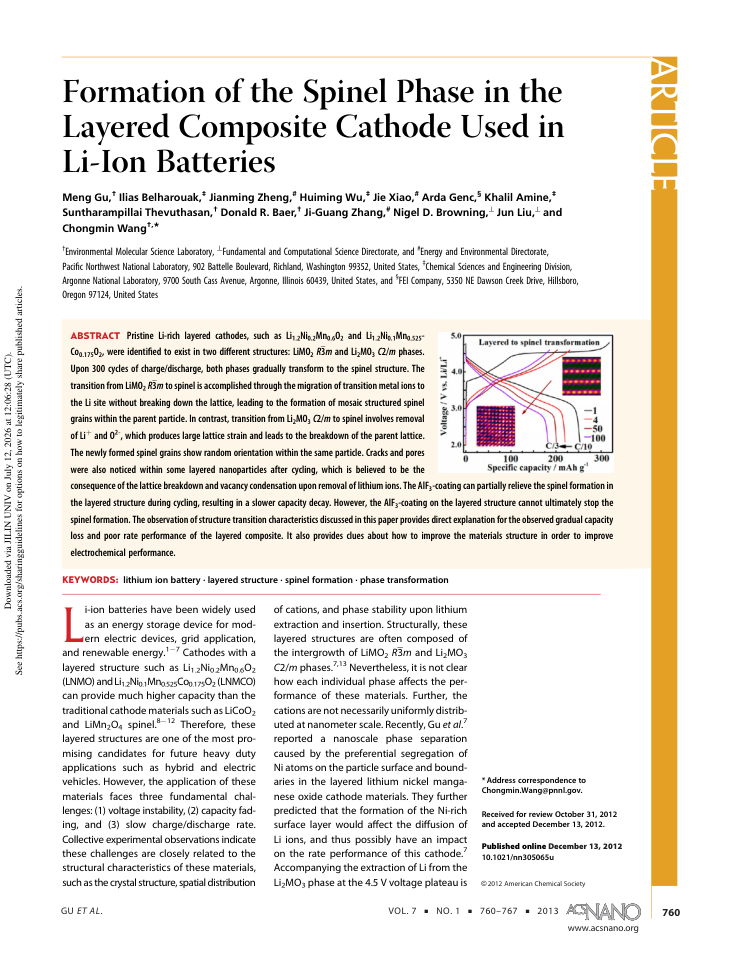
| medium | 1 | 7 | text | abstract_candidate | implicit_abstract | implicit_abstract | p1:body_region:0 | p1:page_body:column_1_of_2:colored | [254, 246, 232] colored | [58.79, 276.17, 295.08, 119.36] | ABSTRACT Pristine Li-rich layered cathodes, such as Li 1.2 Ni 0.2 Mn0.6 O2 and Li 1.2 Ni 0.1 Mn0.525 -Co0.175 O2 , were identi fi ed to exist in two di ff erent structures: LiMO 2 R 3 m and Li2MO3 C 2/ m phases. Upon 300 cycles of charge/discharge, both phases gradually transform to the spinel structure. The transition from LiMO 2 R 3 m to spinel is accomplished through the migration of transition metal ions to the Li site without breaking down the lattice, leading to the formation of mosaic structured spinel grains within the parent particle. In contrast, transition from Li2MO3 C 2/ m to spinel involves removal of Li þ and O 2 -, which produces large lattice strain and leads to the breakdown of the parent lattice. The newly formed spinel grains show random orientation within the same particle. Cracks and pores were also noticed within some layered nanoparticles after cycling, which is believed to be the | ABSTRACT Pristine Li-rich layered cathodes, such as Li 1.2 Ni 0.2 Mn0.6 O2 and Li 1.2 Ni 0.1 Mn0.525 -Co0.175 O2 , were identi fi ed to exist in two di ff erent structures: LiMO 2 R 3 m and Li2MO3 C 2/ m phases. Upon 300 cycles of charge/discharge, both phases gradually transform to the spinel structure. The transition from LiMO 2 R 3 m to spinel is accomplished through the migration of transition metal ions to the Li site without breaking down the lattice, leading to the formation of mosaic structured spinel grains within the parent particle. In contrast, transition from Li2MO3 C 2/ m to spinel involves removal of Li þ and O 2 -, which produces large lattice strain and leads to the breakdown of the parent lattice. The newly formed spinel grains show random orientation within the same particle. Cracks and pores were also noticed within some layered nanoparticles after cycling, which is believed to be the | ||
| medium | 1 | 13 | text | unknown_text | abstract_boundary_dates | abstract_boundary_dates | p1:body_region:0 | p1:page_body:column_2_of_2:white | [255, 255, 255] white | [401.39, 702.45, 111.48, 15.3] | December 13, 2012 Published online 10.1021/nn305065u | December 13, 2012 Published online 10.1021/nn305065u | ||
| low | 1 | 0 | section_header | title_candidate | non_body_heading | non_body_heading | p1:body_region:0 | p1:page_body:column_1_of_2:white | [255, 255, 255] white | [51.82, 65.4, 418.82, 77.58] | Formation of the Spinel Phase in the Layered Composite Cathode Used in Li-Ion Batteries | Formation of the Spinel Phase in the Layered Composite Cathode Used in Li-Ion Batteries | ||
| low | 1 | 1 | text | page_margin_header | document_ui | document_ui | p1:top_margin:column_2_of_2:colored | [230, 168, 56] colored | [536.95, 47.22, 28.39, 112.47] | ARTICLE | ARTICLE | |||
| low | 1 | 4 | page_header | page_header | docling_page_header | docling_page_header | p1:page_body:column_1_of_2:white | [255, 255, 255] white | [3.34, 277.91, 14.66, 284.86] | Downloaded via JILIN UNIV on July 12, 206 at 12:068 (UTC). See https:/pubs.acs.org/sharinguidelines for options on how to legitimately share published articles. | Downloaded via JILIN UNIV on July 12, 206 at 12:068 (UTC). See https:/pubs.acs.org/sharinguidelines for options on how to legitimately share published articles. | |||
| low | 1 | 5 | text | front_matter_heading | front_matter_heading | front_matter_heading | p1:body_region:0 | p1:page_body:column_1_of_2:white | [255, 255, 255] white | [51.82, 480.41, 322.14, 7.2] | KEYWORDS: lithium ion battery . layered structure . spinel formation . phase transformation | KEYWORDS: lithium ion battery . layered structure . spinel formation . phase transformation | ||
| low | 1 | 9 | page_footer | page_footer | docling_page_footer | docling_page_footer | p1:body_region:0 | p1:bottom_margin:column_1_of_2:white | [255, 255, 255] white | [50.74, 756.25, 30.97, 7.28] | GU ET AL | GU ET AL | ||
| low | 1 | 11 | text | metadata | first_page_metadata | first_page_metadata | p1:body_region:0 | p1:page_body:column_2_of_2:white | [255, 255, 255] white | [401.39, 647.44, 86.99, 15.04] | * Address correspondence to Chongmin.Wang@pnnl.gov. | * Address correspondence to Chongmin.Wang@pnnl.gov. | ||
| low | 1 | 12 | text | metadata | first_page_metadata | first_page_metadata | p1:body_region:0 | p1:page_body:column_2_of_2:white | [255, 255, 255] white | [401.39, 675.84, 112.95, 15.04] | Received for review October 31, 2012 and accepted December 13, 2012. | Received for review October 31, 2012 and accepted December 13, 2012. | ||
| low | 1 | 14 | text | page_margin_footer | page_margin_footer | page_margin_footer | p1:body_region:0 | p1:bottom_margin:column_2_of_2:white | [255, 255, 255] white | [400.99, 733.59, 62.39, 5.87] | C 201 American Chemical Society | C 201 American Chemical Society | ||
| low | 1 | 15 | page_footer | page_footer | docling_page_footer | docling_page_footer | p1:body_region:0 | p1:bottom_margin:column_2_of_2:white | [255, 255, 255] white | [322.15, 755.18, 95.47, 8.29] | VOL. - | VOL. - | ||
| low | 1 | 16 | page_footer | page_footer | docling_page_footer | docling_page_footer | p1:bottom_margin:column_2_of_2:white | [255, 255, 255] white | [551.96, 756.94, 10.09, 8.0] | 760 | 760 | |||
| low | 1 | 17 | text | page_margin_footer | document_web_address | document_web_address | p1:bottom_margin:column_2_of_2:white | [254, 254, 254] white | [473.22, 770.6, 29.67, 5.64] | w.acsnano.org | w.acsnano.org | |||
| low | 2 | 20 | section_header | body_heading | body_heading | body_heading | p2:body_region:0 | p2:body_zone:column_1_of_2:white | [255, 255, 255] white | [64.74, 601.09, 120.27, 7.65] | RESULTS AND DISCUSSIONS | RESULTS AND DISCUSSIONS | ||
| low | 2 | 22 | page_footer | page_footer | docling_page_footer | docling_page_footer | p2:body_region:0 | p2:bottom_margin:column_1_of_2:white | [255, 255, 255] white | [64.29, 760.66, 34.51, 7.08] | GU ET AL . | GU ET AL . | ||
| low | 2 | 23 | page_header | page_header | docling_page_header | docling_page_header | p2:top_margin:column_2_of_2:white | [255, 255, 255] white | [540.13, 47.17, 28.39, 112.47] | ARTICLE | ARTICLE | |||
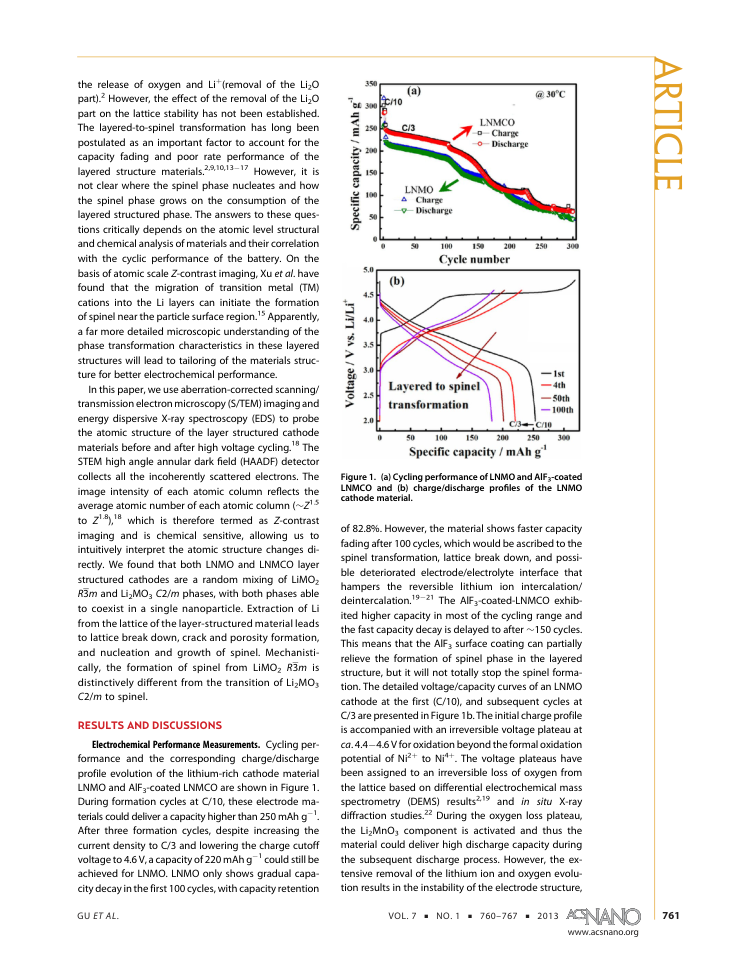
| low | 2 | 24 | caption | caption | outside_body_flow_caption | outside_body_flow_caption | p2:body_region:1 | p2:front_matter:column_2_of_2:white | [255, 255, 255] white | [283.92, 394.54, 201.28, 24.87] | Figure 1. (a) Cycling performance of LNMO and AlF3-coated LNMCO and (b) charge/discharge pro fi les of the LNMO cathode material. | Figure 1. (a) Cycling performance of LNMO and AlF3-coated LNMCO and (b) charge/discharge pro fi les of the LNMO cathode material. | ||
| low | 2 | 26 | page_footer | page_footer | docling_page_footer | docling_page_footer | p2:bottom_margin:column_2_of_2:white | [255, 255, 255] white | [551.96, 758.01, 14.85, 10.27] | 761 | 761 | |||
| low | 2 | 27 | page_footer | page_footer | docling_page_footer | docling_page_footer | p2:body_region:1 | p2:bottom_margin:column_2_of_2:white | [255, 255, 255] white | [323.72, 759.15, 141.77, 8.55] | VOL. 7 ' NO. 1 ' 760 -767 ' 2013 | VOL. 7 ' NO. 1 ' 760 -767 ' 2013 | ||
| low | 2 | 28 | page_footer | page_footer | outside_body_flow_page_footer | outside_body_flow_page_footer | p2:bottom_margin:column_2_of_2:white | [255, 255, 255] white | [473.22, 779.07, 59.2, 1.67] | www.acsnano.org | ||||
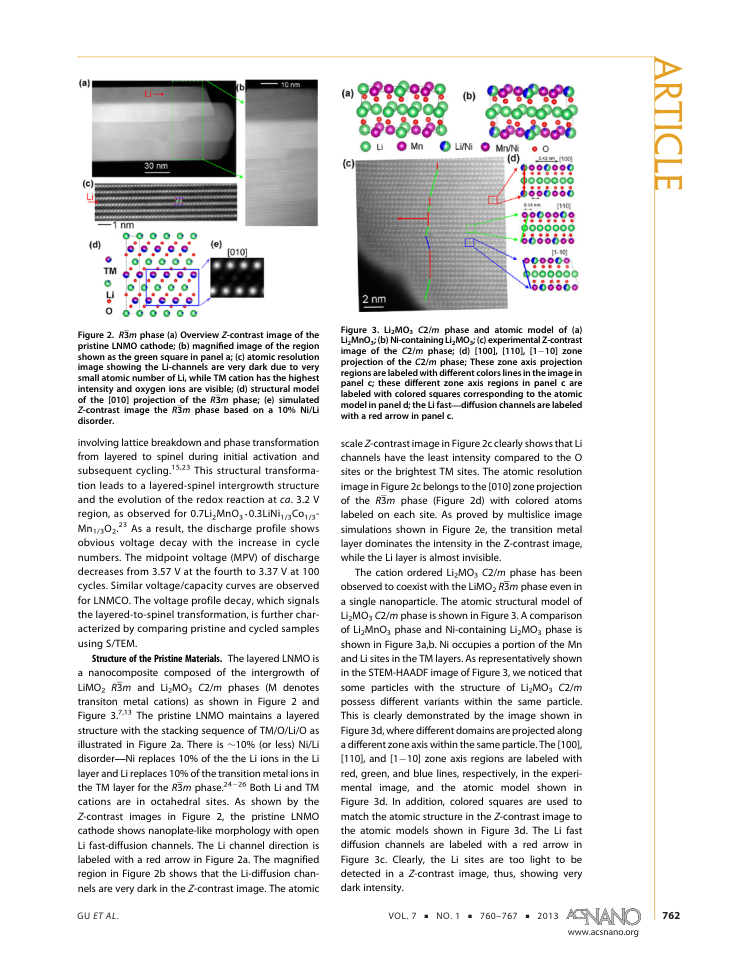
| low | 3 | 29 | caption | caption | outside_body_flow_caption | outside_body_flow_caption | p3:body_region:0 | p3:page_body:column_1_of_2:white | [255, 255, 255] white | [64.74, 275.79, 201.35, 79.28] | Figure 2. R 3 m phase (a) Overview Z -contrast image of the pristine LNMO cathode; (b) magni fi ed image of the region shown as the green square in panel a; (c) atomic resolution image showing the Li-channels are very dark due to very small atomic number of Li, while TM cation has the highest intensity and oxygen ions are visible; (d) structural model of the [010] projection of the R 3 m phase; (e) simulated Z -contrast image the R 3 m phase based on a 10% Ni/Li disorder. | Figure 2. R 3 m phase (a) Overview Z -contrast image of the pristine LNMO cathode; (b) magni fi ed image of the region shown as the green square in panel a; (c) atomic resolution image showing the Li-channels are very dark due to very small atomic number of Li, while TM cation has the highest intensity and oxygen ions are visible; (d) structural model of the [010] projection of the R 3 m phase; (e) simulated Z -contrast image the R 3 m phase based on a 10% Ni/Li disorder. | ||
| low | 3 | 32 | page_footer | page_footer | docling_page_footer | docling_page_footer | p3:body_region:0 | p3:bottom_margin:column_1_of_2:white | [255, 255, 255] white | [64.29, 760.66, 34.51, 7.08] | GU ET AL . | GU ET AL . | ||
| low | 3 | 33 | page_header | page_header | docling_page_header | docling_page_header | p3:top_margin:column_2_of_2:white | [255, 255, 255] white | [540.13, 47.17, 28.39, 112.47] | ARTICLE | ARTICLE | |||
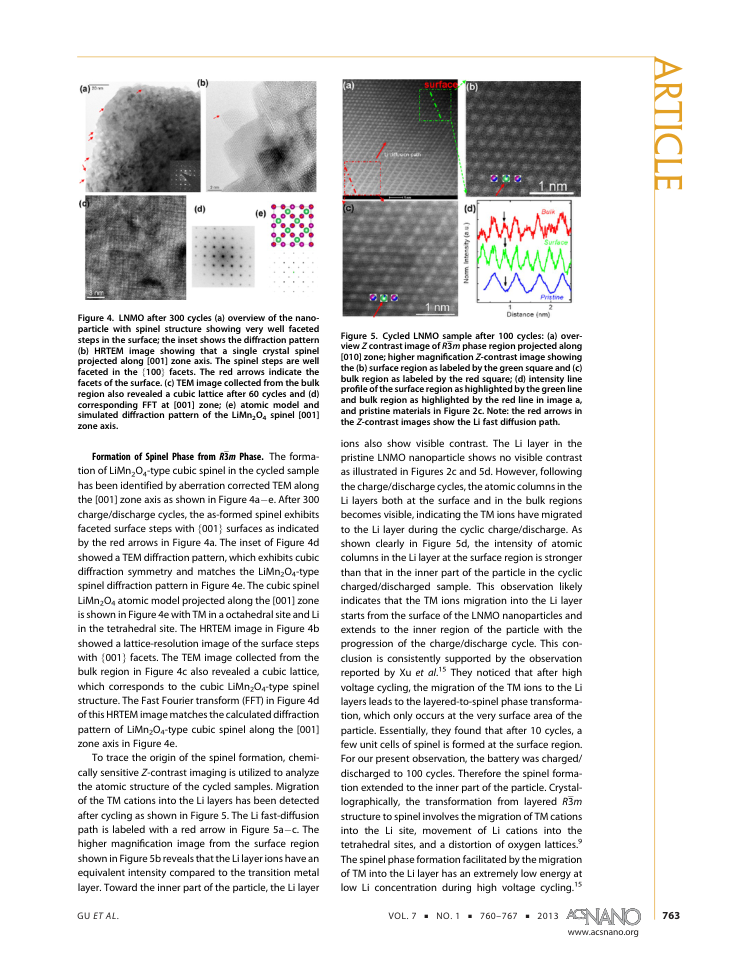
| low | 3 | 34 | caption | caption | outside_body_flow_caption | outside_body_flow_caption | p3:body_region:1 | p3:page_body:column_2_of_2:white | [255, 255, 255] white | [283.92, 271.25, 201.34, 79.28] | Figure 3. Li2MO3 C 2/ m phase and atomic model of (a) Li2MnO3;(b) Ni-containing Li2MO3; (c) experimental Z-contrast image of the C 2/ m phase; (d) [100], [110], [1 10] zone projection of the C 2/ m phase; These zone axis projection regions are labeled with di ff erent colors lines in the image in panel c; these di ff erent zone axis regions in panel c are labeled with colored squares corresponding to the atomic modelin panel d; the Li fast ; di ff usion channels are labeled with a red arrow in panel c. | Figure 3. Li2MO3 C 2/ m phase and atomic model of (a) Li2MnO3;(b) Ni-containing Li2MO3; (c) experimental Z-contrast image of the C 2/ m phase; (d) [100], [110], [1 10] zone projection of the C 2/ m phase; These zone axis projection regions are labeled with di ff erent colors lines in the image in panel c; these di ff erent zone axis regions in panel c are labeled with colored squares corresponding to the atomic modelin panel d; the Li fast ; di ff usion channels are labeled with a red arrow in panel c. | ||
| low | 3 | 37 | page_footer | page_footer | docling_page_footer | docling_page_footer | p3:bottom_margin:column_2_of_2:white | [255, 255, 255] white | [551.96, 758.01, 14.85, 10.27] | 762 | 762 | |||
| low | 3 | 38 | page_footer | page_footer | docling_page_footer | docling_page_footer | p3:body_region:1 | p3:bottom_margin:column_2_of_2:white | [255, 255, 255] white | [323.72, 759.15, 141.77, 8.55] | VOL. 7 ' NO. 1 ' 760 -767 ' 2013 | VOL. 7 ' NO. 1 ' 760 -767 ' 2013 | ||
| low | 3 | 39 | page_footer | page_footer | outside_body_flow_page_footer | outside_body_flow_page_footer | p3:bottom_margin:column_2_of_2:white | [255, 255, 255] white | [473.22, 779.07, 59.2, 1.67] | www.acsnano.org | ||||
| low | 4 | 40 | caption | caption | outside_body_flow_caption | outside_body_flow_caption | p4:body_region:0 | p4:page_body:column_1_of_2:white | [255, 255, 255] white | [64.74, 262.5, 201.33, 96.58] | Figure 4. LNMO after 300 cycles (a) overview of the nanoparticle with spinel structure showing very well faceted steps in the surface; the inset shows the di ff raction pattern (b) HRTEM image showing that a single crystal spinel projected along [001] zone axis. The spinel steps are well faceted in the { 100 } facets. The red arrows indicate the facets of the surface. (c) TEM image collected from the bulk region also revealed a cubic lattice after 60 cycles and (d) corresponding FFT at [001] zone; (e) atomic model and simulated di ff raction pattern of the LiMn2O4 spinel [001] zone axis. | Figure 4. LNMO after 300 cycles (a) overview of the nanoparticle with spinel structure showing very well faceted steps in the surface; the inset shows the di ff raction pattern (b) HRTEM image showing that a single crystal spinel projected along [001] zone axis. The spinel steps are well faceted in the { 100 } facets. The red arrows indicate the facets of the surface. (c) TEM image collected from the bulk region also revealed a cubic lattice after 60 cycles and (d) corresponding FFT at [001] zone; (e) atomic model and simulated di ff raction pattern of the LiMn2O4 spinel [001] zone axis. | ||
| low | 4 | 43 | page_footer | page_footer | docling_page_footer | docling_page_footer | p4:body_region:0 | p4:bottom_margin:column_1_of_2:white | [255, 255, 255] white | [64.29, 760.66, 34.51, 7.08] | GU ET AL . | GU ET AL . | ||
| low | 4 | 44 | page_header | page_header | docling_page_header | docling_page_header | p4:top_margin:column_2_of_2:white | [255, 255, 255] white | [540.13, 47.17, 28.39, 112.47] | ARTICLE | ARTICLE | |||
| low | 4 | 45 | caption | caption | outside_body_flow_caption | outside_body_flow_caption | p4:body_region:1 | p4:page_body:column_2_of_2:white | [255, 255, 255] white | [283.92, 276.9, 201.32, 78.99] | Figure 5. Cycled LNMO sample after 100 cycles: (a) overview Z contrast image of R 3 m phase region projected along [010] zone; higher magni fi cation Z -contrast image showing the (b) surface region as labeled by the green square and (c) bulk region as labeled by the red square; (d) intensity line pro fi le of the surface region as highlighted by the green line and bulk region as highlighted by the red line in image a, and pristine materials in Figure 2c. Note: the red arrows in the Z -contrast images show the Li fast di ff usion path. | Figure 5. Cycled LNMO sample after 100 cycles: (a) overview Z contrast image of R 3 m phase region projected along [010] zone; higher magni fi cation Z -contrast image showing the (b) surface region as labeled by the green square and (c) bulk region as labeled by the red square; (d) intensity line pro fi le of the surface region as highlighted by the green line and bulk region as highlighted by the red line in image a, and pristine materials in Figure 2c. Note: the red arrows in the Z -contrast images show the Li fast di ff usion path. | ||
| low | 4 | 47 | page_footer | page_footer | docling_page_footer | docling_page_footer | p4:bottom_margin:column_2_of_2:white | [255, 255, 255] white | [551.96, 758.01, 14.85, 10.27] | 763 | 763 | |||
| low | 4 | 48 | page_footer | page_footer | docling_page_footer | docling_page_footer | p4:body_region:1 | p4:bottom_margin:column_2_of_2:white | [255, 255, 255] white | [323.72, 759.15, 117.92, 8.55] | VOL. 7 ' NO. 1 ' 760 -767 ' | VOL. 7 ' NO. 1 ' 760 -767 ' | ||
| low | 4 | 49 | page_footer | page_footer | docling_page_footer | docling_page_footer | p4:body_region:1 | p4:bottom_margin:column_2_of_2:white | [255, 255, 255] white | [447.76, 766.03, 17.73, 1.67] | 2013 | 2013 | ||
| low | 4 | 50 | page_footer | page_footer | outside_body_flow_page_footer | outside_body_flow_page_footer | p4:bottom_margin:column_2_of_2:white | [255, 255, 255] white | [473.22, 779.07, 59.2, 1.67] | www.acsnano.org | ||||
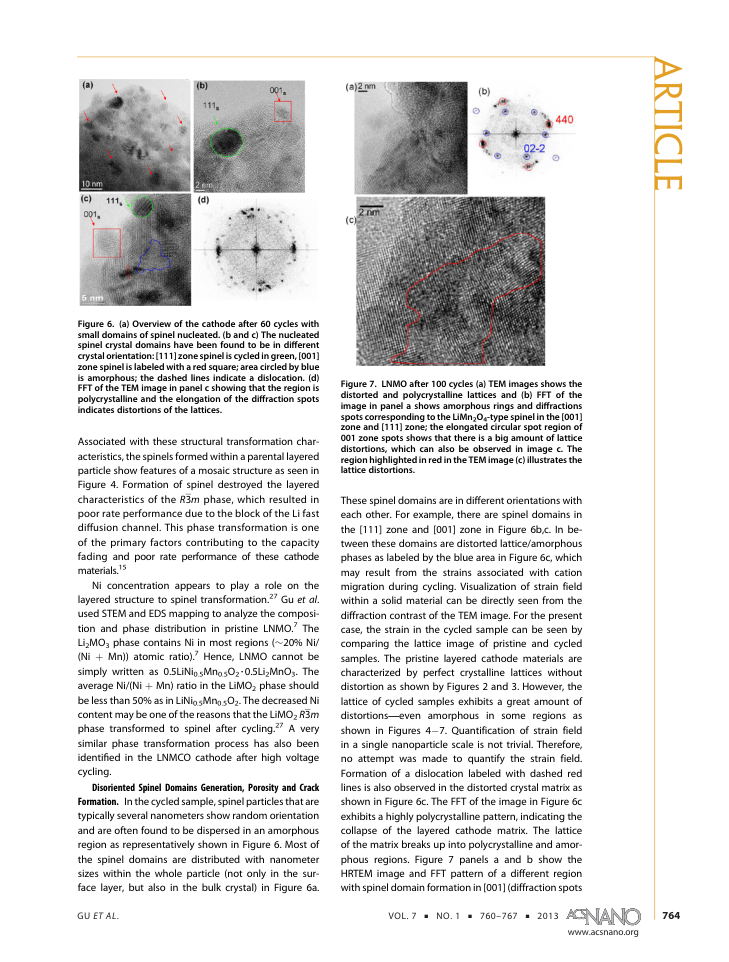
| low | 5 | 51 | caption | caption | outside_body_flow_caption | outside_body_flow_caption | p5:body_region:0 | p5:page_body:column_1_of_2:white | [255, 255, 255] white | [64.74, 267.04, 201.34, 78.67] | Figure 6. (a) Overview of the cathode after 60 cycles with small domains of spinel nucleated. (b and c) The nucleated spinel crystal domains have been found to be in di ff erent crystal orientation: [111] zone spinel is cycled in green, [001] zone spinel is labeled with a red square; area circled by blue is amorphous; the dashed lines indicate a dislocation. (d) FFT of the TEM image in panel c showing that the region is polycrystalline and the elongation of the di ff raction spots indicates distortions of the lattices. | Figure 6. (a) Overview of the cathode after 60 cycles with small domains of spinel nucleated. (b and c) The nucleated spinel crystal domains have been found to be in di ff erent crystal orientation: [111] zone spinel is cycled in green, [001] zone spinel is labeled with a red square; area circled by blue is amorphous; the dashed lines indicate a dislocation. (d) FFT of the TEM image in panel c showing that the region is polycrystalline and the elongation of the di ff raction spots indicates distortions of the lattices. | ||
| low | 5 | 55 | page_footer | page_footer | docling_page_footer | docling_page_footer | p5:body_region:0 | p5:bottom_margin:column_1_of_2:white | [255, 255, 255] white | [64.29, 760.66, 34.51, 7.08] | GU ET AL . | GU ET AL . | ||
| low | 5 | 56 | page_header | page_header | docling_page_header | docling_page_header | p5:top_margin:column_2_of_2:white | [255, 255, 255] white | [540.13, 47.17, 28.39, 112.47] | ARTICLE | ARTICLE | |||
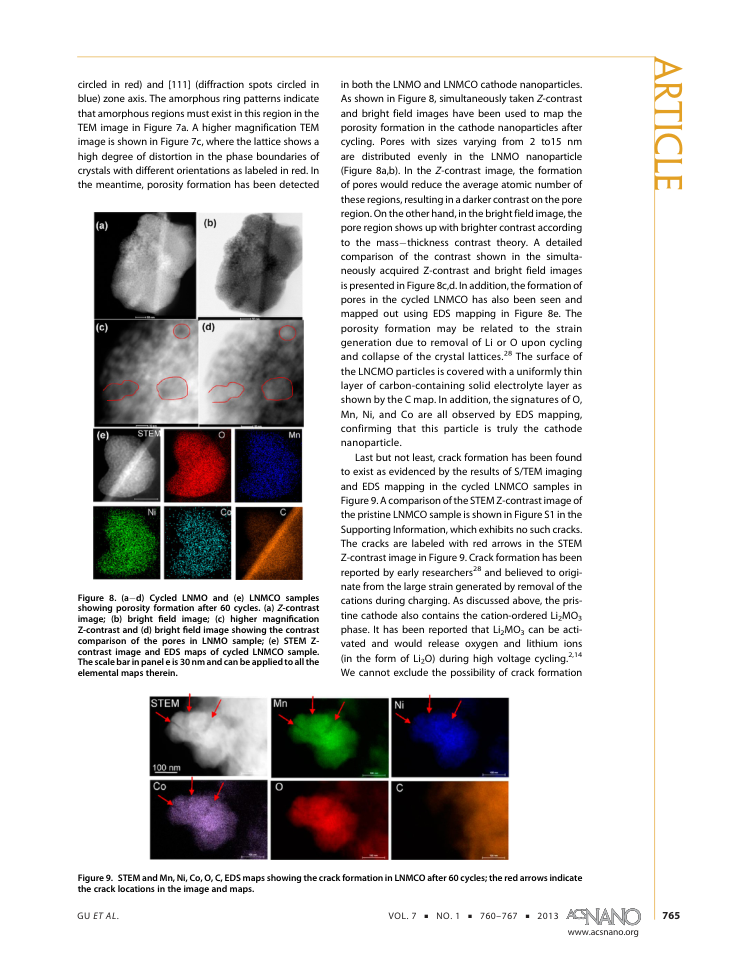
| low | 5 | 57 | caption | caption | outside_body_flow_caption | outside_body_flow_caption | p5:body_region:1 | p5:page_body:column_2_of_2:white | [255, 255, 255] white | [283.92, 317.44, 201.3, 78.73] | Figure 7. LNMO after 100 cycles (a) TEM images shows the distorted and polycrystalline lattices and (b) FFT of the image in panel a shows amorphous rings and di ff ractions spots corresponding to the LiMn2O4-type spinel in the [001] zone and [111] zone; the elongated circular spot region of 001 zone spots shows that there is a big amount of lattice distortions, which can also be observed in image c. The region highlighted in red in the TEM image (c) illustrates the lattice distortions. | Figure 7. LNMO after 100 cycles (a) TEM images shows the distorted and polycrystalline lattices and (b) FFT of the image in panel a shows amorphous rings and di ff ractions spots corresponding to the LiMn2O4-type spinel in the [001] zone and [111] zone; the elongated circular spot region of 001 zone spots shows that there is a big amount of lattice distortions, which can also be observed in image c. The region highlighted in red in the TEM image (c) illustrates the lattice distortions. | ||
| low | 5 | 59 | page_footer | page_footer | docling_page_footer | docling_page_footer | p5:bottom_margin:column_2_of_2:white | [255, 255, 255] white | [551.96, 758.01, 14.85, 10.27] | 764 | 764 | |||
| low | 5 | 60 | page_footer | page_footer | docling_page_footer | docling_page_footer | p5:body_region:1 | p5:bottom_margin:column_2_of_2:white | [255, 255, 255] white | [323.72, 759.15, 141.77, 8.55] | VOL. 7 ' NO. 1 ' 760 -767 ' 2013 | VOL. 7 ' NO. 1 ' 760 -767 ' 2013 | ||
| low | 5 | 61 | text | page_margin_footer | page_margin_footer | page_margin_footer | p5:bottom_margin:column_2_of_2:white | [255, 255, 255] white | [473.22, 779.07, 59.2, 1.67] | www.acsnano.org | ||||
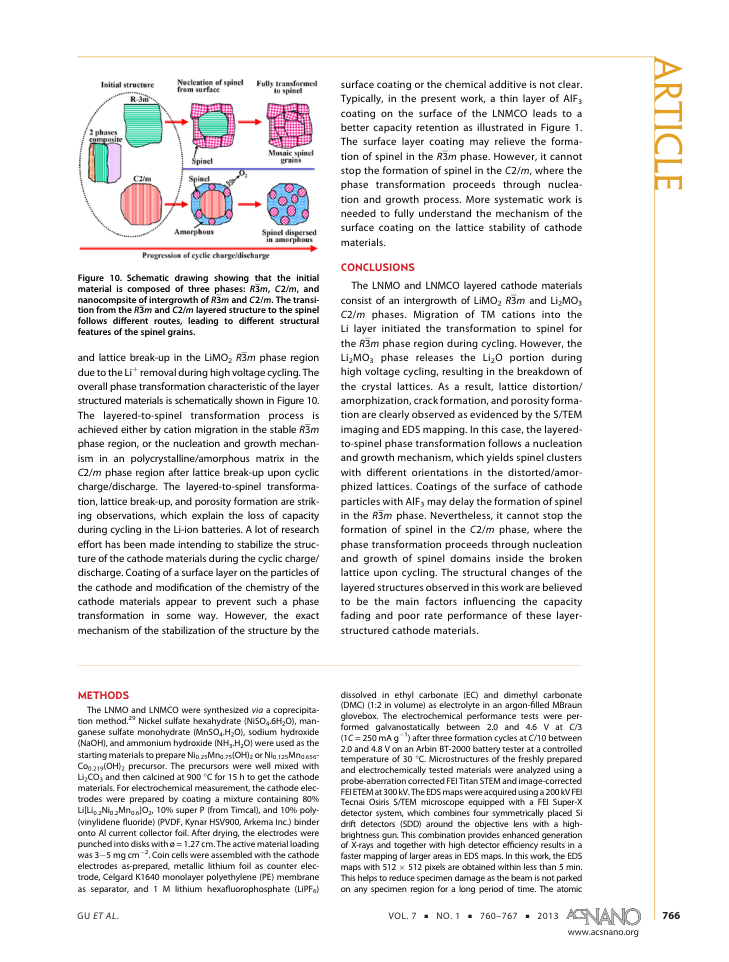
| low | 6 | 63 | caption | caption | outside_body_flow_caption | outside_body_flow_caption | p6:page_body:column_1_of_2:white | [255, 255, 255] white | [64.74, 494.46, 201.34, 70.48] | Figure 8. (a d) Cycled LNMO and (e) LNMCO samples showing porosity formation after 60 cycles. (a) Z -contrast image; (b) bright fi eld image; (c) higher magni fi cation Z-contrast and (d) bright fi eld image showing the contrast comparison of the pores in LNMO sample; (e) STEM Zcontrast image and EDS maps of cycled LNMCO sample. Thescale bar in panel e is 30 nm and can be applied to all the elemental maps therein. | Figure 8. (a d) Cycled LNMO and (e) LNMCO samples showing porosity formation after 60 cycles. (a) Z -contrast image; (b) bright fi eld image; (c) higher magni fi cation Z-contrast and (d) bright fi eld image showing the contrast comparison of the pores in LNMO sample; (e) STEM Zcontrast image and EDS maps of cycled LNMCO sample. Thescale bar in panel e is 30 nm and can be applied to all the elemental maps therein. | |||
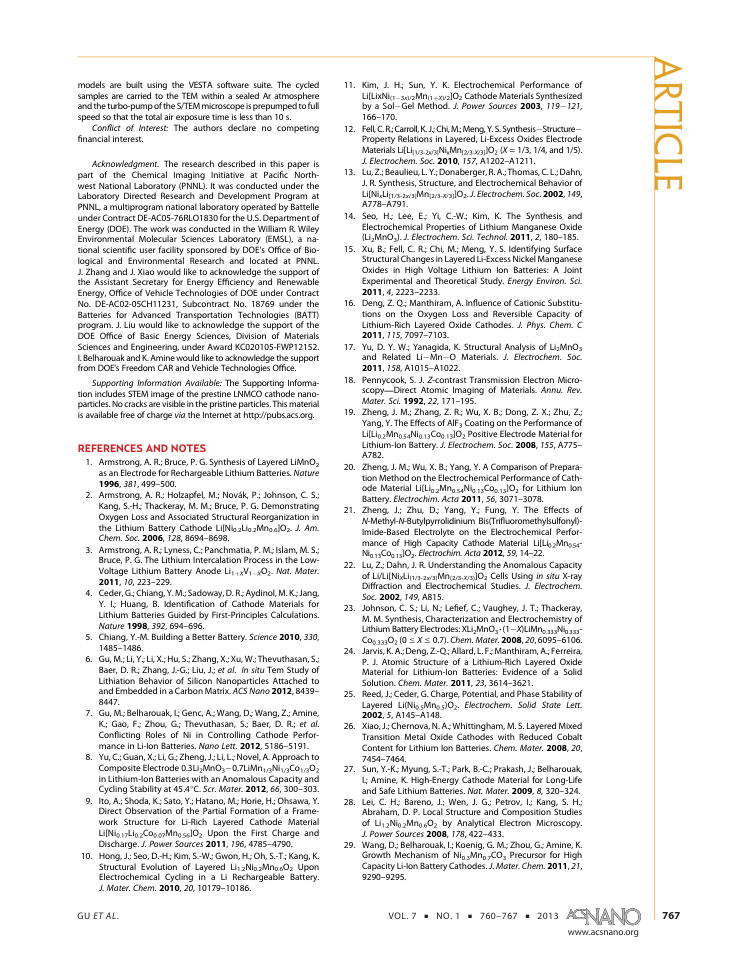
| low | 6 | 64 | caption | caption | docling_caption | docling_caption | p6:bottom_margin:column_1_of_2:white | [255, 255, 255] white | [64.74, 728.63, 420.48, 15.91] | Figure 9. STEMandMn,Ni,Co, O, C, EDS maps showing the crack formation in LNMCO after 60 cycles; the red arrows indicate the crack locations in the image and maps. | Figure 9. STEMandMn,Ni,Co, O, C, EDS maps showing the crack formation in LNMCO after 60 cycles; the red arrows indicate the crack locations in the image and maps. | |||
| low | 6 | 65 | page_footer | page_footer | docling_page_footer | docling_page_footer | p6:bottom_margin:column_1_of_2:white | [255, 255, 255] white | [64.29, 760.66, 34.51, 7.08] | GU ET AL . | GU ET AL . | |||
| low | 6 | 66 | page_header | page_header | docling_page_header | docling_page_header | p6:top_margin:column_2_of_2:white | [255, 255, 255] white | [540.13, 47.17, 28.39, 112.47] | ARTICLE | ARTICLE | |||
| low | 6 | 69 | page_footer | page_footer | docling_page_footer | docling_page_footer | p6:bottom_margin:column_2_of_2:white | [255, 255, 255] white | [551.96, 758.01, 14.85, 10.27] | 765 | 765 | |||
| low | 6 | 70 | page_footer | page_footer | docling_page_footer | docling_page_footer | p6:body_region:0 | p6:bottom_margin:column_2_of_2:white | [255, 255, 255] white | [323.72, 759.15, 141.77, 8.55] | VOL. 7 ' NO. 1 ' 760 -767 ' 2013 | VOL. 7 ' NO. 1 ' 760 -767 ' 2013 | ||
| low | 6 | 71 | page_footer | page_footer | outside_body_flow_page_footer | outside_body_flow_page_footer | p6:bottom_margin:column_2_of_2:white | [255, 255, 255] white | [473.22, 779.07, 59.2, 1.67] | www.acsnano.org | ||||
| low | 7 | 72 | caption | caption | outside_body_flow_caption | outside_body_flow_caption | p7:body_region:0 | p7:body_zone:column_1_of_2:white | [255, 255, 255] white | [64.74, 228.88, 201.31, 51.74] | Figure 10. Schematic drawing showing that the initial material is composed of three phases: R 3 m , C 2/ m , and nanocompsite of intergrowth of R 3 m and C 2/ m . The transition from the R 3 m and C 2/ m layered structure to the spinel follows di ff erent routes, leading to di ff erent structural features of the spinel grains. | Figure 10. Schematic drawing showing that the initial material is composed of three phases: R 3 m , C 2/ m , and nanocompsite of intergrowth of R 3 m and C 2/ m . The transition from the R 3 m and C 2/ m layered structure to the spinel follows di ff erent routes, leading to di ff erent structural features of the spinel grains. | ||
| low | 7 | 74 | section_header | body_heading | body_heading | body_heading | p7:body_region:0 | p7:body_zone:column_1_of_2:white | [255, 255, 255] white | [64.74, 576.08, 42.93, 7.65] | METHODS | METHODS | ||
| low | 7 | 76 | page_footer | page_footer | docling_page_footer | docling_page_footer | p7:body_region:0 | p7:bottom_margin:column_1_of_2:white | [255, 255, 255] white | [64.29, 760.66, 34.51, 7.08] | GU ET AL . | GU ET AL . | ||
| low | 7 | 77 | page_header | page_header | docling_page_header | docling_page_header | p7:top_margin:column_2_of_2:white | [255, 255, 255] white | [540.13, 47.17, 28.39, 112.47] | ARTICLE | ARTICLE | |||
| low | 7 | 79 | section_header | body_heading | body_heading | body_heading | p7:body_region:1 | p7:body_zone:column_2_of_2:white | [255, 255, 255] white | [283.92, 219.32, 61.7, 7.65] | CONCLUSIONS | CONCLUSIONS | ||
| low | 7 | 82 | page_footer | page_footer | docling_page_footer | docling_page_footer | p7:bottom_margin:column_2_of_2:white | [255, 255, 255] white | [551.96, 758.01, 14.85, 10.27] | 766 | 766 | |||
| low | 7 | 83 | page_footer | page_footer | docling_page_footer | docling_page_footer | p7:body_region:1 | p7:bottom_margin:column_2_of_2:white | [255, 255, 255] white | [323.72, 759.15, 117.92, 8.55] | VOL. 7 ' NO. 1 ' 760 -767 ' | VOL. 7 ' NO. 1 ' 760 -767 ' | ||
| low | 7 | 84 | page_footer | page_footer | docling_page_footer | docling_page_footer | p7:body_region:1 | p7:bottom_margin:column_2_of_2:white | [255, 255, 255] white | [447.76, 766.03, 17.73, 1.67] | 2013 | 2013 | ||
| low | 7 | 85 | page_footer | page_footer | outside_body_flow_page_footer | outside_body_flow_page_footer | p7:bottom_margin:column_2_of_2:white | [255, 255, 255] white | [473.22, 779.07, 59.2, 1.67] | www.acsnano.org | ||||
| low | 8 | 87 | text | back_matter_heading | back_matter_heading | back_matter_heading | stop_trigger | p8:body_region:0 | p8:page_body:column_1_of_2:white | [255, 255, 255] white | [64.74, 103.87, 201.2, 15.69] | Conflict of Interest: The authors declare no competing fi nancial interest. | Conflict of Interest: The authors declare no competing fi nancial interest. | |
| low | 8 | 88 | text | back_matter_heading | after_back_matter_stop | after_back_matter_stop | after_stop | p8:body_region:0 | p8:page_body:column_1_of_2:white | [255, 255, 255] white | [64.74, 133.98, 201.38, 177.09] | Acknowledgment. The research described in this paper is part of the Chemical Imaging Initiative at Paci fi c Northwest National Laboratory (PNNL). It was conducted under the Laboratory Directed Research and Development Program at PNNL, a multiprogram national laboratory operated by Battelle under Contract DE-AC05-76RLO1830 for the U.S. Department of Energy (DOE). The work was conducted in the William R. Wiley Environmental Molecular Sciences Laboratory (EMSL), a national scienti fi c user facility sponsored by DOE's O ffi ce of Biological and Environmental Research and located at PNNL. J. Zhang and J. Xiao would like to acknowledge the support of the Assistant Secretary for Energy E ffi ciency and Renewable Energy, O ffi ce of Vehicle Technologies of DOE under Contract No. DE-AC02-05CH11231, Subcontract No. 18769 under the Batteries for Advanced Transportation Technologies (BATT) program. J. Liu would like to acknowledge the support of the DOE Offi ce of Basic Energy Sciences, Division of Materials Sciences and Engineering, under Award KC020105-FWP12152. I. Belharouak and K. Amine would like to acknowledge the support from DOE's Freedom CAR and Vehicle Technologies O ffi ce. | Acknowledgment. The research described in this paper is part of the Chemical Imaging Initiative at Paci fi c Northwest National Laboratory (PNNL). It was conducted under the Laboratory Directed Research and Development Program at PNNL, a multiprogram national laboratory operated by Battelle under Contract DE-AC05-76RLO1830 for the U.S. Department of Energy (DOE). The work was conducted in the William R. Wiley Environmental Molecular Sciences Laboratory (EMSL), a national scienti fi c user facility sponsored by DOE's O ffi ce of Biological and Environmental Research and located at PNNL. J. Zhang and J. Xiao would like to acknowledge the support of the Assistant Secretary for Energy E ffi ciency and Renewable Energy, O ffi ce of Vehicle Technologies of DOE under Contract No. DE-AC02-05CH11231, Subcontract No. 18769 under the Batteries for Advanced Transportation Technologies (BATT) program. J. Liu would like to acknowledge the support of the DOE Offi ce of Basic Energy Sciences, Division of Materials Sciences and Engineering, under Award KC020105-FWP12152. I. Belharouak and K. Amine would like to acknowledge the support from DOE's Freedom CAR and Vehicle Technologies O ffi ce. | |
| low | 8 | 89 | text | back_matter_heading | after_back_matter_stop | after_back_matter_stop | after_stop | p8:body_region:0 | p8:page_body:column_1_of_2:white | [255, 255, 255] white | [64.74, 316.46, 201.39, 33.66] | Supporting Information Available: The Supporting Information includes STEM image of the prestine LNMCO cathode nanoparticles. No cracks are visible in the pristine particles. This material is available free of charge via the Internet at http://pubs.acs.org. | Supporting Information Available: The Supporting Information includes STEM image of the prestine LNMCO cathode nanoparticles. No cracks are visible in the pristine particles. This material is available free of charge via the Internet at | |
| low | 8 | 90 | section_header | back_matter_heading | after_back_matter_stop | after_back_matter_stop | after_stop | p8:body_region:0 | p8:page_body:column_1_of_2:white | [255, 255, 255] white | [64.74, 370.18, 106.92, 7.65] | REFERENCES AND NOTES | REFERENCES AND NOTES | |
| low | 8 | 91 | list_item | reference | after_back_matter_stop | after_back_matter_stop | after_stop | p8:body_region:0 | p8:page_body:column_1_of_2:white | [255, 255, 255] white | [71.21, 382.63, 194.8, 24.96] | Armstrong, A. R.; Bruce, P. G. Synthesis of Layered LiMnO2 as an Electrode for Rechargeable Lithium Batteries. Nature 1996 , 381 , 499 -500. | Armstrong, A. R.; Bruce, P. G. Synthesis of Layered LiMnO2 as an Electrode for Rechargeable Lithium Batteries. Nature 1996 , 381 , 499 -500. | |
| low | 8 | 92 | list_item | reference | after_back_matter_stop | after_back_matter_stop | after_stop | p8:body_region:0 | p8:page_body:column_1_of_2:white | [255, 255, 255] white | [71.21, 410.01, 194.79, 42.94] | Armstrong, A. R.; Holzapfel, M.; Novák, P.; Johnson, C. S.; Kang, S.-H.; Thackeray, M. M.; Bruce, P. G. Demonstrating Oxygen Loss and Associated Structural Reorganization in the Lithium Battery Cathode Li[Ni0.2Li0.2Mn0.6]O2. J. Am. Chem. Soc. 2006 , 128 , 8694 -8698. | Armstrong, A. R.; Holzapfel, M.; Novák, P.; Johnson, C. S.; Kang, S.-H.; Thackeray, M. M.; Bruce, P. G. Demonstrating Oxygen Loss and Associated Structural Reorganization in the Lithium Battery Cathode Li[Ni0.2Li0.2Mn0.6]O2. J. Am. Chem. Soc. 2006 , 128 , 8694 -8698. | |
| low | 8 | 93 | list_item | reference | after_back_matter_stop | after_back_matter_stop | after_stop | p8:body_region:0 | p8:page_body:column_1_of_2:white | [255, 255, 255] white | [71.21, 455.37, 194.79, 33.92] | Armstrong, A. R.; Lyness, C.; Panchmatia, P. M.; Islam, M. S.; Bruce, P. G. The Lithium Intercalation Process in the LowVoltage Lithium Battery Anode Li1 þ X V1 X O2. Nat. Mater. 2011 , 10 , 223 -229. | Armstrong, A. R.; Lyness, C.; Panchmatia, P. M.; Islam, M. S.; Bruce, P. G. The Lithium Intercalation Process in the LowVoltage Lithium Battery Anode Li1 þ X V1 X O2. Nat. Mater. 2011 , 10 , 223 -229. | |
| low | 8 | 94 | list_item | reference | after_back_matter_stop | after_back_matter_stop | after_stop | p8:body_region:0 | p8:page_body:column_1_of_2:white | [255, 255, 255] white | [71.21, 491.71, 194.75, 33.98] | Ceder, G.; Chiang, Y. M.; Sadoway, D. R.; Aydinol, M. K.; Jang, Y. I.; Huang, B. Identi fi cation of Cathode Materials for Lithium Batteries Guided by First-Principles Calculations. Nature 1998 , 392 , 694 -696. | Ceder, G.; Chiang, Y. M.; Sadoway, D. R.; Aydinol, M. K.; Jang, Y. I.; Huang, B. Identi fi cation of Cathode Materials for Lithium Batteries Guided by First-Principles Calculations. Nature 1998 , 392 , 694 -696. | |
| low | 8 | 95 | list_item | reference | after_back_matter_stop | after_back_matter_stop | after_stop | p8:body_region:0 | p8:page_body:column_1_of_2:white | [255, 255, 255] white | [71.21, 527.52, 194.79, 16.28] | Chiang, Y.-M. Building a Better Battery. Science 2010 , 330 , 1485 -1486. | Chiang, Y.-M. Building a Better Battery. Science 2010 , 330 , 1485 -1486. | |
| low | 8 | 96 | list_item | reference | after_back_matter_stop | after_back_matter_stop | after_stop | p8:body_region:0 | p8:page_body:column_1_of_2:white | [255, 255, 255] white | [71.21, 546.53, 194.8, 42.56] | Gu, M.; Li, Y.; Li, X.; Hu, S.; Zhang, X.; Xu, W.; Thevuthasan, S.; Baer, D. R.; Zhang, J.-G.; Liu, J.; et al . In situ Tem Study of Lithiation Behavior of Silicon Nanoparticles Attached to and Embedded in a Carbon Matrix. ACS Nano 2012 , 8439 -8447. | Gu, M.; Li, Y.; Li, X.; Hu, S.; Zhang, X.; Xu, W.; Thevuthasan, S.; Baer, D. R.; Zhang, J.-G.; Liu, J.; et al . In situ Tem Study of Lithiation Behavior of Silicon Nanoparticles Attached to and Embedded in a Carbon Matrix. ACS Nano 2012 , 8439 -8447. | |
| low | 8 | 97 | list_item | reference | after_back_matter_stop | after_back_matter_stop | after_stop | p8:body_region:0 | p8:page_body:column_1_of_2:white | [255, 255, 255] white | [71.21, 591.82, 194.79, 33.98] | Gu, M.; Belharouak, I.; Genc, A.; Wang, D.; Wang, Z.; Amine, K.; Gao, F.; Zhou, G.; Thevuthasan, S.; Baer, D. R.; et al . Con fl icting Roles of Ni in Controlling Cathode Performance in Li-Ion Batteries. Nano Lett. 2012 , 5186 -5191. | Gu, M.; Belharouak, I.; Genc, A.; Wang, D.; Wang, Z.; Amine, K.; Gao, F.; Zhou, G.; Thevuthasan, S.; Baer, D. R.; et al . Con fl icting Roles of Ni in Controlling Cathode Performance in Li-Ion Batteries. Nano Lett. 2012 , 5186 -5191. | |
| low | 8 | 98 | list_item | reference | after_back_matter_stop | after_back_matter_stop | after_stop | p8:body_region:0 | p8:page_body:column_1_of_2:white | [255, 255, 255] white | [71.21, 628.22, 194.8, 34.33] | Yu, C.; Guan, X.; Li, G.; Zheng, J.; Li, L.; Novel, A. Approach to Composite Electrode 0.3Li2MnO3 0.7LiMn1/3Ni1/3Co1/3O2 in Lithium-Ion Batteries with an Anomalous Capacity and Cycling Stability at 45.4 ° C. Scr. Mater. 2012 , 66 , 300 -303. | Yu, C.; Guan, X.; Li, G.; Zheng, J.; Li, L.; Novel, A. Approach to Composite Electrode 0.3Li2MnO3 0.7LiMn1/3Ni1/3Co1/3O2 in Lithium-Ion Batteries with an Anomalous Capacity and Cycling Stability at 45.4 ° C. Scr. Mater. 2012 , 66 , 300 -303. | |
| low | 8 | 99 | list_item | reference | after_back_matter_stop | after_back_matter_stop | after_stop | p8:body_region:0 | p8:page_body:column_1_of_2:white | [255, 255, 255] white | [71.21, 664.56, 194.75, 42.94] | Ito, A.; Shoda, K.; Sato, Y.; Hatano, M.; Horie, H.; Ohsawa, Y. Direct Observation of the Partial Formation of a Framework Structure for Li-Rich Layered Cathode Material Li[Ni0.17Li0.2Co0.07Mn0.56]O2 Upon the First Charge and Discharge. J. Power Sources 2011 , 196 , 4785 -4790. | Ito, A.; Shoda, K.; Sato, Y.; Hatano, M.; Horie, H.; Ohsawa, Y. Direct Observation of the Partial Formation of a Framework Structure for Li-Rich Layered Cathode Material Li[Ni0.17Li0.2Co0.07Mn0.56]O2 Upon the First Charge and Discharge. J. Power Sources 2011 , 196 , 4785 -4790. | |
| low | 8 | 100 | list_item | reference | after_back_matter_stop | after_back_matter_stop | after_stop | p8:body_region:0 | p8:bottom_margin:column_1_of_2:white | [255, 255, 255] white | [67.35, 710.37, 198.62, 33.98] | Hong, J.; Seo, D.-H.; Kim, S.-W.; Gwon, H.; Oh, S.-T.; Kang, K. Structural Evolution of Layered Li1.2Ni0.2Mn0.6O2 Upon Electrochemical Cycling in a Li Rechargeable Battery. J. Mater. Chem. 2010 , 20 , 10179 -10186. | Hong, J.; Seo, D.-H.; Kim, S.-W.; Gwon, H.; Oh, S.-T.; Kang, K. Structural Evolution of Layered Li1.2Ni0.2Mn0.6O2 Upon Electrochemical Cycling in a Li Rechargeable Battery. J. Mater. Chem. 2010 , 20 , 10179 -10186. | |
| low | 8 | 101 | page_footer | page_footer | after_back_matter_stop | after_back_matter_stop | after_stop | p8:body_region:0 | p8:bottom_margin:column_1_of_2:white | [255, 255, 255] white | [64.29, 760.66, 34.51, 7.08] | GU ET AL . | GU ET AL . | |
| low | 8 | 102 | page_header | page_header | after_back_matter_stop | after_back_matter_stop | after_stop | p8:top_margin:column_2_of_2:white | [255, 255, 255] white | [540.13, 47.17, 28.39, 112.47] | ARTICLE | ARTICLE | ||
| low | 8 | 103 | list_item | reference | after_back_matter_stop | after_back_matter_stop | after_stop | p8:page_body:column_2_of_2:white | [255, 255, 255] white | [286.53, 67.99, 198.64, 33.67] | Kim, J. H.; Sun, Y. K. Electrochemical Performance of Li[LixNi (1 3 x )/2Mn(1 þ X )/2]O2 Cathode Materials Synthesized by a Sol Gel Method. J. Power Sources 2003 , 119 121 , 166 -170. | Kim, J. H.; Sun, Y. K. Electrochemical Performance of Li[LixNi (1 3 x )/2Mn(1 þ X )/2]O2 Cathode Materials Synthesized by a Sol Gel Method. J. Power Sources 2003 , 119 121 , 166 -170. | ||
| low | 8 | 104 | list_item | reference | after_back_matter_stop | after_back_matter_stop | after_stop | p8:page_body:column_2_of_2:white | [255, 255, 255] white | [286.52, 103.64, 198.67, 34.66] | Fell, C. R.; Carroll, K. J.; Chi, M.; Meng, Y. S. Synthesis Structure Property Relations in Layered, Li-Excess Oxides Electrode Materials Li[Li [1/3 -2 x /3]NixMn[2/3 -X /3]]O2 ( X = 1/3, 1/4, and 1/5). J. Electrochem. Soc. 2010 , 157 , A1202 -A1211. | Fell, C. R.; Carroll, K. J.; Chi, M.; Meng, Y. S. Synthesis Structure Property Relations in Layered, Li-Excess Oxides Electrode Materials Li[Li [1/3 -2 x /3]NixMn[2/3 -X /3]]O2 ( X = 1/3, 1/4, and 1/5). J. Electrochem. Soc. 2010 , 157 , A1202 -A1211. | ||
| low | 8 | 105 | list_item | reference | after_back_matter_stop | after_back_matter_stop | after_stop | p8:page_body:column_2_of_2:white | [255, 255, 255] white | [286.53, 140.72, 198.64, 33.67] | Lu, Z.; Beaulieu, L. Y.; Donaberger, R. A.; Thomas, C. L.; Dahn, J. R. Synthesis, Structure, and Electrochemical Behavior of Li[Ni x Li [1/3 -2 x /3]Mn[2/3 -X /3]]O2. J. Electrochem. Soc. 2002 , 149 , A778 -A791. | Lu, Z.; Beaulieu, L. Y.; Donaberger, R. A.; Thomas, C. L.; Dahn, J. R. Synthesis, Structure, and Electrochemical Behavior of Li[Ni x Li [1/3 -2 x /3]Mn[2/3 -X /3]]O2. J. Electrochem. Soc. 2002 , 149 , A778 -A791. | ||
| low | 8 | 106 | list_item | reference | after_back_matter_stop | after_back_matter_stop | after_stop | p8:page_body:column_2_of_2:white | [255, 255, 255] white | [286.52, 177.12, 198.65, 24.96] | Seo, H.; Lee, E.; Yi, C.-W.; Kim, K. The Synthesis and Electrochemical Properties of Lithium Manganese Oxide (Li2MnO3). J. Electrochem. Sci. Technol. 2011 , 2 , 180 -185. | Seo, H.; Lee, E.; Yi, C.-W.; Kim, K. The Synthesis and Electrochemical Properties of Lithium Manganese Oxide (Li2MnO3). J. Electrochem. Sci. Technol. 2011 , 2 , 180 -185. | ||
| low | 8 | 107 | list_item | reference | after_back_matter_stop | after_back_matter_stop | after_stop | p8:page_body:column_2_of_2:white | [255, 255, 255] white | [286.53, 204.5, 198.62, 42.93] | Xu, B.; Fell, C. R.; Chi, M.; Meng, Y. S. Identifying Surface Structural Changes in Layered Li-Excess Nickel Manganese Oxides in High Voltage Lithium Ion Batteries: A Joint Experimental and Theoretical Study. Energy Environ. Sci. 2011 , 4 , 2223 -2233. | Xu, B.; Fell, C. R.; Chi, M.; Meng, Y. S. Identifying Surface Structural Changes in Layered Li-Excess Nickel Manganese Oxides in High Voltage Lithium Ion Batteries: A Joint Experimental and Theoretical Study. Energy Environ. Sci. 2011 , 4 , 2223 -2233. | ||
| low | 8 | 108 | list_item | reference | after_back_matter_stop | after_back_matter_stop | after_stop | p8:page_body:column_2_of_2:white | [255, 255, 255] white | [286.53, 249.8, 198.66, 33.98] | Deng, Z. Q.; Manthiram, A. In fl uence of Cationic Substitutions on the Oxygen Loss and Reversible Capacity of Lithium-Rich Layered Oxide Cathodes. J. Phys. Chem. C 2011 , 115 , 7097 -7103. | Deng, Z. Q.; Manthiram, A. In fl uence of Cationic Substitutions on the Oxygen Loss and Reversible Capacity of Lithium-Rich Layered Oxide Cathodes. J. Phys. Chem. C 2011 , 115 , 7097 -7103. | ||
| low | 8 | 109 | list_item | reference | after_back_matter_stop | after_back_matter_stop | after_stop | p8:page_body:column_2_of_2:white | [255, 255, 255] white | [286.53, 286.2, 198.66, 24.97] | Yu, D. Y. W.; Yanagida, K. Structural Analysis of Li2MnO3 and Related Li Mn O Materials. J. Electrochem. Soc. 2011 , 158 , A1015 -A1022. | Yu, D. Y. W.; Yanagida, K. Structural Analysis of Li2MnO3 and Related Li Mn O Materials. J. Electrochem. Soc. 2011 , 158 , A1015 -A1022. | ||
| low | 8 | 110 | list_item | reference | after_back_matter_stop | after_back_matter_stop | after_stop | p8:page_body:column_2_of_2:white | [255, 255, 255] white | [286.53, 313.58, 198.62, 24.96] | Pennycook, S. J. Z -contrast Transmission Electron Microscopy ; Direct Atomic Imaging of Materials. Annu. Rev. Mater. Sci. 1992 , 22 , 171 -195. | Pennycook, S. J. Z -contrast Transmission Electron Microscopy ; Direct Atomic Imaging of Materials. Annu. Rev. Mater. Sci. 1992 , 22 , 171 -195. | ||
| low | 8 | 111 | list_item | reference | after_back_matter_stop | after_back_matter_stop | after_stop | p8:page_body:column_2_of_2:white | [255, 255, 255] white | [286.53, 340.96, 198.66, 42.62] | Zheng, J. M.; Zhang, Z. R.; Wu, X. B.; Dong, Z. X.; Zhu, Z.; Yang, Y. The E ff ects of AlF3 Coating on the Performance of Li[Li0.2Mn0.54Ni0.13Co0.13]O2 Positive Electrode Material for Lithium-Ion Battery. J. Electrochem. Soc. 2008 , 155 , A775 -A782. | Zheng, J. M.; Zhang, Z. R.; Wu, X. B.; Dong, Z. X.; Zhu, Z.; Yang, Y. The E ff ects of AlF3 Coating on the Performance of Li[Li0.2Mn0.54Ni0.13Co0.13]O2 Positive Electrode Material for Lithium-Ion Battery. J. Electrochem. Soc. 2008 , 155 , A775 -A782. | ||
| low | 8 | 112 | list_item | reference | after_back_matter_stop | after_back_matter_stop | after_stop | p8:page_body:column_2_of_2:white | [255, 255, 255] white | [286.53, 386.32, 198.66, 33.92] | Zheng, J. M.; Wu, X. B.; Yang, Y. A Comparison of Preparation Method on the Electrochemical Performance of Cathode Material Li[Li0.2Mn0.54Ni0.13Co0.13]O2 for Lithium Ion Battery. Electrochim. Acta 2011 , 56 , 3071 -3078. | Zheng, J. M.; Wu, X. B.; Yang, Y. A Comparison of Preparation Method on the Electrochemical Performance of Cathode Material Li[Li0.2Mn0.54Ni0.13Co0.13]O2 for Lithium Ion Battery. Electrochim. Acta 2011 , 56 , 3071 -3078. | ||
| low | 8 | 113 | list_item | reference | after_back_matter_stop | after_back_matter_stop | after_stop | p8:page_body:column_2_of_2:white | [255, 255, 255] white | [286.53, 422.66, 198.66, 43.42] | Zheng, J.; Zhu, D.; Yang, Y.; Fung, Y. The E ff ects of N -MethylN -Butylpyrrolidinium Bis(Tri fl uoromethylsulfonyl)Imide-Based Electrolyte on the Electrochemical Performance of High Capacity Cathode Material Li[Li 0.2Mn0.54Ni0.13 Co0.13 ]O2. Electrochim. Acta 2012 , 59 , 14 -22. | Zheng, J.; Zhu, D.; Yang, Y.; Fung, Y. The E ff ects of N -MethylN -Butylpyrrolidinium Bis(Tri fl uoromethylsulfonyl)Imide-Based Electrolyte on the Electrochemical Performance of High Capacity Cathode Material Li[Li 0.2Mn0.54Ni0.13 Co0.13 ]O2. Electrochim. Acta 2012 , 59 , 14 -22. | ||
| low | 8 | 114 | list_item | reference | after_back_matter_stop | after_back_matter_stop | after_stop | p8:page_body:column_2_of_2:white | [255, 255, 255] white | [286.53, 468.01, 198.62, 33.92] | Lu, Z.; Dahn, J. R. Understanding the Anomalous Capacity of Li/Li[Ni X Li (1/3 -2 x /3)Mn(2/3 -X /3)]O2 Cells Using in situ X-ray Di ff raction and Electrochemical Studies. J. Electrochem. Soc. 2002 , 149 , A815. | Lu, Z.; Dahn, J. R. Understanding the Anomalous Capacity of Li/Li[Ni X Li (1/3 -2 x /3)Mn(2/3 -X /3)]O2 Cells Using in situ X-ray Di ff raction and Electrochemical Studies. J. Electrochem. Soc. 2002 , 149 , A815. | ||
| low | 8 | 115 | list_item | reference | after_back_matter_stop | after_back_matter_stop | after_stop | p8:page_body:column_2_of_2:white | [255, 255, 255] white | [286.53, 503.9, 198.66, 34.4] | Johnson, C. S.; Li, N.; Le fi ef, C.; Vaughey, J. T.; Thackeray, M. M. Synthesis, Characterization and Electrochemistry of Lithium Battery Electrodes: XLi2MnO3 3 (1 X )LiMn0.333 Ni0.333 -Co0.333O2 (0 e X e 0.7). Chem. Mater. 2008 , 20 , 6095 -6106. | Johnson, C. S.; Li, N.; Le fi ef, C.; Vaughey, J. T.; Thackeray, M. M. Synthesis, Characterization and Electrochemistry of Lithium Battery Electrodes: XLi2MnO3 3 (1 X )LiMn0.333 Ni0.333 -Co0.333O2 (0 e X e 0.7). Chem. Mater. 2008 , 20 , 6095 -6106. | ||
| low | 8 | 116 | list_item | reference | after_back_matter_stop | after_back_matter_stop | after_stop | p8:page_body:column_2_of_2:white | [255, 255, 255] white | [286.53, 539.73, 198.64, 33.98] | Jarvis, K. A.; Deng, Z.-Q.; Allard, L. F.; Manthiram, A.; Ferreira, P. J. Atomic Structure of a Lithium-Rich Layered Oxide Material for Lithium-Ion Batteries: Evidence of a Solid Solution. Chem. Mater. 2011 , 23 , 3614 -3621. | Jarvis, K. A.; Deng, Z.-Q.; Allard, L. F.; Manthiram, A.; Ferreira, P. J. Atomic Structure of a Lithium-Rich Layered Oxide Material for Lithium-Ion Batteries: Evidence of a Solid Solution. Chem. Mater. 2011 , 23 , 3614 -3621. | ||
| low | 8 | 117 | list_item | reference | after_back_matter_stop | after_back_matter_stop | after_stop | p8:page_body:column_2_of_2:white | [255, 255, 255] white | [286.53, 575.61, 198.61, 24.97] | Reed, J.; Ceder, G. Charge, Potential, and Phase Stability of Layered Li(Ni0.5Mn0.5)O2. Electrochem. Solid State Lett. 2002 , 5 , A145 -A148. | Reed, J.; Ceder, G. Charge, Potential, and Phase Stability of Layered Li(Ni0.5Mn0.5)O2. Electrochem. Solid State Lett. 2002 , 5 , A145 -A148. | ||
| low | 8 | 118 | list_item | reference | after_back_matter_stop | after_back_matter_stop | after_stop | p8:page_body:column_2_of_2:white | [255, 255, 255] white | [286.53, 602.49, 198.64, 33.66] | Xiao, J.; Chernova, N. A.; Whittingham, M. S. Layered Mixed Transition Metal Oxide Cathodes with Reduced Cobalt Content for Lithium Ion Batteries. Chem. Mater. 2008 , 20 , 7454 -7464. | Xiao, J.; Chernova, N. A.; Whittingham, M. S. Layered Mixed Transition Metal Oxide Cathodes with Reduced Cobalt Content for Lithium Ion Batteries. Chem. Mater. 2008 , 20 , 7454 -7464. | ||
| low | 8 | 119 | list_item | reference | after_back_matter_stop | after_back_matter_stop | after_stop | p8:page_body:column_2_of_2:white | [255, 255, 255] white | [286.53, 638.37, 198.64, 24.97] | Sun, Y.-K.; Myung, S.-T.; Park, B.-C.; Prakash, J.; Belharouak, I.; Amine, K. High-Energy Cathode Material for Long-Life and Safe Lithium Batteries. Nat. Mater. 2009 , 8 , 320 -324. | Sun, Y.-K.; Myung, S.-T.; Park, B.-C.; Prakash, J.; Belharouak, I.; Amine, K. High-Energy Cathode Material for Long-Life and Safe Lithium Batteries. Nat. Mater. 2009 , 8 , 320 -324. | ||
| low | 8 | 120 | list_item | reference | after_back_matter_stop | after_back_matter_stop | after_stop | p8:page_body:column_2_of_2:white | [255, 255, 255] white | [286.53, 665.24, 198.62, 33.98] | Lei, C. H.; Bareno, J.; Wen, J. G.; Petrov, I.; Kang, S. H.; Abraham, D. P. Local Structure and Composition Studies of Li1.2Ni0.2Mn0.6O2 by Analytical Electron Microscopy. J. Power Sources 2008 , 178 , 422 -433. | Lei, C. H.; Bareno, J.; Wen, J. G.; Petrov, I.; Kang, S. H.; Abraham, D. P. Local Structure and Composition Studies of Li1.2Ni0.2Mn0.6O2 by Analytical Electron Microscopy. J. Power Sources 2008 , 178 , 422 -433. | ||
| low | 8 | 121 | list_item | reference | after_back_matter_stop | after_back_matter_stop | after_stop | p8:page_body:column_2_of_2:white | [255, 255, 255] white | [286.52, 701.13, 198.64, 33.61] | Wang, D.; Belharouak, I.; Koenig, G. M.; Zhou, G.; Amine, K. Growth Mechanism of Ni0.3Mn0.7CO3 Precursor for High Capacity Li-Ion Battery Cathodes. J. Mater. Chem. 2011 , 21 , 9290 -9295. | Wang, D.; Belharouak, I.; Koenig, G. M.; Zhou, G.; Amine, K. Growth Mechanism of Ni0.3Mn0.7CO3 Precursor for High Capacity Li-Ion Battery Cathodes. J. Mater. Chem. 2011 , 21 , 9290 -9295. | ||
| low | 8 | 122 | page_footer | page_footer | after_back_matter_stop | after_back_matter_stop | after_stop | p8:bottom_margin:column_2_of_2:white | [255, 255, 255] white | [551.96, 758.01, 14.85, 10.27] | 767 | 767 | ||
| low | 8 | 123 | page_footer | page_footer | after_back_matter_stop | after_back_matter_stop | after_stop | p8:bottom_margin:column_2_of_2:white | [255, 255, 255] white | [323.72, 759.15, 141.77, 8.55] | VOL. 7 ' NO. 1 ' 760 -767 ' 2013 | VOL. 7 ' NO. 1 ' 760 -767 ' 2013 | ||
| low | 8 | 124 | text | page_margin_footer | after_back_matter_stop | after_back_matter_stop | after_stop | p8:bottom_margin:column_2_of_2:white | [255, 255, 255] white | [473.22, 779.07, 59.2, 1.67] | www.acsnano.org |