这里是差集:Docling 全量解析 text block 减去最终会进入正文的 block。优先人工检查 risk=high / medium。
layout_review.html excluded_blocks.json excluded_blocks.tsv final_body_blocks.tsv visual_assets.tsv original.pdf
{
  "parsed_text_blocks": 173,
  "final_body_blocks": 23,
  "excluded_blocks": {
    "count": 150,
    "by_reason": {
      "after_back_matter_stop": 95,
      "docling_page_footer": 11,
      "docling_page_header": 6,
      "page_margin_header": 6,
      "affiliation_block": 5,
      "contextual_affiliation_fragment": 5,
      "first_page_metadata": 4,
      "outside_body_flow_caption": 4,
      "outside_body_flow_page_footer": 3,
      "body_heading": 2,
      "document_web_address": 2,
      "outside_body_flow_metadata_line": 2,
      "back_matter_heading": 1,
      "document_ui": 1,
      "empty_after_cleaning": 1,
      "first_page_author_or_affiliation": 1,
      "first_page_front_matter_heading": 1
    },
    "by_role_guess": {
      "reference": 36,
      "page_footer": 33,
      "page_margin_header": 13,
      "metadata": 12,
      "affiliation": 11,
      "body_candidate_excluded": 11,
      "page_header": 11,
      "back_matter_heading": 6,
      "caption": 6,
      "body_heading": 4,
      "back_matter_text": 3,
      "front_matter_heading": 1,
      "page_margin_footer": 1,
      "title_candidate": 1,
      "unknown_text": 1
    },
    "by_risk_level": {
      "low": 139,
      "medium": 11
    },
    "high_risk_count": 0,
    "medium_risk_count": 11
  },
  "char_counts": {
    "parsed_text_chars": 49714,
    "final_body_chars": 18021,
    "excluded_chars": 31693
  }
}
{
  "truncated": true,
  "message": "Body extraction stopped at page 6 block #/texts/60#prov1: Supporting Information, shows the first and last charge and discharge curves at 3 and 5 C charging rate, respectively. There is no obvious difference as charged at 3 C for the two electrodes. However, P0 electrode shows…. 95 following text blocks were excluded as after_back_matter_stop.",
  "stop_trigger": {
    "ref": "#/texts/60#prov1",
    "page": 6,
    "layout_order": 77,
    "role_guess": "back_matter_heading",
    "body_decision_reason": "back_matter_heading",
    "text_preview": "Supporting Information, shows the first and last charge and discharge curves at 3 and 5 C charging rate, respectively. There is no obvious difference as charged at 3 C for the two electrodes. However, P0 electrode shows…"
  },
  "first_truncated_block": {
    "ref": "#/texts/68",
    "page": 6,
    "layout_order": 78,
    "role_guess": "page_footer",
    "body_decision_reason": "after_back_matter_stop",
    "text_preview": "Adv. Funct. Mater. 2023 , 33 , 2304065"
  },
  "truncated_block_count": 95,
  "truncated_pages": [
    6,
    7,
    8,
    9,
    10,
    11
  ],
  "by_role_guess": {
    "reference": 35,
    "page_footer": 18,
    "body_candidate_excluded": 11,
    "metadata": 7,
    "page_margin_header": 6,
    "back_matter_heading": 5,
    "page_header": 4,
    "back_matter_text": 3,
    "body_heading": 2,
    "caption": 2,
    "front_matter_heading": 1,
    "unknown_text": 1
  }
}
这些框显示被排除块,同时叠加真实图表资产框。青色虚线表示该 text block 被图表资产 caption 吸收;红色 STOP 是截断触发点,红色框是截断后被排除的块。
这是实际图表资产输出,不是审计层重新推断。
| # | type | label | page | caption source | suppressed | duplicate reason | rescue reason | group | confidence | bbox | caption |
|---|---|---|---|---|---|---|---|---|---|---|---|
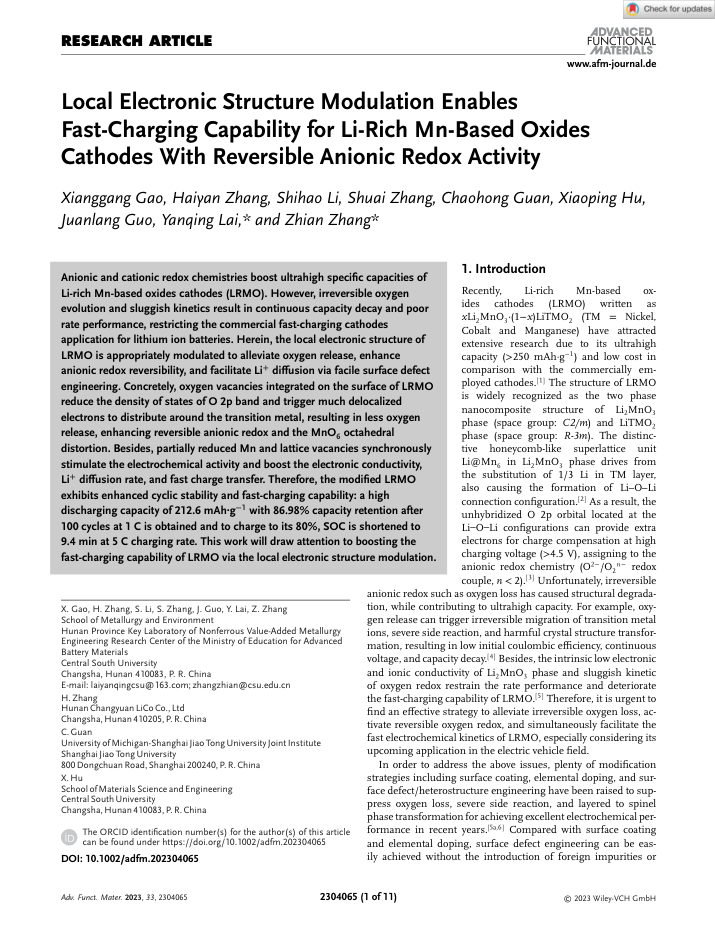
| 1 | figure | Fig. 1 | 2 | direct_caption_ref | 0.82 | [54.14, 76.62, 481.6, 302.21] | Figure 1. Schematic of surface defect engineering and the transformation of surface crystal structures for LRMO materials. | ||||
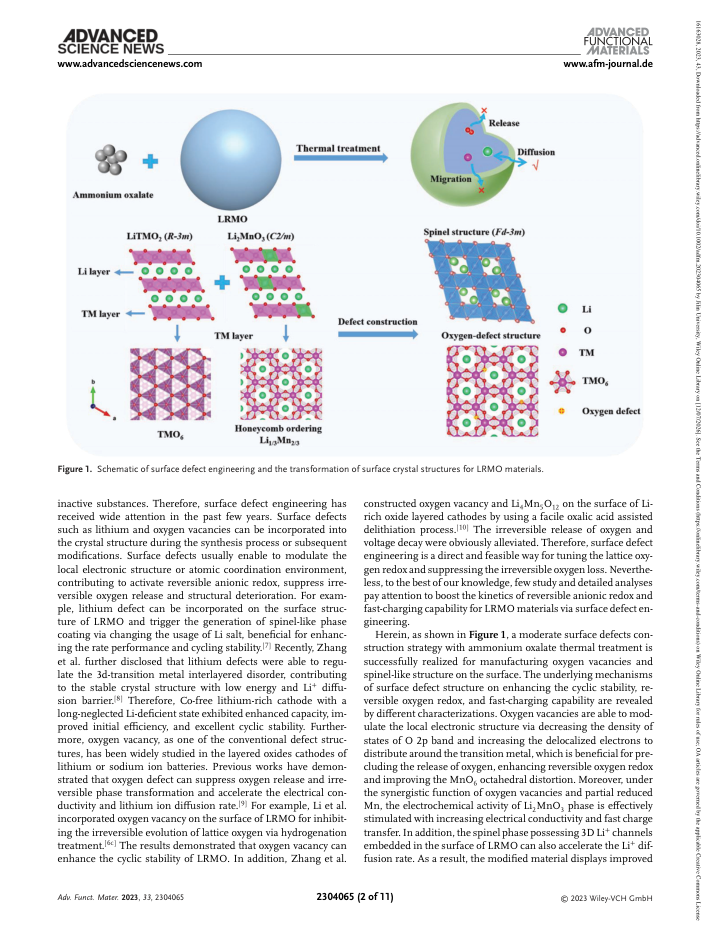
| 2 | figure | Fig. 2 | 3 | nearby_text_caption | 0.82 | [53.64, 80.01, 490.61, 487.63] | Figure 2. a) The XRD patterns of P0 and NHCO-5 samples with the enlarged images of (003), (101), and (104) peaks, respectively. Refined XRD data of b) P0 and c) NHCO-5. Raman spectra of d) P0 and e) NHCO-5. The TEM and HRTEM images of f,g) P0 and h,i) NHCO-5. j) STEM-EDS mapping of Ni, Co, Mn, and O elements of NHCO-5 samples. | ||||
| 3 | figure | Fig. 3 | 5 | nearby_text_caption | 0.82 | [53.61, 79.67, 489.62, 396.64] | Figure 3. High-resolution XPS spectra of O 1s for a) P0 and b) NHCO-5. c) EPR spectra of P0 and NHCO-5. d) Normalized O K-edge sXAS spectra of P0 and NHCO-5. The XPS spectra of Mn 2p for e) P0 and f) NHCO-5. g) The XPS spectra of Mn 3s for P0, NHCO-3, NHCO-5, and NHCO-8. | ||||
| 4 | figure | Fig. 4 | 6 | nearby_text_caption | 0.82 | [51.31, 79.48, 489.57, 393.16] | Figure 4. The electrochemical performance of P0 and NHCO-5 electrodes: charge-discharge curves of a) P0 electrode and b) NHCO-5 electrode. c) The rate performance. d) Cycling performance. The initial charge and discharge curves at e) 3 C and f) 5 C fast charging rate after three cycle activation. g) Constant current and voltage of charging capacity obtained from the 1st, 50th, and 100th at 5 C charging rate. h) Charging SOC versus time curves at 3 C and 5 C. i) Cycling performance at 5 C charging rate and 1 C discharge rate. | ||||
| 5 | figure | Fig. 5 | 7 | nearby_text_caption | 0.82 | [53.93, 77.04, 489.51, 474.51] | Figure 5. The O 1s XPS spectra at different charging/discharging states of a) P0 electrode and b) NHCO-5 electrode. The normalized O pre K-edge and Mn pre L-edge XAS spectra for c,e) P0 electrode and d,f) NHCO-5 electrode. Ex situ XRD patterns of g) P0 electrode and h) NHCO-5 electrode in the initial cyclic process. Density of states of the i) P0 and j) NHCO-5 sample. Maps of ELF for the k) P0 and l) NHCO-5; circles show there are more delocalized electrons around the transition metal. | ||||
| 6 | figure | Fig. 6 | 9 | direct_caption_ref | 0.82 | [52.66, 77.52, 493.42, 389.48] | Figure 6. The analysis of P0 and NHCO-5 electrodes after 200 cycles: a) The comparison of XRD pattern. b) Raman spectra. The SEM images of c) P0 and e) NHCO-5. HRTEM images of d) P0 and f) NHCO-5. g) The schematic of the crystal structure deterioration for P0 electrode. |
| risk | page | order | label | role | reason | parser reason | production usage | trunc | body region | region | bg | bbox | raw text | cleaned text |
|---|---|---|---|---|---|---|---|---|---|---|---|---|---|---|
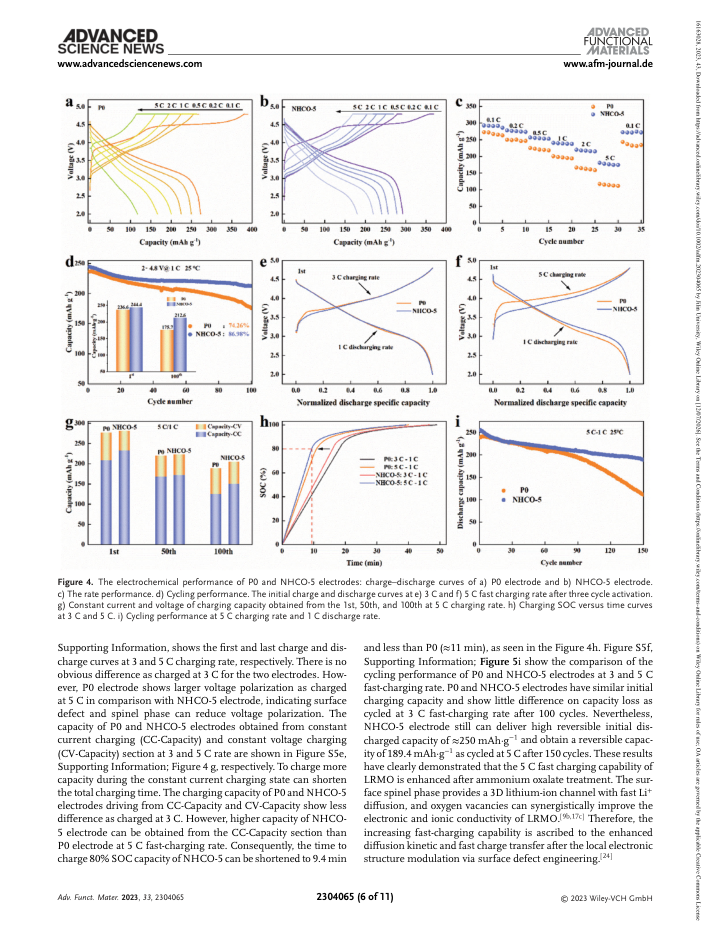
| medium | 6 | 79 | text | body_candidate_excluded | after_back_matter_stop | after_back_matter_stop | after_stop | p6:body_region:1 | p6:bottom_margin:column_2_of_2:white | [255, 255, 255] white | [303.09, 536.61, 240.96, 183.78] | and less than P0 ( ≈ 11 min), as seen in the Figure 4h. Figure S5f, Supporting Information; Figure 5 i show the comparison of the cycling performance of P0 and NHCO-5 electrodes at 3 and 5 C fast-charging rate. P0 and NHCO-5 electrodes have similar initial charging capacity and show little difference on capacity loss as cycled at 3 C fast-charging rate after 100 cycles. Nevertheless, NHCO-5 electrode still can deliver high reversible initial discharged capacity of ≈ 250 mAh · g -1 and obtain a reversible capacity of 189.4 mAh · g -1 as cycled at 5 C after 150 cycles. These results have clearly demonstrated that the 5 C fast charging capability of LRMOis enhanced after ammonium oxalate treatment. The surface spinel phase provides a 3D lithium-ion channel with fast Li + diffusion, and oxygen vacancies can synergistically improve the electronic and ionic conductivity of LRMO. [9b,17c] Therefore, the increasing fast-charging capability is ascribed to the enhanced diffusion kinetic and fast charge transfer after the local electronic structure modulation via surface defect engineering. [ 24] | and less than P0 ( ≈ 11 min), as seen in the Figure 4h. Figure S5f, Supporting Information; Figure 5 i show the comparison of the cycling performance of P0 and NHCO-5 electrodes at 3 and 5 C fast-charging rate. P0 and NHCO-5 electrodes have similar initial charging capacity and show little difference on capacity loss as cycled at 3 C fast-charging rate after 100 cycles. Nevertheless, NHCO-5 electrode still can deliver high reversible initial discharged capacity of ≈ 250 mAh · g -1 and obtain a reversible capacity of 189.4 mAh · g -1 as cycled at 5 C after 150 cycles. These results have clearly demonstrated that the 5 C fast charging capability of LRMOis enhanced after ammonium oxalate treatment. The surface spinel phase provides a 3D lithium-ion channel with fast Li + diffusion, and oxygen vacancies can synergistically improve the electronic and ionic conductivity of LRMO. [9b,17c] Therefore, the increasing fast-charging capability is ascribed to the enhanced diffusion kinetic and fast charge transfer after the local electronic structure modulation via surface defect engineering. [ 24] | |
| medium | 7 | 86 | text | body_candidate_excluded | after_back_matter_stop | after_back_matter_stop | after_stop | p7:body_region:0 | p7:bottom_margin:column_1_of_2:white | [255, 255, 255] white | [50.81, 624.27, 240.97, 96.11] | As far as mechanisms of the improved rate performance and fast-charging capability are concerned, previous reports have demonstrated that oxygen redox chemistry results in sluggish kinetics with low Li + diffusion rate and high charge-transfer resistance. [ 5c,25] Therefore, tuning anionic redox chemistry plays a vital role in raising the electrochemical performance with excellent fast-charging capability. EIS and the GITT were employed to measure the kinetic variation before and after the electronic structure modulation. Figure S6a, Supporting Information | As far as mechanisms of the improved rate performance and fast-charging capability are concerned, previous reports have demonstrated that oxygen redox chemistry results in sluggish kinetics with low Li + diffusion rate and high charge-transfer resistance. [ 5c,25] Therefore, tuning anionic redox chemistry plays a vital role in raising the electrochemical performance with excellent fast-charging capability. EIS and the GITT were employed to measure the kinetic variation before and after the electronic structure modulation. Figure S6a, Supporting Information | |
| medium | 7 | 88 | text | body_candidate_excluded | after_back_matter_stop | after_back_matter_stop | after_stop | p7:body_region:1 | p7:bottom_margin:column_2_of_2:white | [255, 255, 255] white | [305.92, 624.27, 240.96, 96.11] | shows the EIS Nyquist plots of P0 and NHCO-5 electrodes before electrochemical cycles. All the curves include three regions. Asmall interrupt in the high frequency represents the Ohmic resistance ( R s ) of the cell. One semicircle in the middle-high frequency represents the charge transfer resistance ( R ct ). A sloping line in the low-frequency regions represents the Warburg impedance ( W ). [ 10] The related fitting parameters are listed in Table S2, Supporting Information. The R ct of NHCO-5 is 7.525 Ω smaller than P0 (9.660 Ω ), demonstrating a low charge transfer | shows the EIS Nyquist plots of P0 and NHCO-5 electrodes before electrochemical cycles. All the curves include three regions. Asmall interrupt in the high frequency represents the Ohmic resistance ( R s ) of the cell. One semicircle in the middle-high frequency represents the charge transfer resistance ( R ct ). A sloping line in the low-frequency regions represents the Warburg impedance ( W ). [ 10] The related fitting parameters are listed in Table S2, Supporting Information. The R ct of NHCO-5 is 7.525 Ω smaller than P0 (9.660 Ω ), demonstrating a low charge transfer | |
| medium | 8 | 92 | text | body_candidate_excluded | after_back_matter_stop | after_back_matter_stop | after_stop | p8:body_region:0 | p8:page_body:column_1_of_2:white | [255, 255, 255] white | [47.97, 76.43, 240.96, 172.83] | impedance of NHCO-5 with surface defect construction. [17c] The GITT measurement is also conducted to compare the kinetic performance of P0 and NHCO-5 electrodes after five cycles at 0.04 C (Figure S6b, Supporting Information). Figure S6c,d, Supporting Information, show the calculated D Li + of the charging and discharging process according to the Equation (S2), Supporting Information. The D Li + of the NHCO-5 electrode in 'sluggish kinetic region' ( < 3.5 V and > 4.0 V) is increased in comparison with P0. The average D Li + of NHCO-5 electrode in 'sluggish kinetic region' is 8.70 × 10 -10 cm 2 s -1 and 6.40 × 10 -10 cm 2 s -1 during charging process and discharging process respectively, which is larger than the values of 5.97 × 10 -10 cm 2 s -1 and4.56 × 10 -10 cm 2 s -1 for P0 electrode. The improved lithium diffusion rate and fast charge transfer, ascribing to the local electronic structure modulation, result in boosting the rate performance and fast-charging capability of LRMO. | impedance of NHCO-5 with surface defect construction. [17c] The GITT measurement is also conducted to compare the kinetic performance of P0 and NHCO-5 electrodes after five cycles at 0.04 C (Figure S6b, Supporting Information). Figure S6c,d, Supporting Information, show the calculated D Li + of the charging and discharging process according to the Equation (S2), Supporting Information. The D Li + of the NHCO-5 electrode in 'sluggish kinetic region' ( < 3.5 V and > 4.0 V) is increased in comparison with P0. The average D Li + of NHCO-5 electrode in 'sluggish kinetic region' is 8.70 × 10 -10 cm 2 s -1 and 6.40 × 10 -10 cm 2 s -1 during charging process and discharging process respectively, which is larger than the values of 5.97 × 10 -10 cm 2 s -1 and4.56 × 10 -10 cm 2 s -1 for P0 electrode. The improved lithium diffusion rate and fast charge transfer, ascribing to the local electronic structure modulation, result in boosting the rate performance and fast-charging capability of LRMO. | |
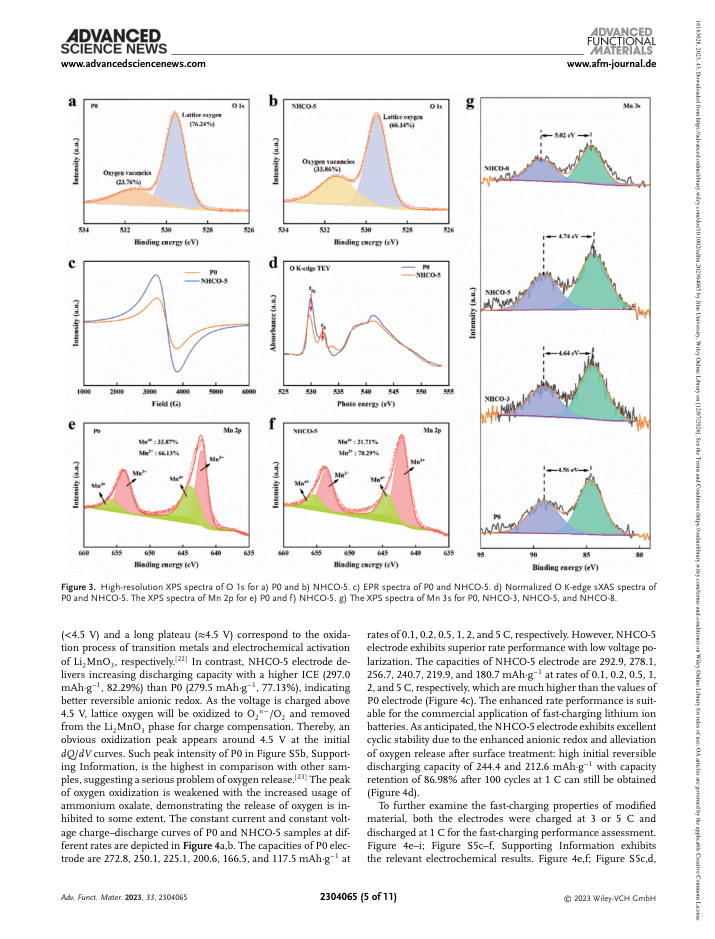
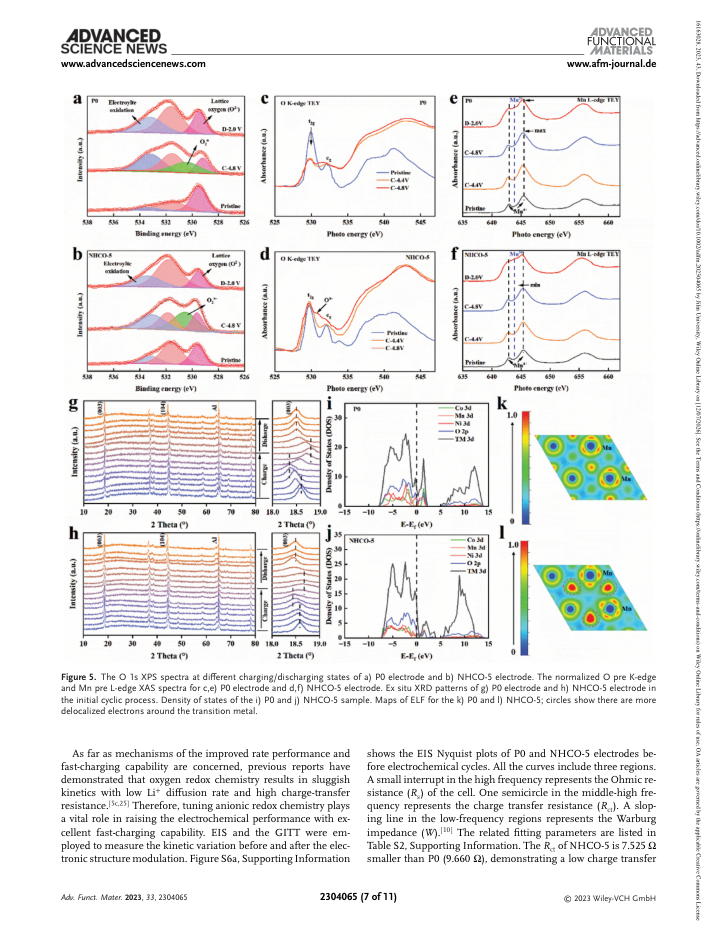
| medium | 8 | 93 | text | body_candidate_excluded | after_back_matter_stop | after_back_matter_stop | after_stop | p8:body_region:0 | p8:bottom_margin:column_1_of_2:white | [255, 255, 255] white | [47.97, 251.77, 240.97, 468.71] | The O 1s XPS spectra of P0 and NHCO-5 electrodes at charging and discharging state in the first cycle are conducted for exploring the mechanisms of oxygen redox (Figure 5a,b). Three obvious peaks appearing at ≈ 529.5, ≈ 531.9, and ≈ 533.2 eV contributing to the lattice oxygen, oxygenated deposited species, and weak electrolyte oxidation, respectively, whether in the charging state of 4.8 V or discharging state 2.0 V, can be found. [ 26] However, an additional peak at ≈ 530.5 eV appears in both the XPS spectra of P0 and NHCO-5 electrodes at the charging state of 4.8 V, contributing to the preoxo-like O 2 n -( n < 2) with a lower electronic density in comparison with lattice oxygen (O 2 -). [ 9a] Nevertheless, compared with P0 electrode, the larger area ratio of O 2 n -peak in NHCO-5 electrode indicates more reversible anionic redox participation in charge compensation. It is worth noting that the increasing content of electrolyte oxides at 4.8 V for both P0 and NHCO-5 electrodes can be ascribed to the side reaction and decomposition of electrolyte at high voltage. [ 27] The disappearance of the preoxo-like O 2 n -peak after discharging to 2.0 V indicates the O 2 n -can convert back to O 2 -. [ 28] These results perfectly demonstrate that the existence of oxygen vacancies in the NHCO5 electrode can greatly stimulate the reversible anionic redox activity. In addition, soft X-ray absorption spectroscopy (sXAS) can prove the reversible oxygen redox and irreversible oxygen release. The total d electronic holes in the hybridized O 2p-TM 3d can be reflected in the pre-edge peaks of O K-edge spectra at ≈ 530 eV. The pre-edge peak of P0 electrode largely reduces during charging process, which may be ascribed to the Mn reduction resulting from oxygen loss (Figure 5c). Previous works have proved that the oxidation of lattice oxygen can trigger the charge transfer from oxygen to TM with release of oxygen. [ 29] The decreasing density of electronic holes in O 2p-Mn 3d due to the reduction of Mn can weaken the O k-edge pre-edge peaks. However, the intensity of pre-edge peaks for charged NHCO-5 electrode shows no obvious changes in comparison with the initial state, indicating the inhibition of oxygen release (Figure 5d). Besides, a new peak located at around 530.5 eV in NHCO-5 electrode is speculated to be the characteristic peak of reversible anionic redox (O 2 -to O 2 n -), conforming to the results of XPS. [5b] Figure 5e,f shows the Mn L-edge XAS spectra at different states for P0 and NHCO-5electrodes. Compared with NHCO-5 electrode, the peak at around 646.5 eV contributes to Mn 4 + for P0 electrode shifts more to low energy, indicating the reduction of Mn due to the irreversible oxygen release. [ 19] Therefore, both the XPS and XAS | The O 1s XPS spectra of P0 and NHCO-5 electrodes at charging and discharging state in the first cycle are conducted for exploring the mechanisms of oxygen redox (Figure 5a,b). Three obvious peaks appearing at ≈ 529.5, ≈ 531.9, and ≈ 533.2 eV contributing to the lattice oxygen, oxygenated deposited species, and weak electrolyte oxidation, respectively, whether in the charging state of 4.8 V or discharging state 2.0 V, can be found. [ 26] However, an additional peak at ≈ 530.5 eV appears in both the XPS spectra of P0 and NHCO-5 electrodes at the charging state of 4.8 V, contributing to the preoxo-like O 2 n -( n < 2) with a lower electronic density in comparison with lattice oxygen (O 2 -). [ 9a] Nevertheless, compared with P0 electrode, the larger area ratio of O 2 n -peak in NHCO-5 electrode indicates more reversible anionic redox participation in charge compensation. It is worth noting that the increasing content of electrolyte oxides at 4.8 V for both P0 and NHCO-5 electrodes can be ascribed to the side reaction and decomposition of electrolyte at high voltage. [ 27] The disappearance of the preoxo-like O 2 n -peak after discharging to 2.0 V indicates the O 2 n -can convert back to O 2 -. [ 28] These results perfectly demonstrate that the existence of oxygen vacancies in the NHCO5 electrode can greatly stimulate the reversible anionic redox activity. In addition, soft X-ray absorption spectroscopy (sXAS) can prove the reversible oxygen redox and irreversible oxygen release. The total d electronic holes in the hybridized O 2p-TM 3d can be reflected in the pre-edge peaks of O K-edge spectra at ≈ 530 eV. The pre-edge peak of P0 electrode largely reduces during charging process, which may be ascribed to the Mn reduction resulting from oxygen loss (Figure 5c). Previous works have proved that the oxidation of lattice oxygen can trigger the charge transfer from oxygen to TM with release of oxygen. [ 29] The decreasing density of electronic holes in O 2p-Mn 3d due to the reduction of Mn can weaken the O k-edge pre-edge peaks. However, the intensity of pre-edge peaks for charged NHCO-5 electrode shows no obvious changes in comparison with the initial state, indicating the inhibition of oxygen release (Figure 5d). Besides, a new peak located at around 530.5 eV in NHCO-5 electrode is speculated to be the characteristic peak of reversible anionic redox (O 2 -to O 2 n -), conforming to the results of XPS. [5b] Figure 5e,f shows the Mn L-edge XAS spectra at different states for P0 and NHCO-5electrodes. Compared with NHCO-5 electrode, the peak at around 646.5 eV contributes to Mn 4 + for P0 electrode shifts more to low energy, indicating the reduction of Mn due to the irreversible oxygen release. [ 19] Therefore, both the XPS and XAS | |
| medium | 8 | 99 | text | body_candidate_excluded | after_back_matter_stop | after_back_matter_stop | after_stop | p8:body_region:1 | p8:bottom_margin:column_2_of_2:white | [255, 255, 255] white | [303.09, 405.2, 240.96, 315.29] | To further demonstrate and understand the influencing mechanisms of surface defect structure on the electrochemical performance, first principles calculations are conducted for studying the electronic structure of P0 and NHCO-5 according to the density functional theory method (DFT). Figure S7a,b, Supporting Information, shows the computational model, and one oxygen vacancy is chosen in the model of NHCO-5. According to this model, the density of states of O 2p and TM 3d band for P0 and NHCO-5 are first computed. Figure 5i,j shows the corresponding computational results. The obvious electron density of TM 3d and O 2p close to the Femi energy indicate that both the P0 and NHCO-5 possess good electrical conductivity. [10] Nevertheless, a careful comparison shows that the density of O 2p band of NHCO-5 decreases in comparison with P0. The decrease of O 2p density can promote lattice oxygen to participate in the charge compensation stably and preclude the oxygen loss, contributing to the enhanced reversible anionic redox. [ 31] Figure 5k,l displays the isosurface images of electron localization function (ELF), which can clearly depict the cationic charge compensation. The red and light blue regions represent the lattice electrons and active covalent electrons, respectively. The P0 show more localized electrons around the oxygen and transition metal (Figure 5k). In contrast, more delocalized electrons appear around Mn in the NHCO-5, as shown by the red dashed coil in Figure 5l. The change of the local electronic structure around the Mn ion can improve the Mn octahedral distortion reversibility and promote the reduced Mn to participate in the charge compensation. [28,32] Therefore, the surface oxygen defect can modulate the electronic structure around oxygen and Mn, resulting in not only | To further demonstrate and understand the influencing mechanisms of surface defect structure on the electrochemical performance, first principles calculations are conducted for studying the electronic structure of P0 and NHCO-5 according to the density functional theory method (DFT). Figure S7a,b, Supporting Information, shows the computational model, and one oxygen vacancy is chosen in the model of NHCO-5. According to this model, the density of states of O 2p and TM 3d band for P0 and NHCO-5 are first computed. Figure 5i,j shows the corresponding computational results. The obvious electron density of TM 3d and O 2p close to the Femi energy indicate that both the P0 and NHCO-5 possess good electrical conductivity. [10] Nevertheless, a careful comparison shows that the density of O 2p band of NHCO-5 decreases in comparison with P0. The decrease of O 2p density can promote lattice oxygen to participate in the charge compensation stably and preclude the oxygen loss, contributing to the enhanced reversible anionic redox. [ 31] Figure 5k,l displays the isosurface images of electron localization function (ELF), which can clearly depict the cationic charge compensation. The red and light blue regions represent the lattice electrons and active covalent electrons, respectively. The P0 show more localized electrons around the oxygen and transition metal (Figure 5k). In contrast, more delocalized electrons appear around Mn in the NHCO-5, as shown by the red dashed coil in Figure 5l. The change of the local electronic structure around the Mn ion can improve the Mn octahedral distortion reversibility and promote the reduced Mn to participate in the charge compensation. [28,32] Therefore, the surface oxygen defect can modulate the electronic structure around oxygen and Mn, resulting in not only | |
| medium | 9 | 106 | text | body_candidate_excluded | after_back_matter_stop | after_back_matter_stop | after_stop | p9:body_region:0 | p9:page_body:column_1_of_2:white | [255, 255, 255] white | [50.81, 514.68, 240.95, 41.32] | increasing electrical conductivity, facilitating lithium ion diffusion and fast charge transfer, but also suppressing oxygen release and promoting the charge compensation of both cationic and anionic redox. | increasing electrical conductivity, facilitating lithium ion diffusion and fast charge transfer, but also suppressing oxygen release and promoting the charge compensation of both cationic and anionic redox. | |
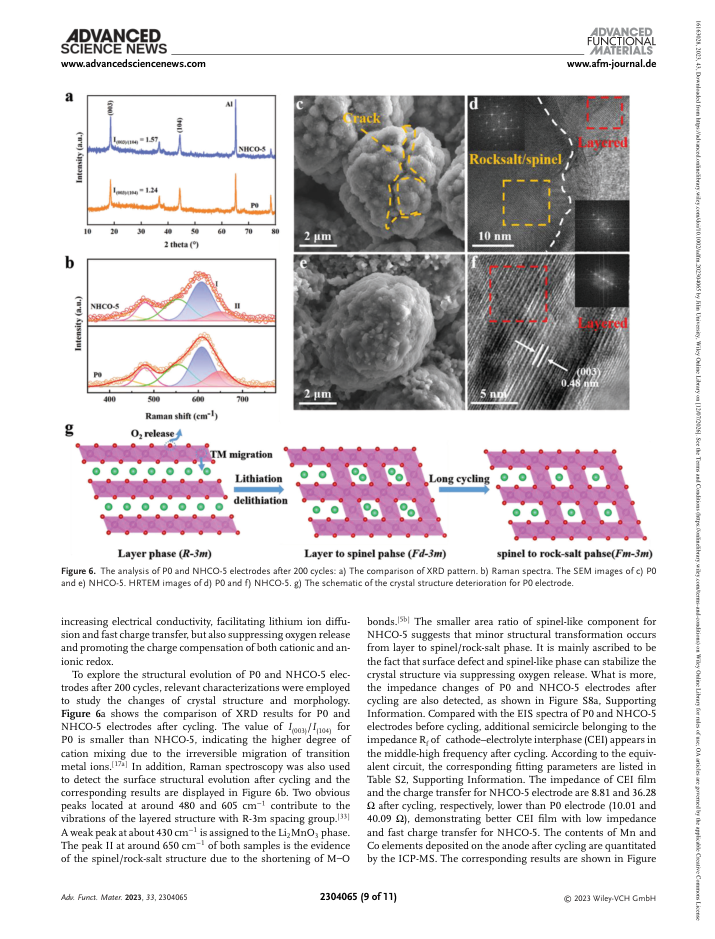
| medium | 9 | 107 | text | body_candidate_excluded | after_back_matter_stop | after_back_matter_stop | after_stop | p9:body_region:0 | p9:bottom_margin:column_1_of_2:white | [255, 255, 255] white | [50.81, 558.52, 240.96, 161.87] | To explore the structural evolution of P0 and NHCO-5 electrodes after 200 cycles, relevant characterizations were employed to study the changes of crystal structure and morphology. Figure 6 a shows the comparison of XRD results for P0 and NHCO-5 electrodes after cycling. The value of I (003) / I (104) for P0 is smaller than NHCO-5, indicating the higher degree of cation mixing due to the irreversible migration of transition metal ions. [17a] In addition, Raman spectroscopy was also used to detect the surface structural evolution after cycling and the corresponding results are displayed in Figure 6b. Two obvious peaks located at around 480 and 605 cm -1 contribute to the vibrations of the layered structure with R-3m spacing group. [ 33] Aweakpeak at about 430 cm -1 is assigned to the Li 2 MnO3 phase. The peak II at around 650 cm -1 of both samples is the evidence of the spinel/rock-salt structure due to the shortening of M-O | To explore the structural evolution of P0 and NHCO-5 electrodes after 200 cycles, relevant characterizations were employed to study the changes of crystal structure and morphology. Figure 6 a shows the comparison of XRD results for P0 and NHCO-5 electrodes after cycling. The value of I (003) / I (104) for P0 is smaller than NHCO-5, indicating the higher degree of cation mixing due to the irreversible migration of transition metal ions. [17a] In addition, Raman spectroscopy was also used to detect the surface structural evolution after cycling and the corresponding results are displayed in Figure 6b. Two obvious peaks located at around 480 and 605 cm -1 contribute to the vibrations of the layered structure with R-3m spacing group. [ 33] Aweakpeak at about 430 cm -1 is assigned to the Li 2 MnO3 phase. The peak II at around 650 cm -1 of both samples is the evidence of the spinel/rock-salt structure due to the shortening of M-O | |
| medium | 9 | 109 | text | body_candidate_excluded | after_back_matter_stop | after_back_matter_stop | after_stop | p9:body_region:1 | p9:bottom_margin:column_2_of_2:white | [255, 255, 255] white | [305.92, 513.64, 240.97, 206.75] | bonds. [5b] The smaller area ratio of spinel-like component for NHCO-5 suggests that minor structural transformation occurs from layer to spinel/rock-salt phase. It is mainly ascribed to be the fact that surface defect and spinel-like phase can stabilize the crystal structure via suppressing oxygen release. What is more, the impedance changes of P0 and NHCO-5 electrodes after cycling are also detected, as shown in Figure S8a, Supporting Information. Compared with the EIS spectra of P0 and NHCO-5 electrodes before cycling, additional semicircle belonging to the impedance R f of cathode-electrolyte interphase (CEI) appears in the middle-high frequency after cycling. According to the equivalent circuit, the corresponding fitting parameters are listed in Table S2, Supporting Information. The impedance of CEI film and the charge transfer for NHCO-5 electrode are 8.81 and 36.28 Ω after cycling, respectively, lower than P0 electrode (10.01 and 40.09 Ω ), demonstrating better CEI film with low impedance and fast charge transfer for NHCO-5. The contents of Mn and Co elements deposited on the anode after cycling are quantitated by the ICP-MS. The corresponding results are shown in Figure | bonds. [5b] The smaller area ratio of spinel-like component for NHCO-5 suggests that minor structural transformation occurs from layer to spinel/rock-salt phase. It is mainly ascribed to be the fact that surface defect and spinel-like phase can stabilize the crystal structure via suppressing oxygen release. What is more, the impedance changes of P0 and NHCO-5 electrodes after cycling are also detected, as shown in Figure S8a, Supporting Information. Compared with the EIS spectra of P0 and NHCO-5 electrodes before cycling, additional semicircle belonging to the impedance R f of cathode-electrolyte interphase (CEI) appears in the middle-high frequency after cycling. According to the equivalent circuit, the corresponding fitting parameters are listed in Table S2, Supporting Information. The impedance of CEI film and the charge transfer for NHCO-5 electrode are 8.81 and 36.28 Ω after cycling, respectively, lower than P0 electrode (10.01 and 40.09 Ω ), demonstrating better CEI film with low impedance and fast charge transfer for NHCO-5. The contents of Mn and Co elements deposited on the anode after cycling are quantitated by the ICP-MS. The corresponding results are shown in Figure | |
| medium | 10 | 113 | text | body_candidate_excluded | after_back_matter_stop | after_back_matter_stop | after_stop | p10:body_region:0 | p10:front_matter:column_1_of_2:white | [255, 255, 255] white | [47.97, 76.43, 240.96, 337.21] | S8b, Supporting Information. Both P0 and NHCO-5 show the high content of Mn in comparison with Co, which demonstrates that Mn dissolves in the electrolyte more easily. In addition, the dissolution content of Mn and Co for the NHCO-5 electrode shows to be less than P0 electrode, indicating oxygen vacancies and integrated spinel-like phase can reduce the side reaction and dissolution of transition metals. SEM images of the cycled P0 and NHCO-5 electrodes are shown in Figures 6c,e, respectively. An obvious crack can be observed on the surface of P0 electrode, which is the result of continuing oxygen release, the formation of microscopic defects, and electrolyte corrosion. [ 34] In contrast, the NCHO-5 electrode still shows intact morphology. Enlarged TEM images of the P0 and NHCO-5 electrodes are shown in Figures 6d,f, respectively. The surface of P0 shows a mixed phase of layered phase (red box) and disorder rock-salt phase (Yellow box), which can be proved by the FFT images. The appearance of disordered rock-salt structure demonstrates the irreversible structural deterioration: first, the layered structure ( R-3m ) transforms to spinel-like phase ( Fd-3m ) and last, to inactive rock-salt phase ( Fm-3m ). This structural transformation occurs from the surface to bulk as shown in Figure 6g. Previous studies have proved that the irreversible lattice oxygen release and migration of transition metal ions mainly cause the structure deterioration and degradation of electrochemical performance. [35] In contrast, the clear lattice fringe of NHCO-5 electrode, corresponding to the (003) facet of R3m space structure, directly demonstrates the relatively intact layered structure after cycling. These results indicate the surface defect can suppress irreversible oxygen release, migration, and dissolution of transition metals and alleviate the side reaction for stabilizing the structure of LRMO. | S8b, Supporting Information. Both P0 and NHCO-5 show the high content of Mn in comparison with Co, which demonstrates that Mn dissolves in the electrolyte more easily. In addition, the dissolution content of Mn and Co for the NHCO-5 electrode shows to be less than P0 electrode, indicating oxygen vacancies and integrated spinel-like phase can reduce the side reaction and dissolution of transition metals. SEM images of the cycled P0 and NHCO-5 electrodes are shown in Figures 6c,e, respectively. An obvious crack can be observed on the surface of P0 electrode, which is the result of continuing oxygen release, the formation of microscopic defects, and electrolyte corrosion. [ 34] In contrast, the NCHO-5 electrode still shows intact morphology. Enlarged TEM images of the P0 and NHCO-5 electrodes are shown in Figures 6d,f, respectively. The surface of P0 shows a mixed phase of layered phase (red box) and disorder rock-salt phase (Yellow box), which can be proved by the FFT images. The appearance of disordered rock-salt structure demonstrates the irreversible structural deterioration: first, the layered structure ( R-3m ) transforms to spinel-like phase ( Fd-3m ) and last, to inactive rock-salt phase ( Fm-3m ). This structural transformation occurs from the surface to bulk as shown in Figure 6g. Previous studies have proved that the irreversible lattice oxygen release and migration of transition metal ions mainly cause the structure deterioration and degradation of electrochemical performance. [35] In contrast, the clear lattice fringe of NHCO-5 electrode, corresponding to the (003) facet of R3m space structure, directly demonstrates the relatively intact layered structure after cycling. These results indicate the surface defect can suppress irreversible oxygen release, migration, and dissolution of transition metals and alleviate the side reaction for stabilizing the structure of LRMO. | |
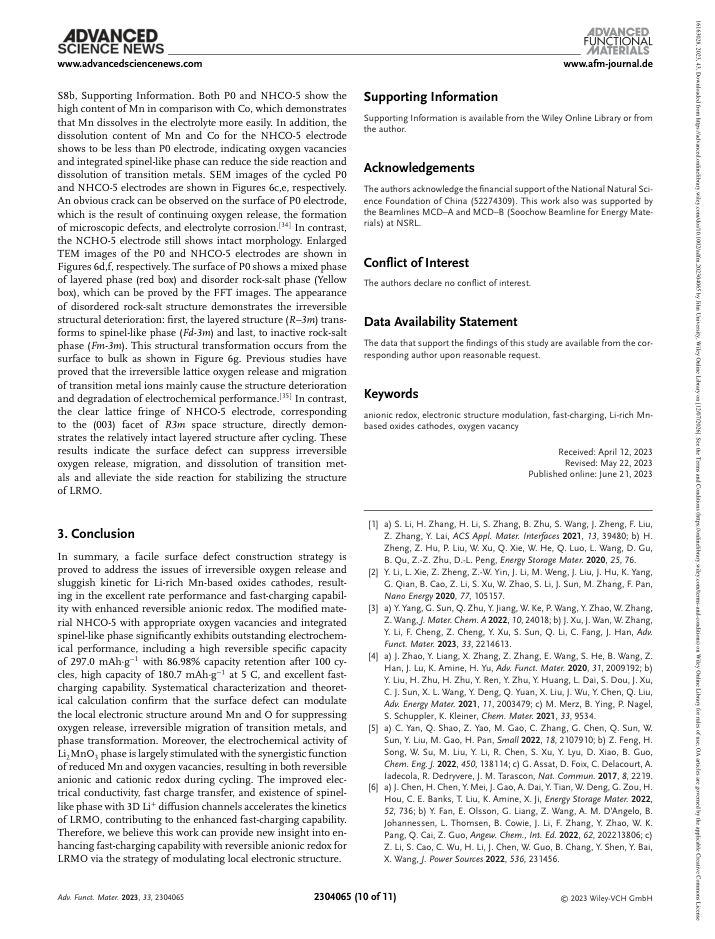
| medium | 10 | 115 | text | body_candidate_excluded | after_back_matter_stop | after_back_matter_stop | after_stop | p10:body_region:0 | p10:bottom_margin:column_1_of_2:white | [255, 255, 255] white | [47.98, 460.19, 240.95, 260.51] | In summary, a facile surface defect construction strategy is proved to address the issues of irreversible oxygen release and sluggish kinetic for Li-rich Mn-based oxides cathodes, resulting in the excellent rate performance and fast-charging capability with enhanced reversible anionic redox. The modified material NHCO-5 with appropriate oxygen vacancies and integrated spinel-like phase significantly exhibits outstanding electrochemical performance, including a high reversible specific capacity of 297.0 mAh · g -1 with 86.98% capacity retention after 100 cycles, high capacity of 180.7 mAh · g -1 at 5 C, and excellent fastcharging capability. Systematical characterization and theoretical calculation confirm that the surface defect can modulate the local electronic structure around Mn and O for suppressing oxygen release, irreversible migration of transition metals, and phase transformation. Moreover, the electrochemical activity of Li 2 MnO3 phase is largely stimulated with the synergistic function of reduced Mn and oxygen vacancies, resulting in both reversible anionic and cationic redox during cycling. The improved electrical conductivity, fast charge transfer, and existence of spinellike phase with 3D Li + diffusion channels accelerates the kinetics of LRMO, contributing to the enhanced fast-charging capability. Therefore, we believe this work can provide new insight into enhancing fast-charging capability with reversible anionic redox for LRMO via the strategy of modulating local electronic structure. | In summary, a facile surface defect construction strategy is proved to address the issues of irreversible oxygen release and sluggish kinetic for Li-rich Mn-based oxides cathodes, resulting in the excellent rate performance and fast-charging capability with enhanced reversible anionic redox. The modified material NHCO-5 with appropriate oxygen vacancies and integrated spinel-like phase significantly exhibits outstanding electrochemical performance, including a high reversible specific capacity of 297.0 mAh · g -1 with 86.98% capacity retention after 100 cycles, high capacity of 180.7 mAh · g -1 at 5 C, and excellent fastcharging capability. Systematical characterization and theoretical calculation confirm that the surface defect can modulate the local electronic structure around Mn and O for suppressing oxygen release, irreversible migration of transition metals, and phase transformation. Moreover, the electrochemical activity of Li 2 MnO3 phase is largely stimulated with the synergistic function of reduced Mn and oxygen vacancies, resulting in both reversible anionic and cationic redox during cycling. The improved electrical conductivity, fast charge transfer, and existence of spinellike phase with 3D Li + diffusion channels accelerates the kinetics of LRMO, contributing to the enhanced fast-charging capability. Therefore, we believe this work can provide new insight into enhancing fast-charging capability with reversible anionic redox for LRMO via the strategy of modulating local electronic structure. | |
| low | 1 | 0 | page_header | page_header | document_ui | document_ui | p1:body_region:0 | p1:top_margin:column_1_of_2:white | [255, 255, 255] white | [50.81, 28.94, 126.19, 12.11] | RESEARCH ARTICLE | RESEARCH ARTICLE | ||
| low | 1 | 1 | text | page_margin_header | document_web_address | document_web_address | p1:body_region:1 | p1:top_margin:column_2_of_2:white | [255, 255, 255] white | [472.46, 49.98, 74.39, 8.02] | www.afm-journal.de | |||
| low | 1 | 2 | section_header | title_candidate | first_page_front_matter_heading | first_page_front_matter_heading | p1:body_region:0 | p1:front_matter:column_1_of_2:white | [255, 255, 255] white | [50.81, 77.5, 441.13, 63.65] | Local Electronic Structure Modulation Enables Fast-Charging Capability for Li-Rich Mn-Based Oxides Cathodes With Reversible Anionic Redox Activity | Local Electronic Structure Modulation Enables Fast-Charging Capability for Li-Rich Mn-Based Oxides Cathodes With Reversible Anionic Redox Activity | ||
| low | 1 | 3 | text | affiliation | first_page_author_or_affiliation | first_page_author_or_affiliation | p1:body_region:0 | p1:front_matter:column_1_of_2:white | [255, 255, 255] white | [50.81, 160.21, 487.97, 30.54] | Xianggang Gao, Haiyan Zhang, Shihao Li, Shuai Zhang, Chaohong Guan, Xiaoping Hu, Juanlang Guo, Yanqing Lai,* and Zhian Zhang* | Xianggang Gao, Haiyan Zhang, Shihao Li, Shuai Zhang, Chaohong Guan, Xiaoping Hu, Juanlang Guo, Yanqing Lai,* and Zhian Zhang* | ||
| low | 1 | 6 | text | affiliation | affiliation_block | affiliation_block | p1:body_region:0 | p1:body_zone:column_1_of_2:white | [255, 255, 255] white | [50.81, 513.78, 127.19, 7.2] | School of Metallurgy and Environment | School of Metallurgy and Environment | ||
| low | 1 | 7 | text | affiliation | affiliation_block | affiliation_block | p1:body_region:0 | p1:body_zone:column_1_of_2:white | [255, 255, 255] white | [50.81, 522.75, 234.43, 25.14] | Hunan Province Key Laboratory of Nonferrous Value-Added Metallurgy Engineering Research Center of the Ministry of Education for Advanced Battery Materials | Hunan Province Key Laboratory of Nonferrous Value-Added Metallurgy Engineering Research Center of the Ministry of Education for Advanced Battery Materials | ||
| low | 1 | 8 | text | affiliation | affiliation_block | affiliation_block | p1:body_region:0 | p1:body_zone:column_1_of_2:white | [255, 255, 255] white | [50.81, 549.65, 80.2, 7.2] | Central South University | Central South University | ||
| low | 1 | 10 | text | metadata | first_page_metadata | first_page_metadata | p1:body_region:0 | p1:body_zone:column_1_of_2:white | [255, 255, 255] white | [50.81, 567.58, 191.32, 7.2] | E-mail: laiyanqingcsu@163.com; zhangzhian@csu.edu.cn | E-mail: laiyanqingcsu@163.com; zhangzhian@csu.edu.cn | ||
| low | 1 | 11 | text | metadata | document_web_address | document_web_address | p1:body_region:0 | p1:body_zone:column_1_of_2:white | [255, 255, 255] white | [50.81, 578.54, 30.54, 7.2] | H.Zhang | H.Zhang | ||
| low | 1 | 13 | text | affiliation | contextual_affiliation_fragment | contextual_affiliation_fragment | p1:body_region:0 | p1:body_zone:column_1_of_2:white | [255, 255, 255] white | [50.81, 596.47, 121.28, 7.2] | Changsha,Hunan410205,P.R.China | Changsha,Hunan410205,P.R.China | ||
| low | 1 | 14 | text | affiliation | contextual_affiliation_fragment | contextual_affiliation_fragment | p1:body_region:0 | p1:body_zone:column_1_of_2:white | [255, 255, 255] white | [50.81, 607.44, 26.12, 7.2] | C. Guan | C. Guan | ||
| low | 1 | 15 | text | affiliation | affiliation_block | affiliation_block | p1:body_region:0 | p1:body_zone:column_1_of_2:white | [255, 255, 255] white | [50.81, 616.4, 216.68, 7.2] | University of Michigan-Shanghai Jiao Tong University Joint Institute | University of Michigan-Shanghai Jiao Tong University Joint Institute | ||
| low | 1 | 17 | text | affiliation | contextual_affiliation_fragment | contextual_affiliation_fragment | p1:body_region:0 | p1:body_zone:column_1_of_2:white | [255, 255, 255] white | [50.81, 634.33, 166.08, 7.2] | 800DongchuanRoad,Shanghai200240,P.R.China | 800DongchuanRoad,Shanghai200240,P.R.China | ||
| low | 1 | 18 | text | affiliation | contextual_affiliation_fragment | contextual_affiliation_fragment | p1:body_region:0 | p1:body_zone:column_1_of_2:white | [255, 255, 255] white | [50.81, 645.29, 18.22, 7.2] | X. Hu | X. Hu | ||
| low | 1 | 20 | text | affiliation | affiliation_block | affiliation_block | p1:body_region:0 | p1:body_zone:column_1_of_2:white | [255, 255, 255] white | [50.81, 663.23, 78.63, 7.2] | Central South University | Central South University | ||
| low | 1 | 21 | text | affiliation | contextual_affiliation_fragment | contextual_affiliation_fragment | p1:body_region:0 | p1:body_zone:column_1_of_2:white | [255, 255, 255] white | [50.81, 672.19, 121.28, 7.2] | Changsha,Hunan410083,P.R.China | Changsha,Hunan410083,P.R.China | ||
| low | 1 | 22 | text | metadata | first_page_metadata | first_page_metadata | p1:body_region:0 | p1:body_zone:column_1_of_2:white | [255, 255, 255] white | [68.79, 690.25, 222.97, 16.17] | The ORCID identification number(s) for the author(s) of this article can be found under https://doi.org/10.1002/adfm.202304065 | The ORCID identification number(s) for the author(s) of this article can be found under | ||
| low | 1 | 23 | text | page_margin_footer | first_page_metadata | first_page_metadata | p1:body_region:0 | p1:bottom_margin:column_1_of_2:white | [255, 255, 255] white | [50.81, 712.5, 114.86, 8.02] | DOI: 10.1002/adfm.202304065 | DOI: 10.1002/adfm.202304065 | ||
| low | 1 | 24 | page_footer | page_footer | outside_body_flow_page_footer | outside_body_flow_page_footer | p1:body_region:0 | p1:bottom_margin:column_1_of_2:white | [255, 255, 255] white | [50.81, 745.71, 105.61, 6.3] | Adv. Funct. Mater. 2023 , 33 , 2304065 | Adv. Funct. Mater. 2023 , 33 , 2304065 | ||
| low | 1 | 25 | section_header | body_heading | body_heading | body_heading | p1:body_region:1 | p1:body_zone:column_2_of_2:white | [255, 255, 255] white | [384.63, 219.54, 70.41, 10.25] | 1. Introduction | 1. Introduction | ||
| low | 1 | 29 | page_footer | page_footer | docling_page_footer | docling_page_footer | p1:body_region:0 | p1:bottom_margin:column_2_of_2:white | [255, 255, 255] white | [266.69, 744.38, 64.3, 8.02] | 2304065 (1 of 11) | 2304065 (1 of 11) | ||
| low | 1 | 30 | page_footer | page_footer | first_page_metadata | first_page_metadata | p1:body_region:1 | p1:bottom_margin:column_2_of_2:white | [255, 255, 255] white | [469.66, 745.82, 77.21, 6.3] | ©2023 Wiley-VCH GmbH | ©2023 Wiley-VCH GmbH | ||
| low | 2 | 31 | text | page_margin_header | page_margin_header | page_margin_header | p2:top_margin:column_1_of_2:white | [255, 255, 255] white | [47.98, 50.12, 120.78, 8.02] | www.advancedsciencenews.com | ||||
| low | 2 | 32 | caption | caption | outside_body_flow_caption | outside_body_flow_caption | p2:page_body:column_1_of_2:white | [255, 255, 255] white | [47.98, 388.13, 405.37, 7.2] | Figure 1. Schematic of surface defect engineering and the transformation of surface crystal structures for LRMO materials. | Figure 1. Schematic of surface defect engineering and the transformation of surface crystal structures for LRMO materials. | |||
| low | 2 | 34 | page_footer | page_footer | outside_body_flow_page_footer | outside_body_flow_page_footer | p2:bottom_margin:column_1_of_2:white | [255, 255, 255] white | [47.98, 745.71, 105.61, 6.3] | Adv. Funct. Mater. 2023 , 33 , 2304065 | Adv. Funct. Mater. 2023 , 33 , 2304065 | |||
| low | 2 | 35 | page_header | page_header | docling_page_header | docling_page_header | p2:top_margin:column_2_of_2:off_white | [246, 246, 246] off_white | [579.16, 15.65, 4.41, 751.61] | 16163028, 2023, 43, Downloaded from https://advanced.onlinelibrary.wiley.com/doi/10.1002/adfm.202304065 by Jilin University, Wiley Online Library on [12/07/2026]. See the Terms and Conditions (https://onlinelibrary.wiley.com/terms-and-conditions) on Wiley Online Library for rules of use; OA articles are governed by the applicable Creative Commons License | ||||
| low | 2 | 36 | text | page_margin_header | page_margin_header | page_margin_header | p2:body_region:0 | p2:top_margin:column_2_of_2:white | [255, 255, 255] white | [469.62, 50.12, 74.39, 8.02] | www.afm-journal.de | |||
| low | 2 | 39 | page_footer | page_footer | docling_page_footer | docling_page_footer | p2:bottom_margin:column_2_of_2:white | [255, 255, 255] white | [263.85, 744.38, 64.3, 8.02] | 2304065 (2 of 11) | 2304065 (2 of 11) | |||
| low | 2 | 40 | page_footer | page_footer | docling_page_footer | docling_page_footer | p2:body_region:0 | p2:bottom_margin:column_2_of_2:white | [255, 255, 255] white | [466.82, 745.82, 77.21, 6.3] | ©2023 Wiley-VCH GmbH | ©2023 Wiley-VCH GmbH | ||
| low | 3 | 41 | page_header | page_header | docling_page_header | docling_page_header | p3:top_margin:column_1_of_2:white | [255, 255, 255] white | [50.81, 50.12, 120.78, 8.02] | www.advancedsciencenews.com | ||||
| low | 3 | 42 | page_header | page_header | docling_page_header | docling_page_header | p3:top_margin:column_2_of_2:off_white | [246, 246, 246] off_white | [579.16, 15.65, 4.41, 751.61] | 16163028, 2023, 43, Downloaded from https://advanced.onlinelibrary.wiley.com/doi/10.1002/adfm.202304065 by Jilin University, Wiley Online Library on [12/07/2026]. See the Terms and Conditions (https://onlinelibrary.wiley.com/terms-and-conditions) on Wiley Online Library for rules of use; OA articles are governed by the applicable Creative Commons License | ||||
| low | 3 | 43 | section_header | metadata | outside_body_flow_metadata_line | outside_body_flow_metadata_line | p3:body_region:0 | p3:top_margin:column_2_of_2:white | [255, 255, 255] white | [472.46, 50.12, 74.39, 8.02] | www.afm-journal.de | |||
| low | 3 | 44 | caption | caption | outside_body_flow_caption | outside_body_flow_caption | p3:front_matter:column_1_of_2:white | [255, 255, 255] white | [50.81, 575.36, 496.07, 26.13] | Figure 2. a) The XRD patterns of P0 and NHCO-5 samples with the enlarged images of (003), (101), and (104) peaks, respectively. Refined XRD data of b) P0 and c) NHCO-5. Raman spectra of d) P0 and e) NHCO-5. The TEM and HRTEM images of f,g) P0 and h,i) NHCO-5. j) STEM-EDS mapping of Ni, Co, Mn, and O elements of NHCO-5 samples. | Figure 2. a) The XRD patterns of P0 and NHCO-5 samples with the enlarged images of (003), (101), and (104) peaks, respectively. Refined XRD data of b) P0 and c) NHCO-5. Raman spectra of d) P0 and e) NHCO-5. The TEM and HRTEM images of f,g) P0 and h,i) NHCO-5. j) STEM-EDS mapping of Ni, Co, Mn, and O elements of NHCO-5 samples. | |||
| low | 3 | 46 | section_header | body_heading | body_heading | body_heading | p3:body_zone:column_1_of_2:white | [255, 255, 255] white | [50.81, 681.93, 122.45, 10.25] | 2. Results and Discussion | 2. Results and Discussion | |||
| low | 3 | 48 | page_footer | page_footer | docling_page_footer | docling_page_footer | p3:bottom_margin:column_1_of_2:white | [255, 255, 255] white | [50.81, 745.71, 105.61, 6.3] | Adv. Funct. Mater. 2023 , 33 , 2304065 | Adv. Funct. Mater. 2023 , 33 , 2304065 | |||
| low | 3 | 50 | page_footer | page_footer | docling_page_footer | docling_page_footer | p3:bottom_margin:column_2_of_2:white | [255, 255, 255] white | [266.69, 744.38, 64.3, 8.02] | 2304065 (3 of 11) | 2304065 (3 of 11) | |||
| low | 3 | 51 | page_footer | page_footer | docling_page_footer | docling_page_footer | p3:body_region:0 | p3:bottom_margin:column_2_of_2:white | [255, 255, 255] white | [469.66, 745.82, 77.21, 6.3] | ©2023 Wiley-VCH GmbH | ©2023 Wiley-VCH GmbH | ||
| low | 4 | 52 | text | page_margin_header | page_margin_header | page_margin_header | p4:body_region:0 | p4:top_margin:column_1_of_2:white | [255, 255, 255] white | [47.98, 50.12, 120.78, 8.02] | www.advancedsciencenews.com | |||
| low | 4 | 55 | page_footer | page_footer | outside_body_flow_page_footer | outside_body_flow_page_footer | p4:body_region:0 | p4:bottom_margin:column_1_of_2:white | [255, 255, 255] white | [47.98, 745.71, 105.61, 6.3] | Adv. Funct. Mater. 2023 , 33 , 2304065 | Adv. Funct. Mater. 2023 , 33 , 2304065 | ||
| low | 4 | 56 | text | reference | empty_after_cleaning | empty_after_cleaning | p4:top_margin:column_2_of_2:off_white | [246, 246, 246] off_white | [579.16, 15.65, 4.41, 751.61] | 16163028, 2023, 43, Downloaded from https://advanced.onlinelibrary.wiley.com/doi/10.1002/adfm.202304065 by Jilin University, Wiley Online Library on [12/07/2026]. See the Terms and Conditions (https://onlinelibrary.wiley.com/terms-and-conditions) on Wiley Online Library for rules of use; OA articles are governed by the applicable Creative Commons License | ||||
| low | 4 | 57 | text | page_margin_header | page_margin_header | page_margin_header | p4:body_region:1 | p4:top_margin:column_2_of_2:white | [255, 255, 255] white | [469.62, 50.12, 74.39, 8.02] | www.afm-journal.de | |||
| low | 4 | 61 | page_footer | page_footer | docling_page_footer | docling_page_footer | p4:bottom_margin:column_2_of_2:white | [255, 255, 255] white | [263.85, 744.38, 64.3, 8.02] | 2304065 (4 of 11) | 2304065 (4 of 11) | |||
| low | 4 | 62 | page_footer | page_footer | docling_page_footer | docling_page_footer | p4:body_region:1 | p4:bottom_margin:column_2_of_2:white | [255, 255, 255] white | [466.82, 745.82, 77.21, 6.3] | ©2023 Wiley-VCH GmbH | ©2023 Wiley-VCH GmbH | ||
| low | 5 | 63 | text | page_margin_header | page_margin_header | page_margin_header | p5:body_region:0 | p5:top_margin:column_1_of_2:white | [255, 255, 255] white | [50.81, 50.12, 120.78, 8.02] | www.advancedsciencenews.com | |||
| low | 5 | 64 | page_header | page_header | docling_page_header | docling_page_header | p5:top_margin:column_2_of_2:off_white | [246, 246, 246] off_white | [579.16, 15.65, 4.41, 751.61] | 16163028, 2023, 43, Downloaded from https://advanced.onlinelibrary.wiley.com/doi/10.1002/adfm.202304065 by Jilin University, Wiley Online Library on [12/07/2026]. See the Terms and Conditions (https://onlinelibrary.wiley.com/terms-and-conditions) on Wiley Online Library for rules of use; OA articles are governed by the applicable Creative Commons License | ||||
| low | 5 | 65 | text | page_margin_header | page_margin_header | page_margin_header | p5:body_region:1 | p5:top_margin:column_2_of_2:white | [255, 255, 255] white | [472.46, 50.12, 74.39, 8.02] | www.afm-journal.de | |||
| low | 5 | 66 | caption | caption | outside_body_flow_caption | outside_body_flow_caption | p5:page_body:column_1_of_2:white | [255, 255, 255] white | [50.81, 486.36, 496.05, 16.66] | Figure 3. High-resolution XPS spectra of O 1s for a) P0 and b) NHCO-5. c) EPR spectra of P0 and NHCO-5. d) Normalized O K-edge sXAS spectra of P0 and NHCO-5. The XPS spectra of Mn 2p for e) P0 and f) NHCO-5. g) The XPS spectra of Mn 3s for P0, NHCO-3, NHCO-5, and NHCO-8. | Figure 3. High-resolution XPS spectra of O 1s for a) P0 and b) NHCO-5. c) EPR spectra of P0 and NHCO-5. d) Normalized O K-edge sXAS spectra of P0 and NHCO-5. The XPS spectra of Mn 2p for e) P0 and f) NHCO-5. g) The XPS spectra of Mn 3s for P0, NHCO-3, NHCO-5, and NHCO-8. | |||
| low | 5 | 68 | page_footer | page_footer | docling_page_footer | docling_page_footer | p5:body_region:0 | p5:bottom_margin:column_1_of_2:white | [255, 255, 255] white | [50.81, 745.71, 105.61, 6.3] | Adv. Funct. Mater. 2023 , 33 , 2304065 | Adv. Funct. Mater. 2023 , 33 , 2304065 | ||
| low | 5 | 71 | page_footer | page_footer | docling_page_footer | docling_page_footer | p5:bottom_margin:column_2_of_2:white | [255, 255, 255] white | [266.69, 744.38, 64.3, 8.02] | 2304065 (5 of 11) | 2304065 (5 of 11) | |||
| low | 5 | 72 | page_footer | page_footer | docling_page_footer | docling_page_footer | p5:body_region:1 | p5:bottom_margin:column_2_of_2:white | [255, 255, 255] white | [469.66, 745.82, 77.21, 6.3] | ©2023 Wiley-VCH GmbH | ©2023 Wiley-VCH GmbH | ||
| low | 6 | 73 | page_header | page_header | docling_page_header | docling_page_header | p6:body_region:0 | p6:top_margin:column_1_of_2:white | [255, 255, 255] white | [47.98, 50.12, 120.78, 8.02] | www.advancedsciencenews.com | |||
| low | 6 | 74 | page_header | page_header | docling_page_header | docling_page_header | p6:top_margin:column_2_of_2:off_white | [246, 246, 246] off_white | [579.16, 15.65, 4.41, 751.61] | 16163028, 2023, 43, Downloaded from https://advanced.onlinelibrary.wiley.com/doi/10.1002/adfm.202304065 by Jilin University, Wiley Online Library on [12/07/2026]. See the Terms and Conditions (https://onlinelibrary.wiley.com/terms-and-conditions) on Wiley Online Library for rules of use; OA articles are governed by the applicable Creative Commons License | ||||
| low | 6 | 75 | section_header | metadata | outside_body_flow_metadata_line | outside_body_flow_metadata_line | p6:body_region:1 | p6:top_margin:column_2_of_2:white | [255, 255, 255] white | [469.62, 50.12, 74.39, 8.02] | www.afm-journal.de | |||
| low | 6 | 76 | caption | caption | outside_body_flow_caption | outside_body_flow_caption | p6:page_body:column_1_of_2:white | [255, 255, 255] white | [47.98, 482.35, 496.08, 35.6] | Figure 4. The electrochemical performance of P0 and NHCO-5 electrodes: charge-discharge curves of a) P0 electrode and b) NHCO-5 electrode. c) The rate performance. d) Cycling performance. The initial charge and discharge curves at e) 3 C and f) 5 C fast charging rate after three cycle activation. g) Constant current and voltage of charging capacity obtained from the 1st, 50th, and 100th at 5 C charging rate. h) Charging SOC versus time curves at 3 C and 5 C. i) Cycling performance at 5 C charging rate and 1 C discharge rate. | Figure 4. The electrochemical performance of P0 and NHCO-5 electrodes: charge-discharge curves of a) P0 electrode and b) NHCO-5 electrode. c) The rate performance. d) Cycling performance. The initial charge and discharge curves at e) 3 C and f) 5 C fast charging rate after three cycle activation. g) Constant current and voltage of charging capacity obtained from the 1st, 50th, and 100th at 5 C charging rate. h) Charging SOC versus time curves at 3 C and 5 C. i) Cycling performance at 5 C charging rate and 1 C discharge rate. | |||
| low | 6 | 77 | text | back_matter_heading | back_matter_heading | back_matter_heading | stop_trigger | p6:body_region:0 | p6:bottom_margin:column_1_of_2:white | [255, 255, 255] white | [47.98, 536.6, 240.96, 183.79] | Supporting Information, shows the first and last charge and discharge curves at 3 and 5 C charging rate, respectively. There is no obvious difference as charged at 3 C for the two electrodes. However, P0 electrode shows larger voltage polarization as charged at 5 C in comparison with NHCO-5 electrode, indicating surface defect and spinel phase can reduce voltage polarization. The capacity of P0 and NHCO-5 electrodes obtained from constant current charging (CC-Capacity) and constant voltage charging (CV-Capacity) section at 3 and 5 C rate are shown in Figure S5e, Supporting Information; Figure 4 g, respectively. To charge more capacity during the constant current charging state can shorten the total charging time. The charging capacity of P0 and NHCO-5 electrodes driving from CC-Capacity and CV-Capacity show less difference as charged at 3 C. However, higher capacity of NHCO5 electrode can be obtained from the CC-Capacity section than P0 electrode at 5 C fast-charging rate. Consequently, the time to charge 80% SOC capacity of NHCO-5 can be shortened to 9.4 min | Supporting Information, shows the first and last charge and discharge curves at 3 and 5 C charging rate, respectively. There is no obvious difference as charged at 3 C for the two electrodes. However, P0 electrode shows larger voltage polarization as charged at 5 C in comparison with NHCO-5 electrode, indicating surface defect and spinel phase can reduce voltage polarization. The capacity of P0 and NHCO-5 electrodes obtained from constant current charging (CC-Capacity) and constant voltage charging (CV-Capacity) section at 3 and 5 C rate are shown in Figure S5e, Supporting Information; Figure 4 g, respectively. To charge more capacity during the constant current charging state can shorten the total charging time. The charging capacity of P0 and NHCO-5 electrodes driving from CC-Capacity and CV-Capacity show less difference as charged at 3 C. However, higher capacity of NHCO5 electrode can be obtained from the CC-Capacity section than P0 electrode at 5 C fast-charging rate. Consequently, the time to charge 80% SOC capacity of NHCO-5 can be shortened to 9.4 min | |
| low | 6 | 78 | page_footer | page_footer | after_back_matter_stop | after_back_matter_stop | after_stop | p6:body_region:0 | p6:bottom_margin:column_1_of_2:white | [255, 255, 255] white | [47.98, 745.71, 105.61, 6.3] | Adv. Funct. Mater. 2023 , 33 , 2304065 | Adv. Funct. Mater. 2023 , 33 , 2304065 | |
| low | 6 | 80 | page_footer | page_footer | after_back_matter_stop | after_back_matter_stop | after_stop | p6:bottom_margin:column_2_of_2:white | [255, 255, 255] white | [263.85, 744.38, 64.3, 8.02] | 2304065 (6 of 11) | 2304065 (6 of 11) | ||
| low | 6 | 81 | page_footer | page_footer | after_back_matter_stop | after_back_matter_stop | after_stop | p6:body_region:1 | p6:bottom_margin:column_2_of_2:white | [255, 255, 255] white | [466.82, 745.82, 77.21, 6.3] | ©2023 Wiley-VCH GmbH | ©2023 Wiley-VCH GmbH | |
| low | 7 | 82 | text | page_margin_header | after_back_matter_stop | after_back_matter_stop | after_stop | p7:body_region:0 | p7:top_margin:column_1_of_2:white | [255, 255, 255] white | [50.81, 50.12, 120.78, 8.02] | www.advancedsciencenews.com | ||
| low | 7 | 83 | page_header | page_header | after_back_matter_stop | after_back_matter_stop | after_stop | p7:top_margin:column_2_of_2:off_white | [246, 246, 246] off_white | [579.16, 15.65, 4.41, 751.61] | 16163028, 2023, 43, Downloaded from https://advanced.onlinelibrary.wiley.com/doi/10.1002/adfm.202304065 by Jilin University, Wiley Online Library on [12/07/2026]. See the Terms and Conditions (https://onlinelibrary.wiley.com/terms-and-conditions) on Wiley Online Library for rules of use; OA articles are governed by the applicable Creative Commons License | |||
| low | 7 | 84 | section_header | metadata | after_back_matter_stop | after_back_matter_stop | after_stop | p7:body_region:1 | p7:top_margin:column_2_of_2:white | [255, 255, 255] white | [472.46, 50.12, 74.39, 8.02] | www.afm-journal.de | ||
| low | 7 | 85 | caption | caption | after_back_matter_stop | after_back_matter_stop | after_stop | p7:page_body:column_1_of_2:white | [255, 255, 255] white | [50.81, 561.36, 496.06, 35.6] | Figure 5. The O 1s XPS spectra at different charging/discharging states of a) P0 electrode and b) NHCO-5 electrode. The normalized O pre K-edge and Mn pre L-edge XAS spectra for c,e) P0 electrode and d,f) NHCO-5 electrode. Ex situ XRD patterns of g) P0 electrode and h) NHCO-5 electrode in the initial cyclic process. Density of states of the i) P0 and j) NHCO-5 sample. Maps of ELF for the k) P0 and l) NHCO-5; circles show there are more delocalized electrons around the transition metal. | Figure 5. The O 1s XPS spectra at different charging/discharging states of a) P0 electrode and b) NHCO-5 electrode. The normalized O pre K-edge and Mn pre L-edge XAS spectra for c,e) P0 electrode and d,f) NHCO-5 electrode. Ex situ XRD patterns of g) P0 electrode and h) NHCO-5 electrode in the initial cyclic process. Density of states of the i) P0 and j) NHCO-5 sample. Maps of ELF for the k) P0 and l) NHCO-5; circles show there are more delocalized electrons around the transition metal. | ||
| low | 7 | 87 | page_footer | page_footer | after_back_matter_stop | after_back_matter_stop | after_stop | p7:body_region:0 | p7:bottom_margin:column_1_of_2:white | [255, 255, 255] white | [50.81, 745.71, 105.61, 6.3] | Adv. Funct. Mater. 2023 , 33 , 2304065 | Adv. Funct. Mater. 2023 , 33 , 2304065 | |
| low | 7 | 89 | page_footer | page_footer | after_back_matter_stop | after_back_matter_stop | after_stop | p7:bottom_margin:column_2_of_2:white | [255, 255, 255] white | [266.69, 744.38, 64.3, 8.02] | 2304065 (7 of 11) | 2304065 (7 of 11) | ||
| low | 7 | 90 | page_footer | page_footer | after_back_matter_stop | after_back_matter_stop | after_stop | p7:body_region:1 | p7:bottom_margin:column_2_of_2:white | [255, 255, 255] white | [469.66, 745.82, 77.21, 6.3] | ©2023 Wiley-VCH GmbH | ©2023 Wiley-VCH GmbH | |
| low | 8 | 91 | section_header | metadata | after_back_matter_stop | after_back_matter_stop | after_stop | p8:body_region:0 | p8:top_margin:column_1_of_2:white | [255, 255, 255] white | [47.98, 50.12, 120.78, 8.02] | www.advancedsciencenews.com | ||
| low | 8 | 94 | page_footer | page_footer | after_back_matter_stop | after_back_matter_stop | after_stop | p8:body_region:0 | p8:bottom_margin:column_1_of_2:white | [255, 255, 255] white | [47.98, 745.71, 105.61, 6.3] | Adv. Funct. Mater. 2023 , 33 , 2304065 | Adv. Funct. Mater. 2023 , 33 , 2304065 | |
| low | 8 | 95 | text | reference | after_back_matter_stop | after_back_matter_stop | after_stop | p8:top_margin:column_2_of_2:off_white | [246, 246, 246] off_white | [579.16, 15.65, 4.41, 751.61] | 16163028, 2023, 43, Downloaded from https://advanced.onlinelibrary.wiley.com/doi/10.1002/adfm.202304065 by Jilin University, Wiley Online Library on [12/07/2026]. See the Terms and Conditions (https://onlinelibrary.wiley.com/terms-and-conditions) on Wiley Online Library for rules of use; OA articles are governed by the applicable Creative Commons License | |||
| low | 8 | 96 | text | page_margin_header | after_back_matter_stop | after_back_matter_stop | after_stop | p8:body_region:1 | p8:top_margin:column_2_of_2:white | [255, 255, 255] white | [469.62, 50.12, 74.39, 8.02] | www.afm-journal.de | ||
| low | 8 | 97 | text | body_heading | after_back_matter_stop | after_back_matter_stop | after_stop | p8:body_region:1 | p8:page_body:column_2_of_2:white | [255, 255, 255] white | [303.09, 76.42, 240.93, 30.37] | results successfully demonstrate the surface oxygen vacancies, and spinel phase can enhance the reversible anionic redox and suppress irreversible oxygen release. | results successfully demonstrate the surface oxygen vacancies, and spinel phase can enhance the reversible anionic redox and suppress irreversible oxygen release. | |
| low | 8 | 98 | text | back_matter_text | after_back_matter_stop | after_back_matter_stop | after_stop | p8:body_region:1 | p8:page_body:column_2_of_2:white | [255, 255, 255] white | [303.09, 109.3, 240.96, 293.38] | Ex situ XRD is applied to figure out the influence of the surface treatment on the crystal structural evolution of LRMO. The associated results are displayed in Figure 5g,h. The shift of (003) peak can directly reflect the changes of lattice parameter c value. Both P0 and NHCO-5 electrodes show similar shift direction during the charging and discharging process. Before the voltage is charged to 4.5 V, the peak of (003) shifts to a low angle, indicating the increasing crystal plane spacing due to the increasing electrostatic repulsion and the expansion of the c -axis after the removal of Li + from the LiTMO 2 phase. [3a] After the voltage reaches to 4.8 V, the peak of (003) shifts to a high angle, which derives from the activation of Li 2 MnO3 phase. The lattice oxygen release of Li 2 MnO3 phase causes the decrease of electrostatic repulsion, inducing the TM to migrate into the Li layer. [ 30] During the discharging process, the peak shifts to left due to the expansion of the crystal plane spacing after the intercalation of Li + . According to the above analysis, the shift angle of the (003) peak for NHCO-5electrode is always smaller than that of P0 electrode during both the charging and discharging process, indicating better structural stability and less oxygen release. In addition, the (003) peak of NHCO-5 electrode at full discharging state is closer to the initial position in comparison with P0 electrode, demonstrating that less irreversible phase transformation occurs in the NHCO-5 electrode. Therefore, these results successfully prove that oxygen vacancies can enhance the structural stability and suppress lattice oxygen loss, which is the foundation for achieving fast-charging properties with reversible oxygen redox. | Ex situ XRD is applied to figure out the influence of the surface treatment on the crystal structural evolution of LRMO. The associated results are displayed in Figure 5g,h. The shift of (003) peak can directly reflect the changes of lattice parameter c value. Both P0 and NHCO-5 electrodes show similar shift direction during the charging and discharging process. Before the voltage is charged to 4.5 V, the peak of (003) shifts to a low angle, indicating the increasing crystal plane spacing due to the increasing electrostatic repulsion and the expansion of the c -axis after the removal of Li + from the LiTMO 2 phase. [3a] After the voltage reaches to 4.8 V, the peak of (003) shifts to a high angle, which derives from the activation of Li 2 MnO3 phase. The lattice oxygen release of Li 2 MnO3 phase causes the decrease of electrostatic repulsion, inducing the TM to migrate into the Li layer. [ 30] During the discharging process, the peak shifts to left due to the expansion of the crystal plane spacing after the intercalation of Li + . According to the above analysis, the shift angle of the (003) peak for NHCO-5electrode is always smaller than that of P0 electrode during both the charging and discharging process, indicating better structural stability and less oxygen release. In addition, the (003) peak of NHCO-5 electrode at full discharging state is closer to the initial position in comparison with P0 electrode, demonstrating that less irreversible phase transformation occurs in the NHCO-5 electrode. Therefore, these results successfully prove that oxygen vacancies can enhance the structural stability and suppress lattice oxygen loss, which is the foundation for achieving fast-charging properties with reversible oxygen redox. | |
| low | 8 | 100 | page_footer | page_footer | after_back_matter_stop | after_back_matter_stop | after_stop | p8:bottom_margin:column_2_of_2:white | [255, 255, 255] white | [263.85, 744.38, 64.3, 8.02] | 2304065 (8 of 11) | 2304065 (8 of 11) | ||
| low | 8 | 101 | page_footer | page_footer | after_back_matter_stop | after_back_matter_stop | after_stop | p8:body_region:1 | p8:bottom_margin:column_2_of_2:white | [255, 255, 255] white | [466.82, 745.82, 77.21, 6.3] | ©2023 Wiley-VCH GmbH | ©2023 Wiley-VCH GmbH | |
| low | 9 | 102 | text | page_margin_header | after_back_matter_stop | after_back_matter_stop | after_stop | p9:body_region:0 | p9:top_margin:column_1_of_2:white | [255, 255, 255] white | [50.81, 50.12, 120.78, 8.02] | www.advancedsciencenews.com | ||
| low | 9 | 103 | page_header | page_header | after_back_matter_stop | after_back_matter_stop | after_stop | p9:top_margin:column_2_of_2:off_white | [246, 246, 246] off_white | [579.16, 15.65, 4.41, 751.61] | 16163028, 2023, 43, Downloaded from https://advanced.onlinelibrary.wiley.com/doi/10.1002/adfm.202304065 by Jilin University, Wiley Online Library on [12/07/2026]. See the Terms and Conditions (https://onlinelibrary.wiley.com/terms-and-conditions) on Wiley Online Library for rules of use; OA articles are governed by the applicable Creative Commons License | |||
| low | 9 | 104 | text | page_margin_header | after_back_matter_stop | after_back_matter_stop | after_stop | p9:body_region:1 | p9:top_margin:column_2_of_2:white | [255, 255, 255] white | [472.46, 50.12, 74.39, 8.02] | www.afm-journal.de | ||
| low | 9 | 105 | caption | caption | after_back_matter_stop | after_back_matter_stop | after_stop | p9:page_body:column_1_of_2:white | [255, 255, 255] white | [50.81, 473.35, 496.06, 16.67] | Figure 6. The analysis of P0 and NHCO-5 electrodes after 200 cycles: a) The comparison of XRD pattern. b) Raman spectra. The SEM images of c) P0 and e) NHCO-5. HRTEM images of d) P0 and f) NHCO-5. g) The schematic of the crystal structure deterioration for P0 electrode. | Figure 6. The analysis of P0 and NHCO-5 electrodes after 200 cycles: a) The comparison of XRD pattern. b) Raman spectra. The SEM images of c) P0 and e) NHCO-5. HRTEM images of d) P0 and f) NHCO-5. g) The schematic of the crystal structure deterioration for P0 electrode. | ||
| low | 9 | 108 | page_footer | page_footer | after_back_matter_stop | after_back_matter_stop | after_stop | p9:body_region:0 | p9:bottom_margin:column_1_of_2:white | [255, 255, 255] white | [50.81, 745.71, 105.61, 6.3] | Adv. Funct. Mater. 2023 , 33 , 2304065 | Adv. Funct. Mater. 2023 , 33 , 2304065 | |
| low | 9 | 110 | page_footer | page_footer | after_back_matter_stop | after_back_matter_stop | after_stop | p9:bottom_margin:column_2_of_2:white | [255, 255, 255] white | [266.69, 744.38, 64.3, 8.02] | 2304065 (9 of 11) | 2304065 (9 of 11) | ||
| low | 9 | 111 | page_footer | page_footer | after_back_matter_stop | after_back_matter_stop | after_stop | p9:body_region:1 | p9:bottom_margin:column_2_of_2:white | [255, 255, 255] white | [469.66, 745.82, 77.21, 6.3] | ©2023 Wiley-VCH GmbH | ©2023 Wiley-VCH GmbH | |
| low | 10 | 112 | text | page_margin_header | after_back_matter_stop | after_back_matter_stop | after_stop | p10:body_region:0 | p10:top_margin:column_1_of_2:white | [255, 255, 255] white | [47.98, 50.12, 120.78, 8.02] | www.advancedsciencenews.com | ||
| low | 10 | 114 | section_header | body_heading | after_back_matter_stop | after_back_matter_stop | after_stop | p10:body_region:0 | p10:body_zone:column_1_of_2:white | [255, 255, 255] white | [47.98, 440.84, 64.45, 10.25] | 3. Conclusion | 3. Conclusion | |
| low | 10 | 116 | page_footer | page_footer | after_back_matter_stop | after_back_matter_stop | after_stop | p10:body_region:0 | p10:bottom_margin:column_1_of_2:white | [255, 255, 255] white | [47.98, 745.71, 105.61, 6.3] | Adv. Funct. Mater. 2023 , 33 , 2304065 | Adv. Funct. Mater. 2023 , 33 , 2304065 | |
| low | 10 | 117 | page_header | page_header | after_back_matter_stop | after_back_matter_stop | after_stop | p10:top_margin:column_2_of_2:off_white | [246, 246, 246] off_white | [579.16, 15.65, 4.41, 751.61] | 16163028, 2023, 43, Downloaded from https://advanced.onlinelibrary.wiley.com/doi/10.1002/adfm.202304065 by Jilin University, Wiley Online Library on [12/07/2026]. See the Terms and Conditions (https://onlinelibrary.wiley.com/terms-and-conditions) on Wiley Online Library for rules of use; OA articles are governed by the applicable Creative Commons License | |||
| low | 10 | 118 | text | page_margin_header | after_back_matter_stop | after_back_matter_stop | after_stop | p10:body_region:1 | p10:top_margin:column_2_of_2:white | [255, 255, 255] white | [469.62, 50.12, 74.39, 8.02] | www.afm-journal.de | ||
| low | 10 | 119 | section_header | back_matter_heading | after_back_matter_stop | after_back_matter_stop | after_stop | p10:body_region:1 | p10:front_matter:column_2_of_2:white | [255, 255, 255] white | [303.09, 76.58, 112.02, 10.25] | Supporting Information | Supporting Information | |
| low | 10 | 120 | text | back_matter_heading | after_back_matter_stop | after_back_matter_stop | after_stop | p10:body_region:1 | p10:front_matter:column_2_of_2:white | [255, 255, 255] white | [303.09, 95.35, 240.96, 16.67] | Supporting Information is available from the Wiley Online Library or from the author. | Supporting Information is available from the Wiley Online Library or from the author. | |
| low | 10 | 121 | section_header | back_matter_heading | after_back_matter_stop | after_back_matter_stop | after_stop | p10:body_region:1 | p10:front_matter:column_2_of_2:white | [255, 255, 255] white | [303.09, 136.03, 92.58, 10.25] | Acknowledgements | Acknowledgements | |
| low | 10 | 122 | text | back_matter_text | after_back_matter_stop | after_back_matter_stop | after_stop | p10:body_region:1 | p10:front_matter:column_2_of_2:white | [255, 255, 255] white | [303.09, 154.8, 240.95, 35.6] | The authors acknowledge the financial support of the National Natural Science Foundation of China (52274309). This work also was supported by the Beamlines MCD-A and MCD-B (Soochow Beamline for Energy Materials) at NSRL. | The authors acknowledge the financial support of the National Natural Science Foundation of China (52274309). This work also was supported by the Beamlines MCD-A and MCD-B (Soochow Beamline for Energy Materials) at NSRL. | |
| low | 10 | 123 | section_header | back_matter_heading | after_back_matter_stop | after_back_matter_stop | after_stop | p10:body_region:1 | p10:front_matter:column_2_of_2:white | [255, 255, 255] white | [303.09, 214.4, 87.65, 10.25] | Conflict of Interest | Conflict of Interest | |
| low | 10 | 124 | text | back_matter_text | after_back_matter_stop | after_back_matter_stop | after_stop | p10:body_region:1 | p10:front_matter:column_2_of_2:white | [255, 255, 255] white | [303.09, 233.17, 139.61, 7.2] | The authors declare no conflict of interest. | The authors declare no conflict of interest. | |
| low | 10 | 125 | section_header | back_matter_heading | after_back_matter_stop | after_back_matter_stop | after_stop | p10:body_region:1 | p10:front_matter:column_2_of_2:white | [255, 255, 255] white | [303.09, 264.37, 128.2, 10.25] | Data Availability Statement | Data Availability Statement | |
| low | 10 | 126 | text | metadata | after_back_matter_stop | after_back_matter_stop | after_stop | p10:body_region:1 | p10:front_matter:column_2_of_2:white | [255, 255, 255] white | [303.09, 283.15, 240.92, 16.67] | The data that support the findings of this study are available from the corresponding author upon reasonable request. | The data that support the findings of this study are available from the corresponding author upon reasonable request. | |
| low | 10 | 127 | section_header | front_matter_heading | after_back_matter_stop | after_back_matter_stop | after_stop | p10:body_region:1 | p10:front_matter:column_2_of_2:white | [255, 255, 255] white | [303.09, 323.81, 45.87, 10.25] | Keywords | Keywords | |
| low | 10 | 128 | text | unknown_text | after_back_matter_stop | after_back_matter_stop | after_stop | p10:body_region:1 | p10:front_matter:column_2_of_2:white | [255, 255, 255] white | [303.09, 342.59, 240.96, 16.67] | anionic redox, electronic structure modulation, fast-charging, Li-rich Mnbased oxides cathodes, oxygen vacancy | anionic redox, electronic structure modulation, fast-charging, Li-rich Mnbased oxides cathodes, oxygen vacancy | |
| low | 10 | 129 | text | metadata | after_back_matter_stop | after_back_matter_stop | after_stop | p10:body_region:1 | p10:front_matter:column_2_of_2:white | [255, 255, 255] white | [465.28, 373.47, 78.77, 16.67] | Received: April 12, 2023 Revised: May 22, 2023 | Received: April 12, 2023 Revised: May 22, 2023 | |
| low | 10 | 130 | text | metadata | after_back_matter_stop | after_back_matter_stop | after_stop | p10:body_region:1 | p10:front_matter:column_2_of_2:white | [255, 255, 255] white | [440.13, 392.41, 103.92, 7.2] | Published online: June 21, 2023 | Published online: June 21, 2023 | |
| low | 10 | 131 | list_item | reference | after_back_matter_stop | after_back_matter_stop | after_stop | p10:body_region:1 | p10:front_matter:column_2_of_2:white | [255, 255, 255] white | [307.08, 434.21, 236.97, 37.09] | a) S. Li, H. Zhang, H. Li, S. Zhang, B. Zhu, S. Wang, J. Zheng, F. Liu, Z. Zhang, Y. Lai, ACS Appl. Mater. Interfaces 2021 , 13 , 39480; b) H. Zheng, Z. Hu, P. Liu, W. Xu, Q. Xie, W. He, Q. Luo, L. Wang, D. Gu, B. Qu, Z.-Z. Zhu, D.-L. Peng, Energy Storage Mater. 2020 , 25 , 76. | a) S. Li, H. Zhang, H. Li, S. Zhang, B. Zhu, S. Wang, J. Zheng, F. Liu, Z. Zhang, Y. Lai, ACS Appl. Mater. Interfaces 2021 , 13 , 39480; b) H. Zheng, Z. Hu, P. Liu, W. Xu, Q. Xie, W. He, Q. Luo, L. Wang, D. Gu, B. Qu, Z.-Z. Zhu, D.-L. Peng, Energy Storage Mater. 2020 , 25 , 76. | |
| low | 10 | 132 | list_item | reference | after_back_matter_stop | after_back_matter_stop | after_stop | p10:body_region:1 | p10:body_zone:column_2_of_2:white | [255, 255, 255] white | [307.08, 474.05, 236.96, 27.13] | Y. Li, L. Xie, Z. Zheng, Z.-W. Yin, J. Li, M. Weng, J. Liu, J. Hu, K. Yang, G. Qian, B. Cao, Z. Li, S. Xu, W. Zhao, S. Li, J. Sun, M. Zhang, F. Pan, Nano Energy 2020 , 77 , 105157. | Y. Li, L. Xie, Z. Zheng, Z.-W. Yin, J. Li, M. Weng, J. Liu, J. Hu, K. Yang, G. Qian, B. Cao, Z. Li, S. Xu, W. Zhao, S. Li, J. Sun, M. Zhang, F. Pan, Nano Energy 2020 , 77 , 105157. | |
| low | 10 | 133 | list_item | reference | after_back_matter_stop | after_back_matter_stop | after_stop | p10:body_region:1 | p10:body_zone:column_2_of_2:white | [255, 255, 255] white | [307.08, 503.94, 236.97, 37.09] | a) Y. Yang, G. Sun, Q. Zhu, Y . Jiang, W. Ke, P. Wang, Y . Zhao, W. Zhang, Z. Wang, J. Mater. Chem. A 2022 , 10 , 24018; b) J. Xu, J. Wan, W. Zhang, Y. Li, F. Cheng, Z. Cheng, Y. Xu, S. Sun, Q. Li, C. Fang, J. Han, Adv. Funct. Mater. 2023 , 33 , 2214613. | a) Y. Yang, G. Sun, Q. Zhu, Y . Jiang, W. Ke, P. Wang, Y . Zhao, W. Zhang, Z. Wang, J. Mater. Chem. A 2022 , 10 , 24018; b) J. Xu, J. Wan, W. Zhang, Y. Li, F. Cheng, Z. Cheng, Y. Xu, S. Sun, Q. Li, C. Fang, J. Han, Adv. Funct. Mater. 2023 , 33 , 2214613. | |
| low | 10 | 134 | list_item | reference | after_back_matter_stop | after_back_matter_stop | after_stop | p10:body_region:1 | p10:body_zone:column_2_of_2:white | [255, 255, 255] white | [307.08, 543.79, 236.97, 57.02] | a) J. Zhao, Y . Liang, X. Zhang, Z. Zhang, E. Wang, S. He, B. Wang, Z. Han, J. Lu, K. Amine, H. Yu, Adv. Funct. Mater. 2020 , 31 , 2009192; b) Y. Liu, H. Zhu, H. Zhu, Y. Ren, Y. Zhu, Y . Huang, L. Dai, S. Dou, J. Xu, C. J. Sun, X. L. Wang, Y . Deng, Q. Yuan, X. Liu, J. Wu, Y . Chen, Q. Liu, Adv. Energy Mater. 2021 , 11 , 2003479; c) M. Merz, B. Ying, P. Nagel, S. Schuppler, K. Kleiner, Chem. Mater. 2021 , 33 , 9534. | a) J. Zhao, Y . Liang, X. Zhang, Z. Zhang, E. Wang, S. He, B. Wang, Z. Han, J. Lu, K. Amine, H. Yu, Adv. Funct. Mater. 2020 , 31 , 2009192; b) Y. Liu, H. Zhu, H. Zhu, Y. Ren, Y. Zhu, Y . Huang, L. Dai, S. Dou, J. Xu, C. J. Sun, X. L. Wang, Y . Deng, Q. Yuan, X. Liu, J. Wu, Y . Chen, Q. Liu, Adv. Energy Mater. 2021 , 11 , 2003479; c) M. Merz, B. Ying, P. Nagel, S. Schuppler, K. Kleiner, Chem. Mater. 2021 , 33 , 9534. | |
| low | 10 | 135 | list_item | reference | after_back_matter_stop | after_back_matter_stop | after_stop | p10:body_region:1 | p10:bottom_margin:column_2_of_2:white | [255, 255, 255] white | [307.08, 603.57, 236.97, 116.79] | a) C. Yan, Q. Shao, Z. Yao, M. Gao, C. Zhang, G. Chen, Q. Sun, W. Sun, Y. Liu, M. Gao, H. Pan, Small 2022 , 18 , 2107910; b) Z. Feng, H. Song, W. Su, M. Liu, Y. Li, R. Chen, S. Xu, Y. Lyu, D. Xiao, B. Guo, Chem. Eng. J. 2022 , 450 , 138114; c) G. Assat, D. Foix, C. Delacourt, A. Iadecola, R. Dedryvere, J. M. Tarascon, Nat. Commun. 2017 , 8 , 2219. [6] a) J. Chen, H. Chen, Y. Mei, J. Gao, A. Dai, Y . Tian, W. Deng, G. Zou, H. Hou, C. E. Banks, T. Liu, K. Amine, X. Ji, Energy Storage Mater. 2022 , 52 , 736; b) Y. Fan, E. Olsson, G. Liang, Z. Wang, A. M. D'Angelo, B. Johannessen, L. Thomsen, B. Cowie, J. Li, F. Zhang, Y. Zhao, W. K. Pang, Q. Cai, Z. Guo, Angew. Chem., Int. Ed. 2022 , 62 , 202213806; c) Z. Li, S. Cao, C. Wu, H. Li, J. Chen, W. Guo, B. Chang, Y. Shen, Y. Bai, X. Wang, J. Power Sources 2022 , 536 , 231456. | a) C. Yan, Q. Shao, Z. Yao, M. Gao, C. Zhang, G. Chen, Q. Sun, W. Sun, Y. Liu, M. Gao, H. Pan, Small 2022 , 18 , 2107910; b) Z. Feng, H. Song, W. Su, M. Liu, Y. Li, R. Chen, S. Xu, Y. Lyu, D. Xiao, B. Guo, Chem. Eng. J. 2022 , 450 , 138114; c) G. Assat, D. Foix, C. Delacourt, A. Iadecola, R. Dedryvere, J. M. Tarascon, Nat. Commun. 2017 , 8 , 2219. [6] a) J. Chen, H. Chen, Y. Mei, J. Gao, A. Dai, Y . Tian, W. Deng, G. Zou, H. Hou, C. E. Banks, T. Liu, K. Amine, X. Ji, Energy Storage Mater. 2022 , 52 , 736; b) Y. Fan, E. Olsson, G. Liang, Z. Wang, A. M. D'Angelo, B. Johannessen, L. Thomsen, B. Cowie, J. Li, F. Zhang, Y. Zhao, W. K. Pang, Q. Cai, Z. Guo, Angew. Chem., Int. Ed. 2022 , 62 , 202213806; c) Z. Li, S. Cao, C. Wu, H. Li, J. Chen, W. Guo, B. Chang, Y. Shen, Y. Bai, X. Wang, J. Power Sources 2022 , 536 , 231456. | |
| low | 10 | 136 | page_footer | page_footer | after_back_matter_stop | after_back_matter_stop | after_stop | p10:bottom_margin:column_2_of_2:white | [255, 255, 255] white | [261.61, 744.38, 68.79, 8.02] | 2304065 (10 of 11) | 2304065 (10 of 11) | ||
| low | 10 | 137 | page_footer | page_footer | after_back_matter_stop | after_back_matter_stop | after_stop | p10:body_region:1 | p10:bottom_margin:column_2_of_2:white | [255, 255, 255] white | [466.82, 745.82, 77.21, 6.3] | ©2023 Wiley-VCH GmbH | ©2023 Wiley-VCH GmbH | |
| low | 11 | 138 | section_header | metadata | after_back_matter_stop | after_back_matter_stop | after_stop | p11:top_margin:column_1_of_2:white | [255, 255, 255] white | [50.81, 50.12, 120.78, 8.02] | www.advancedsciencenews.com | |||
| low | 11 | 139 | list_item | reference | after_back_matter_stop | after_back_matter_stop | after_stop | p11:page_body:column_1_of_2:white | [255, 255, 255] white | [54.8, 77.35, 236.96, 37.09] | a) P. Liu, H. Zhang, W. He, T. Xiong, Y . Cheng, Q. Xie, Y . Ma, H. Zheng, L. Wang, Z. Z. Zhu, Y. Peng, L. Mai, D. L. Peng, J. Am. Chem. Soc. 2019 , 141 , 10876; b) Y. Bao, J. Wang, Y. Qian, Y. Deng, X. Yang, G. Chen, Electrochim. Acta 2020 , 330 , 135240. | a) P. Liu, H. Zhang, W. He, T. Xiong, Y . Cheng, Q. Xie, Y . Ma, H. Zheng, L. Wang, Z. Z. Zhu, Y. Peng, L. Mai, D. L. Peng, J. Am. Chem. Soc. 2019 , 141 , 10876; b) Y. Bao, J. Wang, Y. Qian, Y. Deng, X. Yang, G. Chen, Electrochim. Acta 2020 , 330 , 135240. | ||
| low | 11 | 140 | list_item | reference | after_back_matter_stop | after_back_matter_stop | after_stop | p11:page_body:column_1_of_2:white | [255, 255, 255] white | [54.8, 117.2, 236.96, 17.17] | Y. Zhang, Z. Chen, X. Shi, C. Meng, P. Das, S. Zheng, F. Pan, Z. S. Wu, Adv. Energy Mater. 2022 , 13 , 2203045. | Y. Zhang, Z. Chen, X. Shi, C. Meng, P. Das, S. Zheng, F. Pan, Z. S. Wu, Adv. Energy Mater. 2022 , 13 , 2203045. | ||
| low | 11 | 141 | list_item | reference | after_back_matter_stop | after_back_matter_stop | after_stop | p11:page_body:column_1_of_2:white | [255, 255, 255] white | [54.8, 137.12, 236.96, 57.02] | a) Y . Pei, Q. Chen, M. Wang, B. Li, P. Wang, G. Henkelman, L. Zhen, G. Cao, C.-Y. Xu, Nano Energy 2020 , 71 , 104644; b) Z. Huang, T. Xiong, X. Lin, M. Tian, W. Zeng, J. He, M. Shi, J. Li, G. Zhang, L. Mai, S. Mu, J. Power Sources 2019 , 432 , 8; c) D. Luo, X. Ding, J. Fan, Z. Zhang, P. Liu, X. Yang, J. Guo, S. Sun, Z. Lin, Angew. Chem., Int. Ed. 2020 , 59 , 23061. | a) Y . Pei, Q. Chen, M. Wang, B. Li, P. Wang, G. Henkelman, L. Zhen, G. Cao, C.-Y. Xu, Nano Energy 2020 , 71 , 104644; b) Z. Huang, T. Xiong, X. Lin, M. Tian, W. Zeng, J. He, M. Shi, J. Li, G. Zhang, L. Mai, S. Mu, J. Power Sources 2019 , 432 , 8; c) D. Luo, X. Ding, J. Fan, Z. Zhang, P. Liu, X. Yang, J. Guo, S. Sun, Z. Lin, Angew. Chem., Int. Ed. 2020 , 59 , 23061. | ||
| low | 11 | 142 | list_item | reference | after_back_matter_stop | after_back_matter_stop | after_stop | p11:page_body:column_1_of_2:white | [255, 255, 255] white | [50.81, 196.9, 240.95, 17.17] | G. Zhang, M. Chen, C. Li, B. Wu, J. Chen, W. Xiang, X. Wen, D. Zhang, G. Cao, W. Li, Chem. Eng. J. 2022 , 443 , 136434. | G. Zhang, M. Chen, C. Li, B. Wu, J. Chen, W. Xiang, X. Wen, D. Zhang, G. Cao, W. Li, Chem. Eng. J. 2022 , 443 , 136434. | ||
| low | 11 | 143 | list_item | reference | after_back_matter_stop | after_back_matter_stop | after_stop | p11:page_body:column_1_of_2:white | [255, 255, 255] white | [50.81, 216.82, 240.94, 17.17] | S. L. Xianggang Gao, H. Zhang, S. Zhang, S. Chang, H. Li, S. Li, Y. Lai, Zhian Zhang, Mater. Today Energy 2022 , 30 , 101152. | S. L. Xianggang Gao, H. Zhang, S. Zhang, S. Chang, H. Li, S. Li, Y. Lai, Zhian Zhang, Mater. Today Energy 2022 , 30 , 101152. | ||
| low | 11 | 144 | list_item | reference | after_back_matter_stop | after_back_matter_stop | after_stop | p11:page_body:column_1_of_2:white | [255, 255, 255] white | [50.81, 236.75, 240.92, 17.17] | L. Bao, L. Wei, N. Fu, J. Dong, L. Chen, Y. Su, N. Li, Y. Lu, Y. Li, S. Chen, F. Wu, J. Energy Chem. 2022 , 66 , 123. | L. Bao, L. Wei, N. Fu, J. Dong, L. Chen, Y. Su, N. Li, Y. Lu, Y. Li, S. Chen, F. Wu, J. Energy Chem. 2022 , 66 , 123. | ||
| low | 11 | 145 | list_item | reference | after_back_matter_stop | after_back_matter_stop | after_stop | p11:page_body:column_1_of_2:white | [255, 255, 255] white | [50.81, 256.67, 240.95, 17.17] | Z. Ye, B. Zhang, T. Chen, Z. Wu, D. Wang, W. Xiang, Y. Sun, Y. Liu, Y. Liu, J. Zhang, Y . Song, X. Guo, Angew. Chem., Int. Ed. 2021 , 60 , 23248. | Z. Ye, B. Zhang, T. Chen, Z. Wu, D. Wang, W. Xiang, Y. Sun, Y. Liu, Y. Liu, J. Zhang, Y . Song, X. Guo, Angew. Chem., Int. Ed. 2021 , 60 , 23248. | ||
| low | 11 | 146 | list_item | reference | after_back_matter_stop | after_back_matter_stop | after_stop | p11:page_body:column_1_of_2:white | [255, 255, 255] white | [50.81, 276.6, 240.94, 17.16] | Z. Lin, L. Dong, H. Xie, F. Tan, X. Ding, J. Cui, X. Xie, C. Liu, Angew. Chem., Int. Ed. 2022 , 61 , 202203698. | Z. Lin, L. Dong, H. Xie, F. Tan, X. Ding, J. Cui, X. Xie, C. Liu, Angew. Chem., Int. Ed. 2022 , 61 , 202203698. | ||
| low | 11 | 147 | list_item | reference | after_back_matter_stop | after_back_matter_stop | after_stop | p11:page_body:column_1_of_2:white | [255, 255, 255] white | [50.81, 296.52, 240.95, 37.09] | a) P. Zhang, Y. He, H. Huang, B. Chen, X. Zhai, J. Zhou, J. Dong, Z. Guo, Appl. Surf. Sci. 2021 , 554 , 149626; b) Z. Chen, J. Meng, Y. Wang, Q. Ma, F. Lai, Z. Li, Q. Zhang, D. Li, S. Zhong, Electrochim. Acta 2021 , 378 , 138138. | a) P. Zhang, Y. He, H. Huang, B. Chen, X. Zhai, J. Zhou, J. Dong, Z. Guo, Appl. Surf. Sci. 2021 , 554 , 149626; b) Z. Chen, J. Meng, Y. Wang, Q. Ma, F. Lai, Z. Li, Q. Zhang, D. Li, S. Zhong, Electrochim. Acta 2021 , 378 , 138138. | ||
| low | 11 | 148 | list_item | reference | after_back_matter_stop | after_back_matter_stop | after_stop | p11:page_body:column_1_of_2:white | [255, 255, 255] white | [50.81, 336.37, 240.95, 37.09] | a) W. He, F. Ye, J. Lin, Q. Wang, Q. Xie, F. Pei, C. Zhang, P. Liu, X. Li, L. Wang, B. Qu, D. L. Peng, Nano-Micro Lett. 2021 , 13 , 205; b) W. Wang, W. Cheng, Y. Huang, Y. Wang, Y. Wei, Q. Liu, Appl. Surf. Sci. 2022 , 605 , 154819. | a) W. He, F. Ye, J. Lin, Q. Wang, Q. Xie, F. Pei, C. Zhang, P. Liu, X. Li, L. Wang, B. Qu, D. L. Peng, Nano-Micro Lett. 2021 , 13 , 205; b) W. Wang, W. Cheng, Y. Huang, Y. Wang, Y. Wei, Q. Liu, Appl. Surf. Sci. 2022 , 605 , 154819. | ||
| low | 11 | 149 | list_item | reference | after_back_matter_stop | after_back_matter_stop | after_stop | p11:page_body:column_1_of_2:white | [255, 255, 255] white | [50.81, 376.22, 240.95, 47.06] | a) C. Zheng, Z. Yang, J. Feng, J. Zhong, Z. Wei, J. Li, J. Mater. Chem. A 2022 , 10 , 16046; b) X. Ding, D. Luo, J. Cui, H. Xie, Q. Ren, Z. Lin, Angew. Chem. 2020 , 132 , 7852; c) Z. Li, H. Li, S. Cao, W. Guo, J. Liu, J. Chen, C. Guo, G. Chen, B. Chang, Y. Bai, X. Wang, Chem. Eng. J. 2022 , 452 , 139041. | a) C. Zheng, Z. Yang, J. Feng, J. Zhong, Z. Wei, J. Li, J. Mater. Chem. A 2022 , 10 , 16046; b) X. Ding, D. Luo, J. Cui, H. Xie, Q. Ren, Z. Lin, Angew. Chem. 2020 , 132 , 7852; c) Z. Li, H. Li, S. Cao, W. Guo, J. Liu, J. Chen, C. Guo, G. Chen, B. Chang, Y. Bai, X. Wang, Chem. Eng. J. 2022 , 452 , 139041. | ||
| low | 11 | 150 | list_item | reference | after_back_matter_stop | after_back_matter_stop | after_stop | p11:page_body:column_1_of_2:white | [255, 255, 255] white | [50.81, 426.04, 240.95, 17.17] | W. Guo, C. Zhang, Y. Zhang, L. Lin, W. He, Q. Xie, B. Sa, L. Wang, D. L. Peng, Adv. Mater. 2021 , 33 , 2103173. | W. Guo, C. Zhang, Y. Zhang, L. Lin, W. He, Q. Xie, B. Sa, L. Wang, D. L. Peng, Adv. Mater. 2021 , 33 , 2103173. | ||
| low | 11 | 151 | list_item | reference | after_back_matter_stop | after_back_matter_stop | after_stop | p11:page_body:column_1_of_2:white | [255, 255, 255] white | [50.81, 445.96, 240.95, 17.17] | Q. X. Ma, Z. J. Chen, S. W. Zhong, J. X. Meng, F. L. Lai, Z. F. Li, C. Cheng, L. Zhang, T. F. Liu, Nano Energy 2021 , 81 , 105622. | Q. X. Ma, Z. J. Chen, S. W. Zhong, J. X. Meng, F. L. Lai, Z. F. Li, C. Cheng, L. Zhang, T. F. Liu, Nano Energy 2021 , 81 , 105622. | ||
| low | 11 | 152 | page_footer | page_footer | after_back_matter_stop | after_back_matter_stop | after_stop | p11:bottom_margin:column_1_of_2:white | [255, 255, 255] white | [50.81, 745.71, 105.61, 6.3] | Adv. Funct. Mater. 2023 , 33 , 2304065 | Adv. Funct. Mater. 2023 , 33 , 2304065 | ||
| low | 11 | 153 | page_header | page_header | after_back_matter_stop | after_back_matter_stop | after_stop | p11:top_margin:column_2_of_2:off_white | [246, 246, 246] off_white | [579.16, 15.65, 4.41, 751.61] | 16163028, 2023, 43, Downloaded from https://advanced.onlinelibrary.wiley.com/doi/10.1002/adfm.202304065 by Jilin University, Wiley Online Library on [12/07/2026]. See the Terms and Conditions (https://onlinelibrary.wiley.com/terms-and-conditions) on Wiley Online Library for rules of use; OA articles are governed by the applicable Creative Commons License | |||
| low | 11 | 154 | section_header | metadata | after_back_matter_stop | after_back_matter_stop | after_stop | p11:top_margin:column_2_of_2:white | [255, 255, 255] white | [472.46, 50.12, 74.39, 8.02] | www.afm-journal.de | |||
| low | 11 | 155 | list_item | reference | after_back_matter_stop | after_back_matter_stop | after_stop | p11:page_body:column_2_of_2:white | [255, 255, 255] white | [305.92, 77.34, 240.94, 27.13] | B. Qiu, M. Zhang, L. Wu, J. Wang, Y. Xia, D. Qian, H. Liu, S. Hy, Y. Chen, K. An, Y. Zhu, Z. Liu, Y. S. Meng, Nat. Commun. 2016 , 7 , 12108. | B. Qiu, M. Zhang, L. Wu, J. Wang, Y. Xia, D. Qian, H. Liu, S. Hy, Y. Chen, K. An, Y. Zhu, Z. Liu, Y. S. Meng, Nat. Commun. 2016 , 7 , 12108. | ||
| low | 11 | 156 | list_item | reference | after_back_matter_stop | after_back_matter_stop | after_stop | p11:page_body:column_2_of_2:white | [255, 255, 255] white | [305.92, 107.23, 240.96, 37.09] | a) Q. Li, Ning, D. W., K. An, Y . Tang, D. Zhou, G. Schuck, Z. Chen, N. Zhang, X. Liu, Nat. Commun. 2022 , 13 , 1123; b) T. Lin, T. U. Schulli, Y. Hu, X. Zhu, Q. Gu, B. Luo, B. Cowie, L. Wang, Adv. Funct. Mater. 2020 , 30 , 1909192. | a) Q. Li, Ning, D. W., K. An, Y . Tang, D. Zhou, G. Schuck, Z. Chen, N. Zhang, X. Liu, Nat. Commun. 2022 , 13 , 1123; b) T. Lin, T. U. Schulli, Y. Hu, X. Zhu, Q. Gu, B. Luo, B. Cowie, L. Wang, Adv. Funct. Mater. 2020 , 30 , 1909192. | ||
| low | 11 | 157 | list_item | reference | after_back_matter_stop | after_back_matter_stop | after_stop | p11:page_body:column_2_of_2:white | [255, 255, 255] white | [305.93, 147.08, 240.95, 17.17] | W. He, C. Zhang, M. Wang, B. Wei, Y. Zhu, J. Wu, C. Liang, L. Chen, P. Wang, W. Wei, Adv. Funct. Mater. 2022 , 32 , 2200322. | W. He, C. Zhang, M. Wang, B. Wei, Y. Zhu, J. Wu, C. Liang, L. Chen, P. Wang, W. Wei, Adv. Funct. Mater. 2022 , 32 , 2200322. | ||
| low | 11 | 158 | list_item | reference | after_back_matter_stop | after_back_matter_stop | after_stop | p11:page_body:column_2_of_2:white | [255, 255, 255] white | [305.93, 167.01, 240.96, 17.17] | Y. Kang, X. Guo, Z. Guo, J. Li, Y. Zhou, Z. Liang, C. Han, X. He, Y. Zhao, N. Tavajohi, B. Li, J. Energy Chem. 2021 , 62 , 538. | Y. Kang, X. Guo, Z. Guo, J. Li, Y. Zhou, Z. Liang, C. Han, X. He, Y. Zhao, N. Tavajohi, B. Li, J. Energy Chem. 2021 , 62 , 538. | ||
| low | 11 | 159 | list_item | reference | after_back_matter_stop | after_back_matter_stop | after_stop | p11:page_body:column_2_of_2:white | [255, 255, 255] white | [305.93, 186.93, 240.95, 17.17] | X. Wu, Y. Bai, Z. Li, J. Liu, K. Zhao, Z. Du, J. Energy Chem. 2021 , 56 , 121. | X. Wu, Y. Bai, Z. Li, J. Liu, K. Zhao, Z. Du, J. Energy Chem. 2021 , 56 , 121. | ||
| low | 11 | 160 | list_item | reference | after_back_matter_stop | after_back_matter_stop | after_stop | p11:page_body:column_2_of_2:white | [255, 255, 255] white | [305.93, 206.86, 240.96, 17.17] | J. Hwang, S. Myeong, W. Jin, H. Jang, G. Nam, M. Yoon, S. H. Kim, S. H. Joo, S. K. Kwak, M. G. Kim, J. Cho, Adv. Mater. 2020 , 32 , 2001944. | J. Hwang, S. Myeong, W. Jin, H. Jang, G. Nam, M. Yoon, S. H. Kim, S. H. Joo, S. K. Kwak, M. G. Kim, J. Cho, Adv. Mater. 2020 , 32 , 2001944. | ||
| low | 11 | 161 | list_item | reference | after_back_matter_stop | after_back_matter_stop | after_stop | p11:page_body:column_2_of_2:white | [255, 255, 255] white | [305.93, 226.78, 240.94, 17.17] | C. Huang, Z. Wang, H. Wang, D. Huang, Y.-b. He, S.-X. Zhao, Mater. Today Energy 2022 , 29 , 101116. | C. Huang, Z. Wang, H. Wang, D. Huang, Y.-b. He, S.-X. Zhao, Mater. Today Energy 2022 , 29 , 101116. | ||
| low | 11 | 162 | list_item | reference | after_back_matter_stop | after_back_matter_stop | after_stop | p11:page_body:column_2_of_2:white | [255, 255, 255] white | [305.92, 246.71, 240.96, 7.2] | B. Xu, C. R. Fell, M. Chi, Y . S. Meng, Energy Environ. Sci. 2011 , 4 , 2223. | B. Xu, C. R. Fell, M. Chi, Y . S. Meng, Energy Environ. Sci. 2011 , 4 , 2223. | ||
| low | 11 | 163 | list_item | reference | after_back_matter_stop | after_back_matter_stop | after_stop | p11:page_body:column_2_of_2:white | [255, 255, 255] white | [305.92, 256.67, 240.95, 17.17] | X.-Y. Li, F. Yu, W. Ke, Y .-S. Jiang, l. Que, L. Zhao, S.-E. Hao, Z.-B. Wang, J. Mater. Chem. A 2023 , 11 , 2252. | X.-Y. Li, F. Yu, W. Ke, Y .-S. Jiang, l. Que, L. Zhao, S.-E. Hao, Z.-B. Wang, J. Mater. Chem. A 2023 , 11 , 2252. | ||
| low | 11 | 164 | list_item | reference | after_back_matter_stop | after_back_matter_stop | after_stop | p11:page_body:column_2_of_2:white | [255, 255, 255] white | [305.92, 276.6, 240.96, 37.09] | a) K. Chai, J. Zhang, Q. Li, D. Wong, L. Zheng, C. Schulz, M. Bartkowiak, D. Smirnov, X. Liu, Small 2022 , 18 , 2201014; b) D. Dixon, S. Mangold, M. Knapp, H. Ehrenberg, A. Bhaskar, Adv. Energy Mater. 2021 , 11 , 2100479. | a) K. Chai, J. Zhang, Q. Li, D. Wong, L. Zheng, C. Schulz, M. Bartkowiak, D. Smirnov, X. Liu, Small 2022 , 18 , 2201014; b) D. Dixon, S. Mangold, M. Knapp, H. Ehrenberg, A. Bhaskar, Adv. Energy Mater. 2021 , 11 , 2100479. | ||
| low | 11 | 165 | list_item | reference | after_back_matter_stop | after_back_matter_stop | after_stop | p11:page_body:column_2_of_2:white | [255, 255, 255] white | [305.93, 316.45, 240.92, 17.17] | G.-J. Xu, W. Ke, F.-D. Yu, J. Feng, Y .-S. Jiang, L.-F. Que, L. Zhao, Z.-B. Wang, J. Energy Chem. 2022 , 75 , 117. | G.-J. Xu, W. Ke, F.-D. Yu, J. Feng, Y .-S. Jiang, L.-F. Que, L. Zhao, Z.-B. Wang, J. Energy Chem. 2022 , 75 , 117. | ||
| low | 11 | 166 | list_item | reference | after_back_matter_stop | after_back_matter_stop | after_stop | p11:page_body:column_2_of_2:white | [255, 255, 255] white | [305.93, 336.37, 240.96, 27.13] | Q. Li, D. Ning, D. Zhou, K. An, D. Wong, L. Zhang, Z. Chen, G. Schuck, C. Schulz, Z. Xu, G. Schumacher, X. Liu, J. Mater. Chem. A 2020 , 8 , 7733. | Q. Li, D. Ning, D. Zhou, K. An, D. Wong, L. Zhang, Z. Chen, G. Schuck, C. Schulz, Z. Xu, G. Schumacher, X. Liu, J. Mater. Chem. A 2020 , 8 , 7733. | ||
| low | 11 | 167 | list_item | reference | after_back_matter_stop | after_back_matter_stop | after_stop | p11:page_body:column_2_of_2:white | [255, 255, 255] white | [305.93, 366.26, 240.97, 27.13] | Z. Lun, B. Ouyang, D. A. Kitchaev, R. J. Clément, J. K. Papp, M. Balasubramanian, Y. Tian, T. Lei, T. Shi, B. D. McCloskey, J. Lee, G. Ceder, Adv. Energy Mater. 2018 , 9 , 1802959. | Z. Lun, B. Ouyang, D. A. Kitchaev, R. J. Clément, J. K. Papp, M. Balasubramanian, Y. Tian, T. Lei, T. Shi, B. D. McCloskey, J. Lee, G. Ceder, Adv. Energy Mater. 2018 , 9 , 1802959. | ||
| low | 11 | 168 | list_item | reference | after_back_matter_stop | after_back_matter_stop | after_stop | p11:page_body:column_2_of_2:white | [255, 255, 255] white | [305.93, 396.15, 240.95, 17.17] | Y. C. Zhuo Yao, C. Liu, H. Chen, S. Wu, D. Luo, Z. Lin, S. Zhang, J. Energy Chem. 2023 , 82 , 513. | Y. C. Zhuo Yao, C. Liu, H. Chen, S. Wu, D. Luo, Z. Lin, S. Zhang, J. Energy Chem. 2023 , 82 , 513. | ||
| low | 11 | 169 | list_item | reference | after_back_matter_stop | after_back_matter_stop | after_stop | p11:page_body:column_2_of_2:white | [255, 255, 255] white | [305.93, 416.07, 240.95, 17.17] | L. Zeng, H. Liang, B. Qiu, Z. Shi, S. Cheng, K. Shi, Q. Liu, Z. Liu, Adv. Funct. Mater. 2023 , 2213260. | L. Zeng, H. Liang, B. Qiu, Z. Shi, S. Cheng, K. Shi, Q. Liu, Z. Liu, Adv. Funct. Mater. 2023 , 2213260. | ||
| low | 11 | 170 | list_item | reference | after_back_matter_stop | after_back_matter_stop | after_stop | p11:page_body:column_2_of_2:white | [255, 255, 255] white | [305.93, 436.0, 240.95, 27.13] | a) Z. Feng, H. Song, Y. Li, Y. Lyu, D. Xiao, B. Guo, ACS Appl. Mater. Interfaces 2022 , 14 , 5308; b) J. Yang, P. Li, F. Zhong, X. Feng, W. Chen, X. Ai, H. Yang, D. Xia, Y . Cao, Adv. Energy Mater. 2020 , 10 , 1904264. | a) Z. Feng, H. Song, Y. Li, Y. Lyu, D. Xiao, B. Guo, ACS Appl. Mater. Interfaces 2022 , 14 , 5308; b) J. Yang, P. Li, F. Zhong, X. Feng, W. Chen, X. Ai, H. Yang, D. Xia, Y . Cao, Adv. Energy Mater. 2020 , 10 , 1904264. | ||
| low | 11 | 171 | page_footer | page_footer | after_back_matter_stop | after_back_matter_stop | after_stop | p11:bottom_margin:column_2_of_2:white | [255, 255, 255] white | [264.44, 744.38, 68.79, 8.02] | 2304065 (11 of 11) | 2304065 (11 of 11) | ||
| low | 11 | 172 | page_footer | page_footer | after_back_matter_stop | after_back_matter_stop | after_stop | p11:bottom_margin:column_2_of_2:white | [255, 255, 255] white | [469.66, 745.82, 77.21, 6.3] | ©2023 Wiley-VCH GmbH | ©2023 Wiley-VCH GmbH |