H
1
2
3
original.pdf layout_review.html excluded_blocks.html final_body_blocks.tsv layout_blocks.tsv
绿色编号 = 最终进入正文的段落顺序;蓝色虚线 = section heading 边界。每个条目同时显示 Docling 页内原序、新页内顺序和识别栏位;排序只在同页内调整,不拆分文本块。
| # | page | Docling 页内原序 | 新页内顺序 | global layout order | zone | column | region | bbox | text |
|---|---|---|---|---|---|---|---|---|---|
| 1 | 1 | 14 | 14 | 13 | bottom_margin | column_1_of_2 | p1:body_region:0 | [60.49, 523.43, 240.0, 233.93] | Li-ion batteries (LIBs) have been powering most of the portable electronics for decades and are driving various types of electric vehicles nowadays. Safety, energy density, and cycle life are the essential criteria to evaluate if an LIB (or its pack) can be applied in these facilities. Mn-based Li-rich layer-structured oxide composites (or solid solutions) x Li2MnO3 · (1 -x )Li M O2 (0 < x < 1.0, M = Mn, Ni, Co, etc.) are promising cathode materials with reversible capacities above 280 mAh g -1 due to the stabilizing e ff ect of the Li2MnO3 component on its structure. 1 However, the intrinsic properties of Li2MnO3, including the charge transfer from O 2 -after oxygen release 2 or exchange of Li + by H + , which is generated in the electrolyte 3 instead of the oxidation of Mn 4+ ions, as well as the irreversible Mn 4+ -ion migration into the lithium vacancies in the transition metal layer during the initial delithiation, 4 irreversible layer-tospinel transition in subsequent Li + insertion, 5 and poor electrochemical kinetics, 6,7 make the composites su ff er from drawbacks such as low initial Coulombic e ffi ciency, 8 falling of discharge voltage and energy density, 4,9,10 and poor rate performance 11 during cycling as well as potential safety hazard caused by oxygen release 12,13 in the initial charge. Although |
| 2 | 1 | 15 | 16 | 15 | body_zone | column_2_of_2 | p1:body_region:1 | [324.45, 502.82, 240.04, 115.98] | surface modi fi cation, 14,15 atomic substitution, 16 -18 and optimization of synthesis strategies 19,20 have been pursued to improve the performances of the composites, complete elimination of their drawbacks related to the Li2MnO3 component cannot be accomplished. Therefore, search for a replacement of Li 2 MnO3 that is compatible with Li M O2 but is free of the disadvantages of Li 2 MnO3 is critical in designing novel Li-rich cathode materials x Li 2 M ′ O3 · (1 -x )Li M O2 (0 < x < 1.0, M ′ ́ = Ti, Mn, Zr, Ru, Mo, Sn, Pt, Ir, etc.) with improved electrochemical performances. |
| 3 | 1 | 16 | 17 | 16 | body_zone | column_2_of_2 | p1:body_region:1 | [324.45, 621.22, 240.01, 88.63] | Here, we propose to replace Li2MnO3 with Li2MoO3 with disordered NaFeO2 structure ( R 3 ̅ m ; a = 2.884 Å, c = 14.834 Å) 21 -24 to construct novel Li-rich x Li2MoO3 · (1 -x )Li M O2 cathodes and evaluate its feasibility by X-ray di ff raction (XRD), X-ray absorption spectroscopy (XAS) and spherical-aberrationcorrected scanning transmission electron microscopy (STEM). This proposal was made on the basis of the following considerations and/or facts. (1) The Mo 4+ /Mo 6+ redox couple |
| 4 | 2 | 3 | 2 | 26 | front_matter | column_1_of_2 | p2:body_region:0 | [60.49, 69.37, 240.01, 372.97] | in Li2MoO3 can exchange multiple electrons and supply a theoretical capacity up to 339 mAh g -1 . (2) Our fi rst-principles calculations indicate that Mo doping delays the oxygen release (i.e., oxygen evolution occurs only when more Li ions are extracted) and lowers the potential of lithium extraction of Li 2 MnO3, bene fi cial for improving its structural stability and compatibility with the electrolyte. 25 (3) The similarity of lattice parameter of the hexagonal Li2MoO3 to that of Li M O2 is bene fi cial for forming layer -layer solid solutions. 26 -28 (4) Although Li2MoO3 was ruled out as an independent cathode due to the disproportionation and migration of its Mo ions in the fi rst cycle, 21 that does not necessarily prevent it from becoming an ideal building block for constructing novel layerstructured cathode materials, x Li2MoO3 · (1 -x )Li M O2. Actually, x Li2MoO3 · (1 -x )LiFeO2 has been used as a cathode additive to improve the electrochemical performance of LiCoO2 based cathode system. 29 (5) Black Li2MoO3 is expected to have a higher electronic conductivity than the red Li 2 MnO3, based on their colors (Figure S1). (6) Our recent studies indicate that Li 2 MoO3 is pretty stable in air, ensuring the air-stability of its related compounds. 30 Therefore, Li2MoO3 is considered as a possible replacement of conventional Li2MnO3 in building new layer-structured x Li2MoO3 · (1 -x )Li M O2 cathode materials. The features Li2MoO3 demonstrated in this article such as the reversible Mo-ion migration to/from the Li vacancies in the transition metal layer and the quasi-reversible electron transfer to/from the O 2 -ions (without oxygen release) prove that Li2MoO3 can be an ideal replacement of Li 2 MnO3 in constructing novel Li-rich cathode materials x Li2MoO3 · (1 -x )Li M O2 with superior cycling stability, rate performance and safety. The basic fi ndings in this work will also shed light on understanding and improving the voltage and capacity dropping of the conventional x Li2MnO3 · (1 -x )Li M O2 materials. |
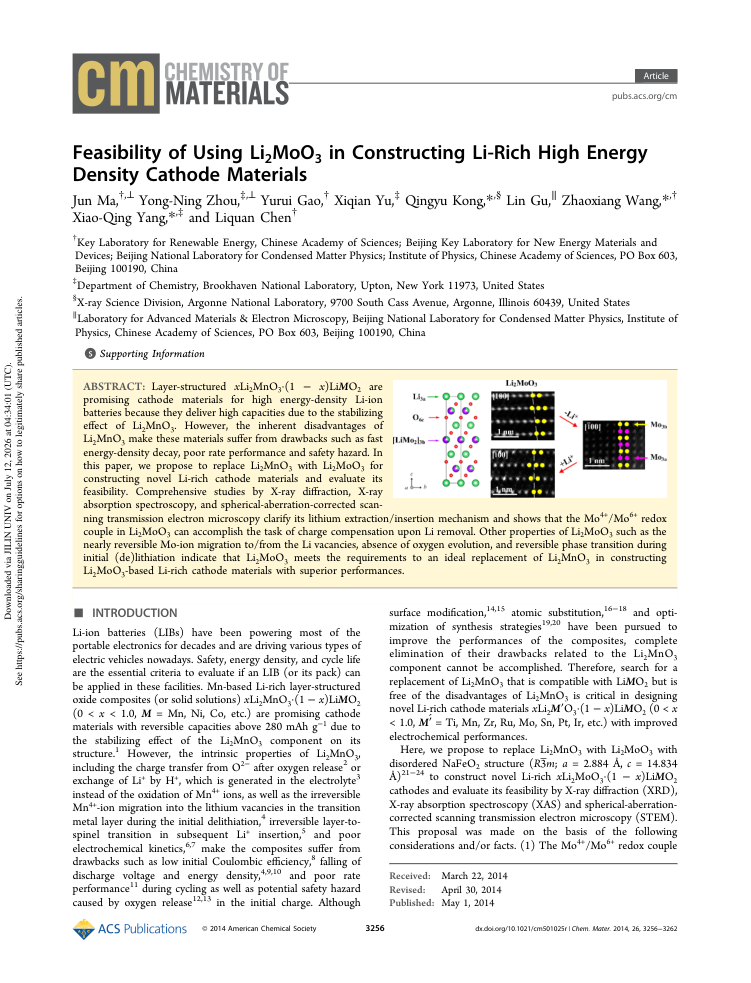
| 5 | 2 | 5 | 4 | 28 | body_zone | column_1_of_2 | p2:body_region:0 | [60.49, 467.95, 239.99, 152.21] | Structure of As-Prepared Li2MoO3. The re fi ned XRD pattern of the as-prepared Li2MoO3 powder matches well with the α -NaFeO2 structure R 3 ̅ m with lattice constants a = 2.8675(9) Å and c = 14.8357(6) Å (Figure 1a and b and Supporting Information Table S1). The high intensity ratio (ca. 1.27) of (003)/(104) and clear splitting of the (018)/(110) di ff raction peaks suggest the well-de fi ned layered structure with very few antisite occupations concerning the Li + (3a site) and Mo 4+ (3b sites) ions in the as-prepared Li2MoO3. 31 -33 These are supported, in the atomic scale, with the investigation of STEM imaging (Figure 1c -f and Supporting Information Figure S2). These features ensure the good electrochemical performance of the material and the reliability of physical and electrochemical properties. |
| 6 | 2 | 6 | 5 | 29 | bottom_margin | column_1_of_2 | p2:body_region:0 | [60.49, 622.36, 240.0, 140.84] | It is worthwhile to point out that the contrast of the highangle annular-dark- fi eld (HAADF) image exhibits a Z 1.7 dependence as compared with Z 1/3 for the annular-brightfi eld (ABF) image with respect to the atomic number Z. 34,35 The ABF image unambiguously displays the 3a-sited Li, 3bsited Mo, and 6c-sited O-ion columns, while the HAADF image only displays the Mo-ion columns clearly. Due to the random distribution of the Li ions at the 3b sites, the 3b-sited Li-ion columns are superposed with the 3b-sited Mo-ion columns and could not be separately identi fi ed in Figure 1c and d. Figure 1e compares the line contrast pro fi les of the Li-, Mo- and O-ion columns along the [421 ̅ ] direction projected on the [100] zone axis. However, in the as-prepared Li2MoO3, the Mo-ion |
| 7 | 2 | 7 | 8 | 32 | body_zone | column_2_of_2 | p2:body_region:1 | [324.45, 488.15, 240.02, 100.18] | columns show an αβγ -stacking with an irregular shift along the [010] direction (slipped O3 type; Supporting Information Figure S3), due to the presence of disordered Mo3O13 clusters in the Li -Mo layers (Supporting Information Figure S4). In addition, the presence of the short-range ordered distribution of the Mo3O13 clusters is evidenced by the strong and weak contrast alternation in some areas in Figure 1d and f. The areas without such alternation are attributed to the disordered Mo3O13 clusters (Supporting Information Figure S5). |
| 8 | 2 | 9 | 9 | 33 | bottom_margin | column_2_of_2 | p2:body_region:1 | [324.45, 588.93, 240.03, 174.27] | Structural Transition and Mo-Ion Migration. Irreversible migration of the Mn ions into the transition metal layer to fi ll out the Li vacancies (a proposed layer-to-spinel transition) has been reported to be one of the causes for the capacity decay and discharge voltage dropping of the x Li2MnO3 · (1 -x )Li M O2 cathode materials. There are three charge plateaus but only one discharge slope in the fi rst-cycle voltage pro fi le of Li2MoO3 (Supporting Information Figure S6 -S8). The slope corresponds to a reversible capacity of 210 mAh g -1 (when cycled between 2.0 and 4.5 V vs Li/Li + ) or ca. 190 mAh g -1 (when cycled between 2.0 and 4.8 V) any of which is much higher than that of Li2MnO3. 36 The fact that the material charged to 4.5 V should have a higher reversible capacity than the one charged to 4.8 V is attributed to the destructive structural variation of Li2MoO3 when too many Li ions are extracted. |
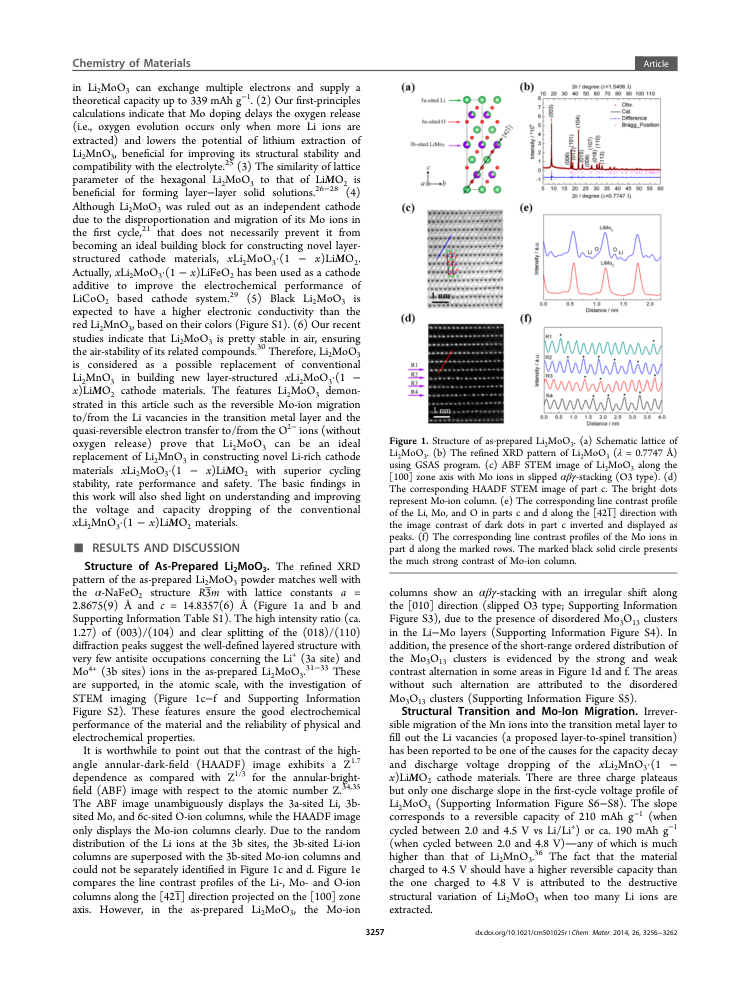
| 9 | 3 | 3 | 2 | 37 | page_body | column_1_of_2 | p3:body_region:0 | [60.49, 69.37, 240.0, 30.8] | In order to investigate the structural changes of Li2MoO3 during electrochemical (de)lithiation between 2.0 and 4.8 V, in situ XRD characterization was performed (Figure 2a and |