1
2
3
4
5
6
H
7
8
9
original.pdf layout_review.html excluded_blocks.html final_body_blocks.tsv layout_blocks.tsv
绿色编号 = 最终进入正文的段落顺序;蓝色虚线 = section heading 边界。每个条目同时显示 Docling 页内原序、新页内顺序和识别栏位;排序只在同页内调整,不拆分文本块。
| # | page | Docling 页内原序 | 新页内顺序 | global layout order | zone | column | region | bbox | text |
|---|---|---|---|---|---|---|---|---|---|
| 1 | 1 | 5 | 5 | 4 | body_zone | column_1_of_2 | p1:body_region:0 | [50.81, 227.68, 312.83, 241.82] | Anionic and cationic redox chemistries boost ultrahigh specific capacities of Li-rich Mn-based oxides cathodes (LRMO). However, irreversible oxygen evolution and sluggish kinetics result in continuous capacity decay and poor rate performance, restricting the commercial fast-charging cathodes application for lithium ion batteries. Herein, the local electronic structure of LRMO is appropriately modulated to alleviate oxygen release, enhance anionic redox reversibility, and facilitate Li + diffusion via facile surface defect engineering. Concretely, oxygen vacancies integrated on the surface of LRMO reduce the density of states of O 2p band and trigger much delocalized electrons to distribute around the transition metal, resulting in less oxygen release, enhancing reversible anionic redox and the MnO 6 octahedral distortion. Besides, partially reduced Mn and lattice vacancies synchronously stimulate the electrochemical activity and boost the electronic conductivity, Li + diffusion rate, and fast charge transfer. Therefore, the modified LRMO exhibits enhanced cyclic stability and fast-charging capability: a high discharging capacity of 212.6 mAh · g -1 with 86.98% capacity retention after 100 cycles at 1 C is obtained and to charge to its 80%, SOC is shortened to 9.4 min at 5 C charging rate. This work will draw attention to boosting the fast-charging capability of LRMO via the local electronic structure modulation. |
| 2 | 1 | 6 | 6 | 5 | body_zone | column_1_of_2 | p1:body_region:0 | [50.81, 504.82, 188.74, 7.2] | X. Gao, H. Zhang, S. Li, S. Zhang, J. Guo, Y. Lai, Z. Zhang |
| 3 | 1 | 10 | 10 | 9 | body_zone | column_1_of_2 | p1:body_region:0 | [50.81, 558.61, 125.23, 7.2] | Changsha, Hunan 410083, P. R. China |
| 4 | 1 | 13 | 13 | 12 | body_zone | column_1_of_2 | p1:body_region:0 | [50.81, 587.51, 103.08, 7.2] | HunanChangyuanLiCoCo.,Ltd |
| 5 | 1 | 17 | 17 | 16 | body_zone | column_1_of_2 | p1:body_region:0 | [50.81, 625.36, 96.01, 7.2] | ShanghaiJiaoTongUniversity |
| 6 | 1 | 20 | 20 | 19 | body_zone | column_1_of_2 | p1:body_region:0 | [50.81, 654.25, 142.95, 7.2] | SchoolofMaterialsScienceandEngineering |
| 7 | 1 | 27 | 27 | 26 | body_zone | column_2_of_2 | p1:body_region:1 | [384.63, 238.89, 162.26, 249.54] | Recently, Li-rich Mn-based oxides cathodes (LRMO) written as x Li2MnO3 · (1 -x )LiTMO2 (TM = Nickel, Cobalt and Manganese) have attracted extensive research due to its ultrahigh capacity ( > 250 mAh · g -1 ) and low cost in comparison with the commercially employed cathodes. [1] The structure of LRMO is widely recognized as the two phase nanocomposite structure of Li2MnO3 phase (space group: C2/m ) and LiTMO2 phase (space group: R-3m ). The distinctive honeycomb-like superlattice unit Li@Mn6 in Li2MnO3 phase drives from the substitution of 1/3 Li in TM layer, also causing the formation of Li-O-Li connection configuration. [2] As a result, the unhybridized O 2p orbital located at the Li-O-Li configurations can provide extra electrons for charge compensation at high charging voltage ( > 4.5 V), assigning to the anionic redox chemistry (O 2 -/O2 n -redox couple, n < 2). [ 3] Unfortunately, irreversible |
| 8 | 1 | 28 | 28 | 27 | body_zone | column_2_of_2 | p1:body_region:1 | [305.92, 490.95, 240.96, 139.94] | anionic redox such as oxygen loss has caused structural degradation, while contributing to ultrahigh capacity. For example, oxygen release can trigger irreversible migration of transition metal ions, severe side reaction, and harmful crystal structure transformation, resulting in low initial coulombic efficiency, continuous voltage, and capacity decay. [ 4] Besides, the intrinsic low electronic and ionic conductivity of Li2MnO3 phase and sluggish kinetic of oxygen redox restrain the rate performance and deteriorate the fast-charging capability of LRMO. [ 5] Therefore, it is urgent to find an effective strategy to alleviate irreversible oxygen loss, activate reversible oxygen redox, and simultaneously facilitate the fast electrochemical kinetics of LRMO, especially considering its upcoming application in the electric vehicle field. |
| 9 | 1 | 29 | 29 | 28 | body_zone | column_2_of_2 | p1:body_region:1 | [305.92, 633.41, 240.95, 85.16] | In order to address the above issues, plenty of modification strategies including surface coating, elemental doping, and surface defect/heterostructure engineering have been raised to suppress oxygen loss, severe side reaction, and layered to spinel phase transformation for achieving excellent electrochemical performance in recent years. [5a,6] Compared with surface coating and elemental doping, surface defect engineering can be easily achieved without the introduction of foreign impurities or |
| 10 | 2 | 3 | 3 | 33 | bottom_margin | column_1_of_2 | [47.98, 416.06, 240.96, 304.33] | inactive substances. Therefore, surface defect engineering has received wide attention in the past few years. Surface defects such as lithium and oxygen vacancies can be incorporated into the crystal structure during the synthesis process or subsequent modifications. Surface defects usually enable to modulate the local electronic structure or atomic coordination environment, contributing to activate reversible anionic redox, suppress irreversible oxygen release and structural deterioration. For example, lithium defect can be incorporated on the surface structure of LRMO and trigger the generation of spinel-like phase coating via changing the usage of Li salt, beneficial for enhancing the rate performance and cycling stability. [ 7] Recently, Zhang et al. further disclosed that lithium defects were able to regulate the 3d-transition metal interlayered disorder, contributing to the stable crystal structure with low energy and Li + diffusion barrier. [ 8] Therefore, Co-free lithium-rich cathode with a long-neglected Li-deficient state exhibited enhanced capacity, improved initial efficiency, and excellent cyclic stability. Furthermore, oxygen vacancy, as one of the conventional defect structures, has been widely studied in the layered oxides cathodes of lithium or sodium ion batteries. Previous works have demonstrated that oxygen defect can suppress oxygen release and irreversible phase transformation and accelerate the electrical conductivity and lithium ion diffusion rate. [ 9] For example, Li et al. incorporated oxygen vacancy on the surface of LRMO for inhibiting the irreversible evolution of lattice oxygen via hydrogenation treatment. [6c] The results demonstrated that oxygen vacancy can enhance the cyclic stability of LRMO. In addition, Zhang et al. | |
| 11 | 2 | 7 | 7 | 37 | page_body | column_2_of_2 | p2:body_region:0 | [303.09, 416.06, 240.96, 107.07] | constructed oxygen vacancy and Li4Mn5O12 on the surface of Lirich oxide layered cathodes by using a facile oxalic acid assisted delithiation process. [ 10] The irreversible release of oxygen and voltage decay were obviously alleviated. Therefore, surface defect engineering is a direct and feasible way for tuning the lattice oxygen redox and suppressing the irreversible oxygen loss. Nevertheless, to the best of our knowledge, few study and detailed analyses pay attention to boost the kinetics of reversible anionic redox and fast-charging capability for LRMO materials via surface defect engineering. |
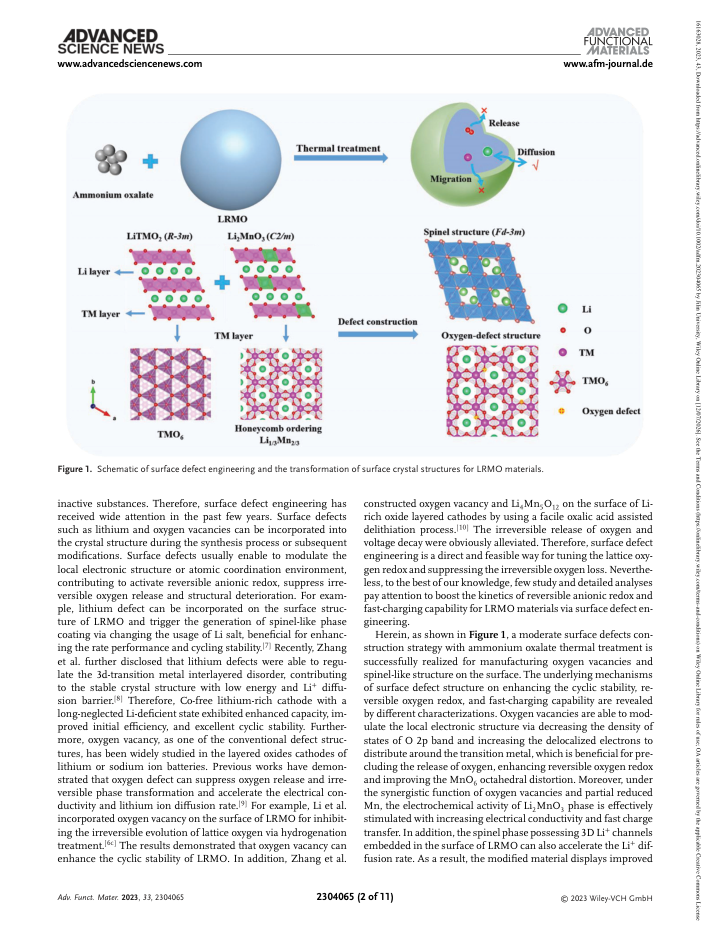
| 12 | 2 | 8 | 8 | 38 | bottom_margin | column_2_of_2 | p2:body_region:0 | [303.09, 525.65, 240.96, 194.74] | Herein, as shown in Figure 1 , a moderate surface defects construction strategy with ammonium oxalate thermal treatment is successfully realized for manufacturing oxygen vacancies and spinel-like structure on the surface. The underlying mechanisms of surface defect structure on enhancing the cyclic stability, reversible oxygen redox, and fast-charging capability are revealed by different characterizations. Oxygen vacancies are able to modulate the local electronic structure via decreasing the density of states of O 2p band and increasing the delocalized electrons to distribute around the transition metal, which is beneficial for precluding the release of oxygen, enhancing reversible oxygen redox and improving the MnO 6 octahedral distortion. Moreover, under the synergistic function of oxygen vacancies and partial reduced Mn, the electrochemical activity of Li 2 MnO3 phase is effectively stimulated with increasing electrical conductivity and fast charge transfer. In addition, the spinel phase possessing 3D Li + channels embedded in the surface of LRMO can also accelerate the Li + diffusion rate. As a result, the modified material displays improved |
| 13 | 3 | 1 | 5 | 45 | front_matter | column_1_of_2 | [50.81, 624.27, 240.96, 41.32] | cycling performance with excellent rate performance and fastcharging capability. The present work provides some references to enhance fast-charging capability of LRMO with reversible anionic redox via surface defect engineering. | |
| 14 | 3 | 7 | 7 | 47 | bottom_margin | column_1_of_2 | [50.81, 701.29, 240.94, 19.41] | Li-rich Mn-based oxides cathodes treated with 3wt%, 5wt%, and 8wt% of ammonium oxalate are denoted as NHCO-3, NHCO-5, | |
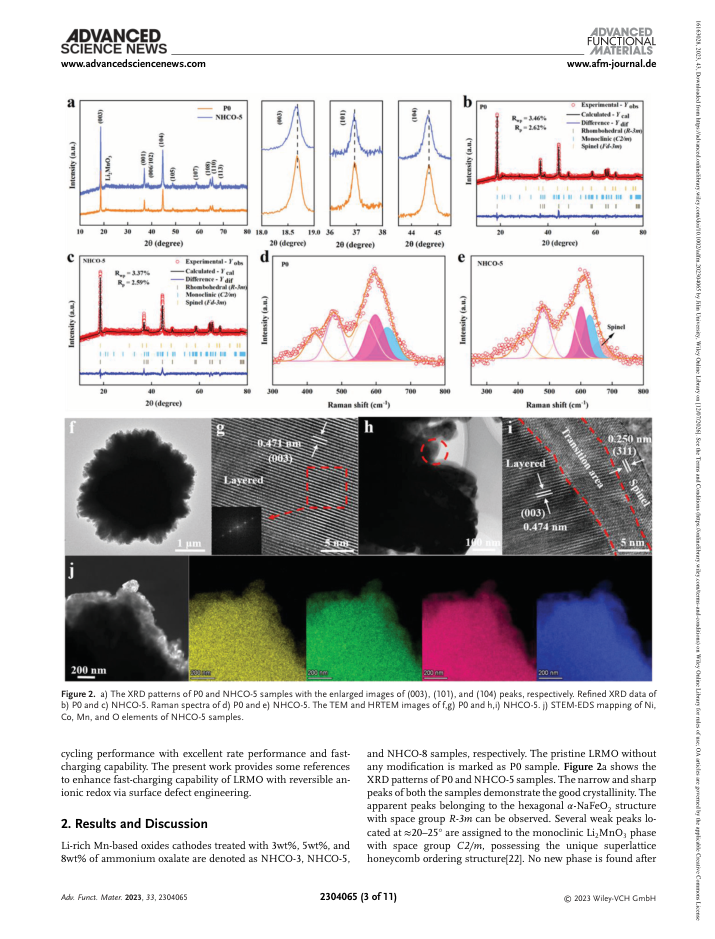
| 15 | 3 | 8 | 9 | 49 | bottom_margin | column_2_of_2 | p3:body_region:0 | [305.92, 624.27, 240.97, 96.11] | and NHCO-8 samples, respectively. The pristine LRMO without any modification is marked as P0 sample. Figure 2 a shows the XRDpatterns of P0 and NHCO-5 samples. The narrow and sharp peaks of both the samples demonstrate the good crystallinity. The apparent peaks belonging to the hexagonal /u1D6FC -NaFeO2 structure with space group R-3m can be observed. Several weak peaks located at ≈ 20-25 ° are assigned to the monoclinic Li 2 MnO3 phase with space group C2/m , possessing the unique superlattice honeycomb ordering structure[22]. No new phase is found after |
| 16 | 4 | 2 | 2 | 53 | page_body | column_1_of_2 | p4:body_region:0 | [47.98, 76.43, 240.96, 413.93] | ammonium oxalate thermal treatment. What is more, the well splitting of (006)/(102) and (108)/(110) peaks for all the samples demonstrates the well-formed layered ordering structure without any destruction after surface modification treatment. The value of I(003)/I(104) of all the samples is larger than 1.2, indicating the low cation mixing. [11] In addition, the left-shift peaks of (003) and (104) ascribe to the enlarged d-spacing and Li + slab, ascribing to the extraction of oxygen atoms after surface defect construction. [ 9b,12] The increasing interplanar spacing is beneficial for the fast Li + diffusion and to enhance the fast-charging capability. Meanwhile, the shoulder (101) peak indicates the existence of spinel phase. [ 13] Figure 2b,c; Figure S1c,d, Supporting Information, shows the results of Rietveld refined XRD data of all the samples, and the detailed refined lattice parameters are listed in Table S1, Supporting Information. The increasing c value conforms to the left-shift of (003) peak in XRD pattern. Moreover, the decrease of Li 2 MnO3 phase and the increase of spinel phase further demonstrate that the spinel phase originates from the reaction of Li2MnO3 phase with the products of ammonium oxalate pyrolysis. Raman spectra is also performed to detect the local structure as it is sensitive to the short-range ordering and beneficial for phase identification. The fitting results of Raman spectra are displayed in Figure 2d,e; Figure S1e,f, Supporting Information. The peaks around 479 and 597 cm -1 belong to the Eg and A lg vibrations of LiTMO 2 component. [5a] The peaks of 420 and 632 cm -1 are ascribed to Li2MnO3 constituent. The additional peak around 660 cm -1 after ammonium oxalate treatment appears due to the formation of the spinel-like structure. [ 5a,14] These results further demonstrate the appearance of spinel phase due to the in situ atomic structure rearrangement after surface treatment. Incorporating spinel-like structure with 3D Li ions diffusion tunnel on the surface of modified materials can promote the fast Li + diffusion and alleviate the irreversible structural transformation. [ 15] The modified materials possess similar coral-like morphology with the pristine materials except for the denser surface as shown in Figure S2a-h, Supporting Information, which can reduce the contact area between materials and electrolyte to alleviate side reaction and enhance cycling stability. |
| 17 | 4 | 3 | 3 | 54 | bottom_margin | column_1_of_2 | p4:body_region:0 | [47.98, 492.87, 240.96, 227.62] | Further, transmission electron microscopy (TEM) and highresolution TEM (HRTEM) characterizations were conducted to explore the surface crystal structure changes after surface modification. The relevant results are depicted in Figure 2f-j. Both the P0 and NHCO-5 samples show clear lattice stripe, indicating a perfect crystal structure. Figure 2g depicts the HRTEM images of P0 samples driving from the Figure 2f. A classic interplanar spacing of 0.471 nm corresponding to (003) facet of layer structure with R-̄ 3 m space group can be found, which is also demonstrated by the fast Fourier transform (FFT) analysis (a local FFT of the rectangular area in Figure 2g). [ 16] In contrast, an enlarged interplanar spacing of 0.474 nm in bulk can be detected in Figure 2i (enlarged TEM images of circular area in Figure 2h), conforming to the above XRD results. In addition, a narrow interplanar spacing of 0.250 nm in the outside of surface belongs to the (311) lattice planes of the spinel phase with Fd-3m space group being clearly observed. [ 17] Transition area located between the bulk and surface area is referred to the layered-spinel growth structure, indicating that the migration of transition ions to the Li layer triggers the surface structure rearrangement and formation of spinel phase. [ 17b] The enlarged d-space and integrated spinel |
| 18 | 4 | 6 | 7 | 58 | page_body | column_2_of_2 | p4:body_region:1 | [303.09, 75.54, 240.95, 86.05] | structure can boost the fast Li + diffusion, enhance the rate performance and fast-charging capability of LRMO. These results provide strong evidences of the existence of spinel phase, well consistent with the results from XRD and Raman analysis (Figure 2a,e). EDSmapping under high resolution shows the uniform elemental distribution of NHCO-5 samples (Figure 2j), indicating that surface defect engineering does not change the uniform distribution of Ni, Co, Mn, and O elements. |
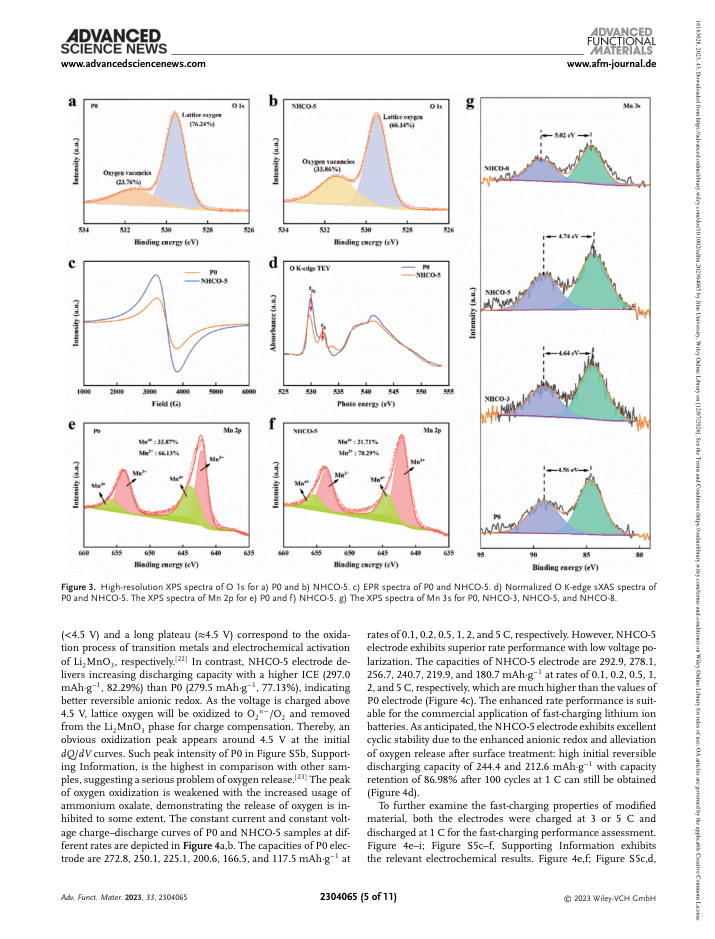
| 19 | 4 | 7 | 8 | 59 | page_body | column_2_of_2 | p4:body_region:1 | [303.09, 164.11, 240.97, 479.67] | Surface defect engineering usually can result in the obvious changes of elemental chemical compositions and metal valence, exerting a significant impact on the electrochemical properties of LRMO. Therefore, relevant characterizations such as XPS, EPR, and XAS were carried out for detecting these specific changes, and the corresponding results were depicted in Figure 3 ; Figure S4, Supporting Information. The peaks of 531.54 and 529.55 eV in the XPS spectra of O 1s contributed to the oxygen vacancies and lattice oxygen, respectively. [ 6c,10] The content of oxygen vacancies increased with the increasing usage of ammonium oxalate as displayed in Figure 3a,b; Figure S4a,b, Supporting Information. Moreover, the EPR signal intensity of NHCO-5 was also much higher than P0 in Figure 3c, further proving the increasing of oxygen vacancies on the surface. [18] Further, the O K-edge XANES spectra of NHCO-5 in TEY mode showed an obvious decrease of pre-edge peak overall intensity in comparison with P0 (Figure 3d), ascribing to the formation of surface oxygen vacancies. [19] Therefore, these results have directly demonstrated that oxygen defects are successfully constructed on the surface of NHCO-5 sample via ammonium oxalate treatment. The surface oxygen defects are able to suppress oxygen release and structural deterioration. The possible formation mechanism of oxygen defects is that the decomposed NH 3 , CO, and CO 2 , deriving from the pyrolysis of ammonium oxalate, can induce the formation of oxygen vacancies via extracting lattice oxygen under high temperature. [9b,20] Figure 3e,f shows the Mn 2p peak of P0 and NHCO-5, respectively. The larger area of Mn 3 + peak in comparison with P0 indicates that partial Mn is reduced from the Mn 4 + to Mn 3 + . In addition, the multiple splitting of Mn 3s XPS spectra analysis can further be used to calculate the changes of the average valence state of Mn. Figure 3g shows that the Mn 3s peak splitting has been increased from 4.43 to 5.02 eV after ammonium oxalate treatment, equaling to the reduction of Mn valence state from 3.88 to + 3.29, calculated from the empirical Equation (S1), Supporting Information. The result also further demonstrates the generation of spinel structure due to the increasing low valence of Mn, corresponding to the results of XRD, Raman, and HRTEM analysis. What is more, partially reduced Mn on the surface can activate the Li 2 MnO3 phase and promote the cation to participate in charge compensation. [ 21] Besides, the valence of Ni and Co shows little change in comparison with Mn, as displayed in Figure S4, Supporting Information, contributing to the fact that ammonium oxalate mainly reacts with Li2MnO3 components. |
| 20 | 4 | 8 | 9 | 60 | bottom_margin | column_2_of_2 | p4:body_region:1 | [303.09, 646.29, 240.96, 74.2] | With respect to electrochemical performance, to evaluate the cyclic stability, rate performance, and fast-charging properties of P0 and NHCO-5, all the assembled electrodes are initially activated at a low rate of 0.1 C rate test for three cycles (1 C = 250 mAh g -1 , ≈ 2.0-4.8 V, 25 ° C). Typical initial charge-discharge curves of LRMO can be observed for both P0 and NHCO-5 electrodes (Figure S5a, Supporting Information): a sloped region |
| 21 | 5 | 5 | 5 | 67 | bottom_margin | column_1_of_2 | p5:body_region:0 | [50.81, 525.64, 240.96, 194.75] | ( < 4.5 V) and a long plateau ( ≈ 4.5 V) correspond to the oxidation process of transition metals and electrochemical activation of Li 2 MnO3, respectively. [22] In contrast, NHCO-5 electrode delivers increasing discharging capacity with a higher ICE (297.0 mAh · g -1 , 82.29%) than P0 (279.5 mAh · g -1 , 77.13%), indicating better reversible anionic redox. As the voltage is charged above 4.5 V, lattice oxygen will be oxidized to O 2 n -/O2 and removed from the Li 2 MnO3 phase for charge compensation. Thereby, an obvious oxidization peak appears around 4.5 V at the initial dQ / dV curves. Such peak intensity of P0 in Figure S5b, Supporting Information, is the highest in comparison with other samples, suggesting a serious problem of oxygen release. [ 23] The peak of oxygen oxidization is weakened with the increased usage of ammonium oxalate, demonstrating the release of oxygen is inhibited to some extent. The constant current and constant voltage charge-discharge curves of P0 and NHCO-5 samples at different rates are depicted in Figure 4 a,b. The capacities of P0 electrode are 272.8, 250.1, 225.1, 200.6, 166.5, and 117.5 mAh · g -1 at |
| 22 | 5 | 6 | 7 | 69 | page_body | column_2_of_2 | p5:body_region:1 | [305.92, 525.64, 240.96, 139.95] | rates of 0.1, 0.2, 0.5, 1, 2, and 5 C, respectively. However, NHCO-5 electrode exhibits superior rate performance with low voltage polarization. The capacities of NHCO-5 electrode are 292.9, 278.1, 256.7, 240.7, 219.9, and 180.7 mAh · g -1 at rates of 0.1, 0.2, 0.5, 1, 2, and 5 C, respectively, which are much higher than the values of P0 electrode (Figure 4c). The enhanced rate performance is suitable for the commercial application of fast-charging lithium ion batteries. As anticipated, the NHCO-5 electrode exhibits excellent cyclic stability due to the enhanced anionic redox and alleviation of oxygen release after surface treatment: high initial reversible discharging capacity of 244.4 and 212.6 mAh · g -1 with capacity retention of 86.98% after 100 cycles at 1 C can still be obtained (Figure 4d). |
| 23 | 5 | 7 | 8 | 70 | bottom_margin | column_2_of_2 | p5:body_region:1 | [305.92, 668.11, 240.96, 52.27] | To further examine the fast-charging properties of modified material, both the electrodes were charged at 3 or 5 C and discharged at 1 C for the fast-charging performance assessment. Figure 4e-i; Figure S5c-f, Supporting Information exhibits the relevant electrochemical results. Figure 4e,f; Figure S5c,d, |