这里是差集:Docling 全量解析 text block 减去最终会进入正文的 block。优先人工检查 risk=high / medium。
layout_review.html excluded_blocks.json excluded_blocks.tsv final_body_blocks.tsv visual_assets.tsv original.pdf
{
  "parsed_text_blocks": 140,
  "final_body_blocks": 23,
  "excluded_blocks": {
    "count": 117,
    "by_reason": {
      "after_back_matter_stop": 49,
      "body_heading": 11,
      "inside_back_matter": 9,
      "docling_page_header": 7,
      "first_page_metadata": 6,
      "outside_body_flow_caption": 6,
      "page_margin_header": 6,
      "docling_page_footer": 5,
      "front_matter_heading": 3,
      "outside_body_flow_list_item": 3,
      "first_page_author_or_affiliation": 2,
      "first_page_front_matter_heading": 2,
      "abstract_heading": 1,
      "back_matter_heading": 1,
      "before_body_started": 1,
      "docling_caption": 1,
      "early_back_matter_heading": 1,
      "empty_after_cleaning": 1,
      "first_page_summary": 1,
      "inside_front_matter": 1
    },
    "by_role_guess": {
      "reference": 33,
      "body_heading": 12,
      "page_footer": 10,
      "body_candidate_excluded": 8,
      "caption": 8,
      "page_header": 8,
      "page_margin_header": 8,
      "unknown_text": 7,
      "back_matter_heading": 6,
      "front_matter_heading": 5,
      "affiliation": 4,
      "front_matter_candidate": 3,
      "title_candidate": 2,
      "abstract_heading": 1,
      "back_matter_text": 1,
      "footnote": 1
    },
    "by_risk_level": {
      "low": 106,
      "high": 8,
      "medium": 3
    },
    "high_risk_count": 8,
    "medium_risk_count": 3
  },
  "char_counts": {
    "parsed_text_chars": 29730,
    "final_body_chars": 10841,
    "excluded_chars": 18889
  }
}
{
  "truncated": true,
  "message": "Body extraction stopped at page 7 block #/texts/84: CRediT authorship contribution statement. 49 following text blocks were excluded as after_back_matter_stop.",
  "stop_trigger": {
    "ref": "#/texts/84",
    "page": 7,
    "layout_order": 90,
    "role_guess": "back_matter_heading",
    "body_decision_reason": "back_matter_heading",
    "text_preview": "CRediT authorship contribution statement"
  },
  "first_truncated_block": {
    "ref": "#/texts/85",
    "page": 7,
    "layout_order": 91,
    "role_guess": "affiliation",
    "body_decision_reason": "after_back_matter_stop",
    "text_preview": "Tao Huang: Investigation, Methodology, Writing -original draft. Xiangzhen Zheng: Investigation. Chunfeng Yan: Validation. Ying Pan: Software. Maoxiang Wu: Conceptualization, Writing -review & editing."
  },
  "truncated_block_count": 49,
  "truncated_pages": [
    7,
    8
  ],
  "by_role_guess": {
    "reference": 33,
    "back_matter_heading": 4,
    "unknown_text": 3,
    "affiliation": 2,
    "page_footer": 2,
    "page_margin_header": 2,
    "back_matter_text": 1,
    "caption": 1,
    "page_header": 1
  }
}
这些框显示被排除块,同时叠加真实图表资产框。青色虚线表示该 text block 被图表资产 caption 吸收;红色 STOP 是截断触发点,红色框是截断后被排除的块。
这是实际图表资产输出,不是审计层重新推断。
| # | type | label | page | caption source | suppressed | duplicate reason | rescue reason | group | confidence | bbox | caption |
|---|---|---|---|---|---|---|---|---|---|---|---|
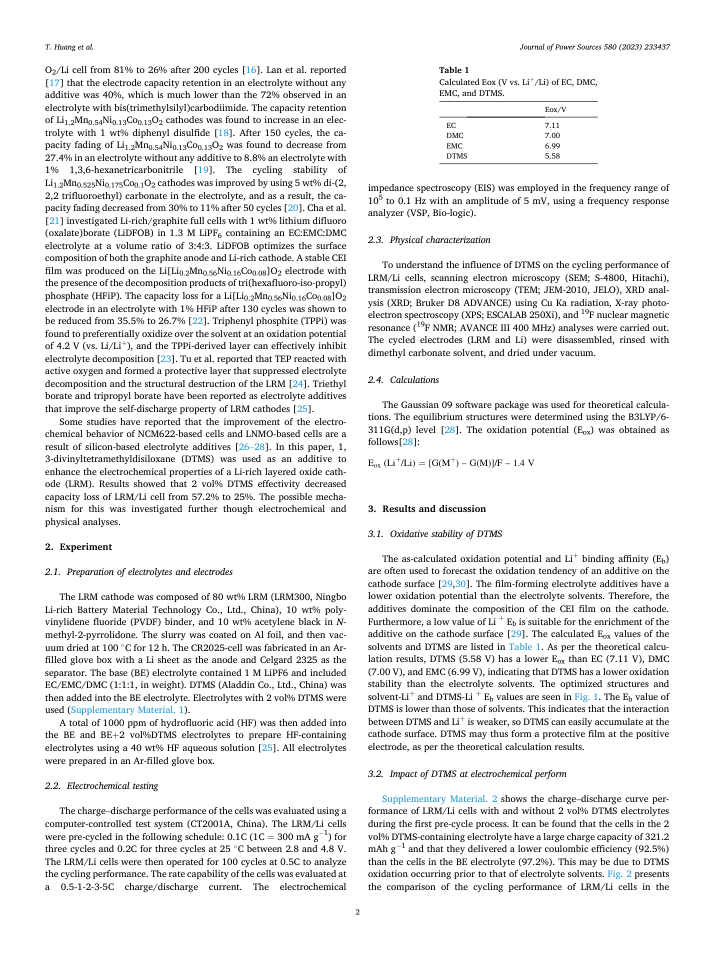
| 1 | figure | Fig. 1 | 3 | direct_caption_ref | 0.82 | [134.62, 56.55, 333.87, 121.09] | Fig. 1. Optimized structures and Eb values of solvents-Li + and DTMS-Li + . | ||||
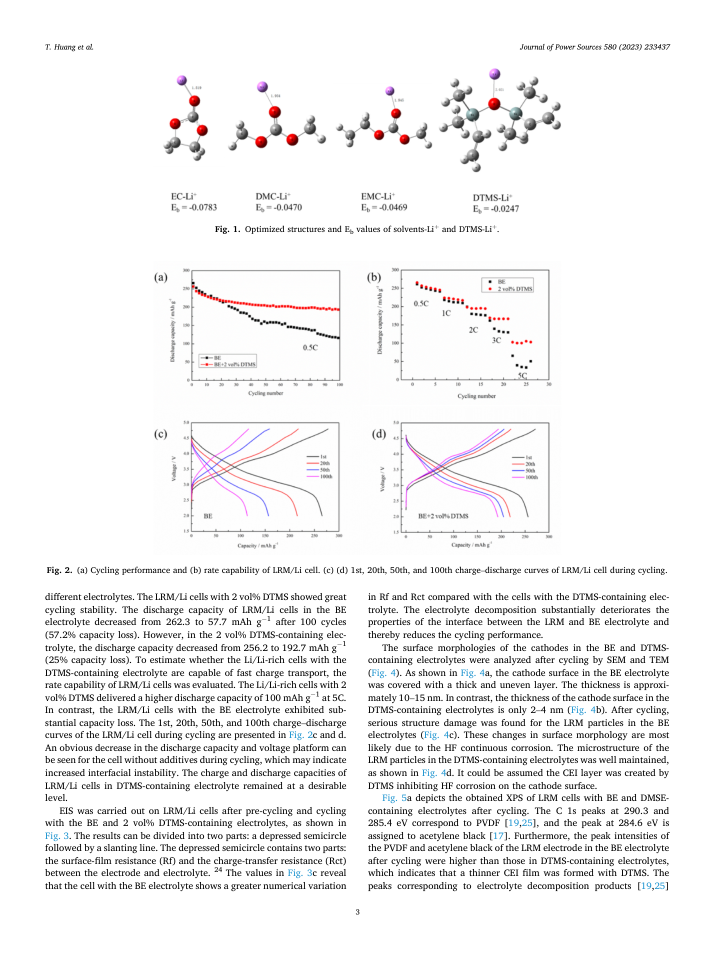
| 2 | figure | Fig. 2 | 3 | direct_caption_ref | 0.82 | [126.51, 219.03, 339.8, 241.36] | Fig. 2. (a) Cycling performance and (b) rate capability of LRM/Li cell. (c) (d) 1st, 20th, 50th, and 100th charge -discharge curves of LRM/Li cell during cycling. | ||||
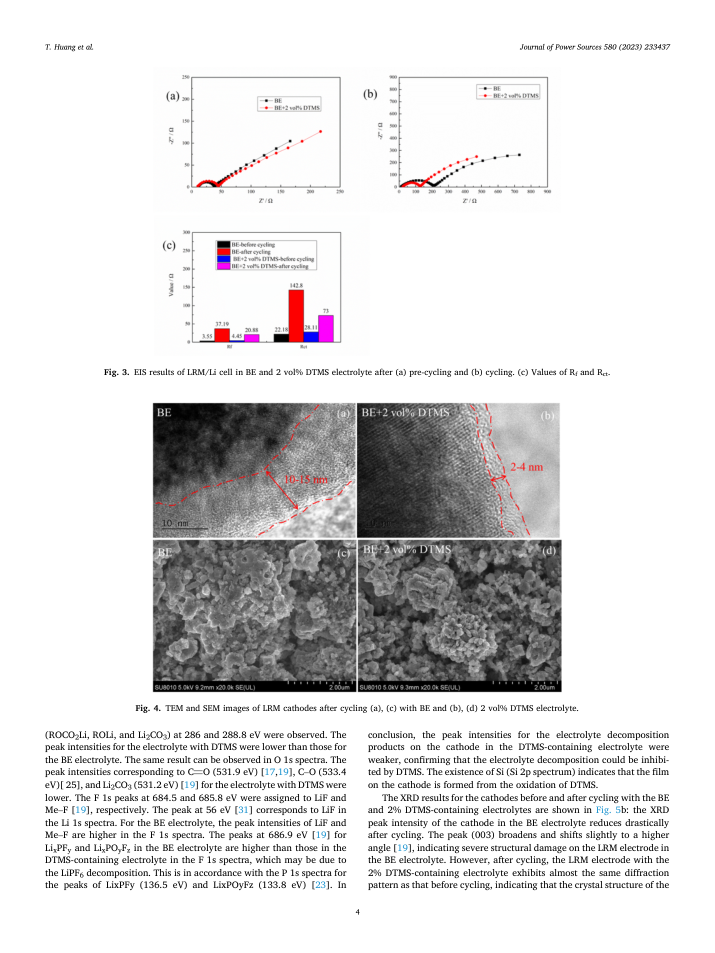
| 3 | figure | Fig. 3 | 4 | direct_caption_ref | 0.82 | [127.57, 56.82, 339.17, 237.05] | Fig. 3. EIS results of LRM/Li cell in BE and 2 vol% DTMS electrolyte after (a) pre-cycling and (b) cycling. (c) Values of Rf and Rct. | ||||
| 4 | figure | Fig. 4 | 4 | direct_caption_ref | 0.82 | [126.02, 335.06, 341.65, 242.9] | Fig. 4. TEM and SEM images of LRM cathodes after cycling (a), (c) with BE and (b), (d) 2 vol% DTMS electrolyte. | ||||
| 5 | figure | Fig. 5 | 5 | direct_caption_ref | 0.82 | [77.13, 57.01, 440.24, 486.67] | Fig. 5. (a)XPS spectra of LRM cathodes after cycling with BE and 2 vol% DTMS electrolytes. (b) XRD patterns of LRM cathodes and (c) dissolution of transition metal on Li electrode taken from cell after cycling. | ||||
| 6 | figure | Fig. 6 | 6 | direct_caption_ref | 0.82 | [126.82, 57.22, 340.55, 172.57] | Fig. 6. (a) Discharge profiles of cell during cycling with BE + 1000 ppm HF and 2 vol% DTMS-containing + 1000 ppm HF; F 1s XPS spectra of LRM cathodes after cycling with (b) BE + 1000 ppm HF and (c) 2 vol% DTMS-containing + 1000 ppm HF electrolyte. | ||||
| 7 | figure | Docling Figure 7 | 6 | missing_caption | 0.55 | [127.42, 421.93, 340.9, 242.33] | |||||
| 8 | figure | Fig. 8 | 7 | direct_caption_ref | 0.82 | [128.27, 57.42, 337.83, 98.38] | Fig. 8. Possible mechanism of DTMS. | ||||
| 9 | table | Table 1 | 2 | nearby_text_caption | 0.82 | [364.83, 83.37, 133.46, 53.61] | Table 1 Calculated Eox (V vs. Li + |
| risk | page | order | label | role | reason | parser reason | production usage | trunc | body region | region | bg | bbox | raw text | cleaned text |
|---|---|---|---|---|---|---|---|---|---|---|---|---|---|---|
| high | 3 | 54 | text | body_candidate_excluded | inside_back_matter | inside_back_matter | p3:body_region:0 | p3:page_body:column_1_of_2:white | [255, 255, 255] white | [37.59, 494.91, 253.44, 174.67] | different electrolytes. The LRM/Li cells with 2 vol% DTMS showed great cycling stability. The discharge capacity of LRM/Li cells in the BE electrolyte decreased from 262.3 to 57.7 mAh g 1 after 100 cycles (57.2% capacity loss). However, in the 2 vol% DTMS-containing electrolyte, the discharge capacity decreased from 256.2 to 192.7 mAh g 1 (25% capacity loss). To estimate whether the Li/Li-rich cells with the DTMS-containing electrolyte are capable of fast charge transport, the rate capability of LRM/Li cells was evaluated. The Li/Li-rich cells with 2 vol% DTMS delivered a higher discharge capacity of 100 mAh g 1 at 5C. In contrast, the LRM/Li cells with the BE electrolyte exhibited substantial capacity loss. The 1st, 20th, 50th, and 100th charge -discharge curves of the LRM/Li cell during cycling are presented in Fig. 2c and d. An obvious decrease in the discharge capacity and voltage platform can be seen for the cell without additives during cycling, which may indicate increased interfacial instability. The charge and discharge capacities of LRM/Li cells in DTMS-containing electrolyte remained at a desirable level. | different electrolytes. The LRM/Li cells with 2 vol% DTMS showed great cycling stability. The discharge capacity of LRM/Li cells in the BE electrolyte decreased from 262.3 to 57.7 mAh g 1 after 100 cycles (57.2% capacity loss). However, in the 2 vol% DTMS-containing electrolyte, the discharge capacity decreased from 256.2 to 192.7 mAh g 1 (25% capacity loss). To estimate whether the Li/Li-rich cells with the DTMS-containing electrolyte are capable of fast charge transport, the rate capability of LRM/Li cells was evaluated. The Li/Li-rich cells with 2 vol% DTMS delivered a higher discharge capacity of 100 mAh g 1 at 5C. In contrast, the LRM/Li cells with the BE electrolyte exhibited substantial capacity loss. The 1st, 20th, 50th, and 100th charge -discharge curves of the LRM/Li cell during cycling are presented in Fig. 2c and d. An obvious decrease in the discharge capacity and voltage platform can be seen for the cell without additives during cycling, which may indicate increased interfacial instability. The charge and discharge capacities of LRM/Li cells in DTMS-containing electrolyte remained at a desirable level. | ||
| high | 3 | 55 | text | body_candidate_excluded | inside_back_matter | inside_back_matter | p3:body_region:0 | p3:bottom_margin:column_1_of_2:white | [255, 255, 255] white | [37.59, 672.7, 253.44, 70.07] | EIS was carried out on LRM/Li cells after pre-cycling and cycling with the BE and 2 vol% DTMS-containing electrolytes, as shown in Fig. 3. The results can be divided into two parts: a depressed semicircle followed by a slanting line. The depressed semicircle contains two parts: the surface-film resistance (Rf) and the charge-transfer resistance (Rct) between the electrode and electrolyte. 24 The values in Fig. 3c reveal that the cell with the BE electrolyte shows a greater numerical variation | EIS was carried out on LRM/Li cells after pre-cycling and cycling with the BE and 2 vol% DTMS-containing electrolytes, as shown in Fig. 3. The results can be divided into two parts: a depressed semicircle followed by a slanting line. The depressed semicircle contains two parts: the surface-film resistance (Rf) and the charge-transfer resistance (Rct) between the electrode and electrolyte. 24 The values in Fig. 3c reveal that the cell with the BE electrolyte shows a greater numerical variation | ||
| high | 3 | 56 | text | body_candidate_excluded | inside_back_matter | inside_back_matter | p3:body_region:1 | p3:page_body:column_2_of_2:white | [255, 255, 255] white | [306.59, 494.91, 253.4, 38.66] | in Rf and Rct compared with the cells with the DTMS-containing electrolyte. The electrolyte decomposition substantially deteriorates the properties of the interface between the LRM and BE electrolyte and thereby reduces the cycling performance. | in Rf and Rct compared with the cells with the DTMS-containing electrolyte. The electrolyte decomposition substantially deteriorates the properties of the interface between the LRM and BE electrolyte and thereby reduces the cycling performance. | ||
| high | 3 | 57 | text | body_candidate_excluded | inside_back_matter | inside_back_matter | p3:body_region:1 | p3:page_body:column_2_of_2:white | [255, 255, 255] white | [306.59, 536.75, 253.43, 122.34] | The surface morphologies of the cathodes in the BE and DTMScontaining electrolytes were analyzed after cycling by SEM and TEM (Fig. 4). As shown in Fig. 4a, the cathode surface in the BE electrolyte was covered with a thick and uneven layer. The thickness is approximately 10 -15 nm. In contrast, the thickness of the cathode surface in the DTMS-containing electrolytes is only 2 -4 nm (Fig. 4b). After cycling, serious structure damage was found for the LRM particles in the BE electrolytes (Fig. 4c). These changes in surface morphology are most likely due to the HF continuous corrosion. The microstructure of the LRM particles in the DTMS-containing electrolytes was well maintained, as shown in Fig. 4d. It could be assumed the CEI layer was created by DTMS inhibiting HF corrosion on the cathode surface. | The surface morphologies of the cathodes in the BE and DTMScontaining electrolytes were analyzed after cycling by SEM and TEM (Fig. 4). As shown in Fig. 4a, the cathode surface in the BE electrolyte was covered with a thick and uneven layer. The thickness is approximately 10 -15 nm. In contrast, the thickness of the cathode surface in the DTMS-containing electrolytes is only 2 -4 nm (Fig. 4b). After cycling, serious structure damage was found for the LRM particles in the BE electrolytes (Fig. 4c). These changes in surface morphology are most likely due to the HF continuous corrosion. The microstructure of the LRM particles in the DTMS-containing electrolytes was well maintained, as shown in Fig. 4d. It could be assumed the CEI layer was created by DTMS inhibiting HF corrosion on the cathode surface. | ||
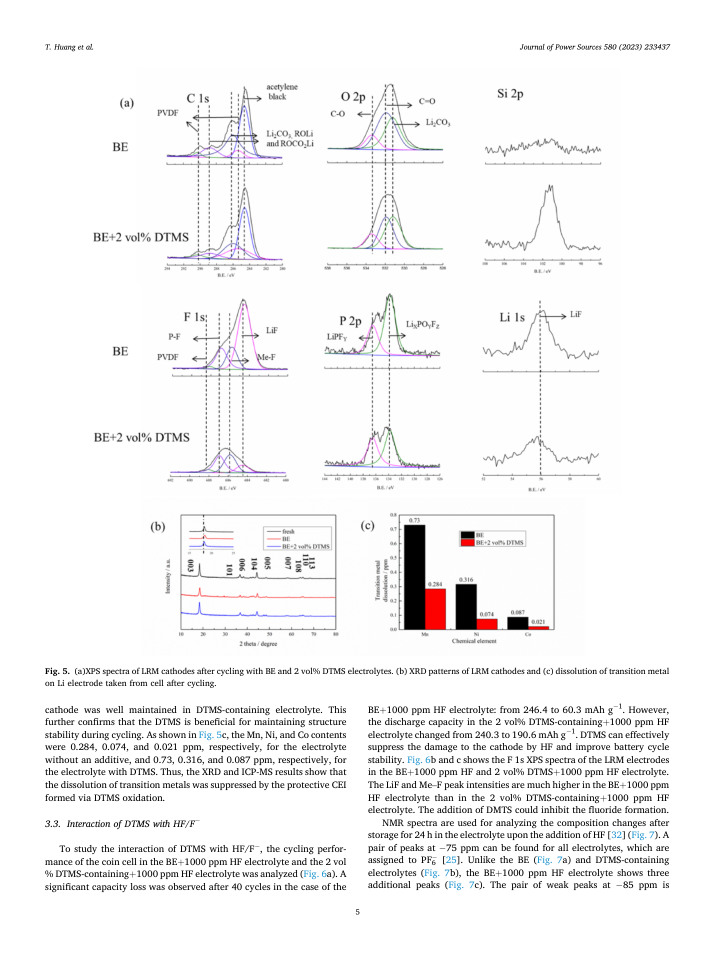
| high | 3 | 58 | text | body_candidate_excluded | inside_back_matter | inside_back_matter | p3:body_region:1 | p3:bottom_margin:column_2_of_2:white | [255, 255, 255] white | [306.59, 662.27, 253.42, 80.5] | Fig. 5a depicts the obtained XPS of LRM cells with BE and DMSEcontaining electrolytes after cycling. The C 1s peaks at 290.3 and 285.4 eV correspond to PVDF [19,25], and the peak at 284.6 eV is assigned to acetylene black [17]. Furthermore, the peak intensities of the PVDF and acetylene black of the LRM electrode in the BE electrolyte after cycling were higher than those in DTMS-containing electrolytes, which indicates that a thinner CEI film was formed with DTMS. The peaks corresponding to electrolyte decomposition products [19,25] | Fig. 5a depicts the obtained XPS of LRM cells with BE and DMSEcontaining electrolytes after cycling. The C 1s peaks at 290.3 and 285.4 eV correspond to PVDF [19,25], and the peak at 284.6 eV is assigned to acetylene black [17]. Furthermore, the peak intensities of the PVDF and acetylene black of the LRM electrode in the BE electrolyte after cycling were higher than those in DTMS-containing electrolytes, which indicates that a thinner CEI film was formed with DTMS. The peaks corresponding to electrolyte decomposition products [19,25] | ||
| high | 4 | 64 | text | body_candidate_excluded | inside_back_matter | inside_back_matter | p4:body_region:0 | p4:bottom_margin:column_1_of_2:white | [255, 255, 255] white | [37.59, 609.43, 253.44, 132.83] | (ROCO2Li, ROLi, and Li2CO3) at 286 and 288.8 eV were observed. The peak intensities for the electrolyte with DTMS were lower than those for the BE electrolyte. The same result can be observed in O 1s spectra. The peak intensities corresponding to C --O (531.9 eV) [17,19], C -O (533.4 eV)[ 25], and Li2CO3 (531.2 eV) [19] for the electrolyte with DTMS were lower. The F 1s peaks at 684.5 and 685.8 eV were assigned to LiF and Me -F [19], respectively. The peak at 56 eV [31] corresponds to LiF in the Li 1s spectra. For the BE electrolyte, the peak intensities of LiF and Me -F are higher in the F 1s spectra. The peaks at 686.9 eV [19] for LixPFy and LixPOyFz in the BE electrolyte are higher than those in the DTMS-containing electrolyte in the F 1s spectra, which may be due to the LiPF6 decomposition. This is in accordance with the P 1s spectra for the peaks of LixPFy (136.5 eV) and LixPOyFz (133.8 eV) [23]. In | (ROCO2Li, ROLi, and Li2CO3) at 286 and 288.8 eV were observed. The peak intensities for the electrolyte with DTMS were lower than those for the BE electrolyte. The same result can be observed in O 1s spectra. The peak intensities corresponding to C --O (531.9 eV) [17,19], C -O (533.4 eV)[ 25], and Li2CO3 (531.2 eV) [19] for the electrolyte with DTMS were lower. The F 1s peaks at 684.5 and 685.8 eV were assigned to LiF and Me -F [19], respectively. The peak at 56 eV [31] corresponds to LiF in the Li 1s spectra. For the BE electrolyte, the peak intensities of LiF and Me -F are higher in the F 1s spectra. The peaks at 686.9 eV [19] for LixPFy and LixPOyFz in the BE electrolyte are higher than those in the DTMS-containing electrolyte in the F 1s spectra, which may be due to the LiPF6 decomposition. This is in accordance with the P 1s spectra for the peaks of LixPFy (136.5 eV) and LixPOyFz (133.8 eV) [23]. In | ||
| high | 4 | 66 | text | body_candidate_excluded | inside_back_matter | inside_back_matter | p4:body_region:1 | p4:bottom_margin:column_2_of_2:white | [255, 255, 255] white | [306.59, 661.76, 253.43, 80.5] | The XRD results for the cathodes before and after cycling with the BE and 2% DTMS-containing electrolytes are shown in Fig. 5b: the XRD peak intensity of the cathode in the BE electrolyte reduces drastically after cycling. The peak (003) broadens and shifts slightly to a higher angle [19], indicating severe structural damage on the LRM electrode in the BE electrolyte. However, after cycling, the LRM electrode with the 2% DTMS-containing electrolyte exhibits almost the same diffraction pattern as that before cycling, indicating that the crystal structure of the | The XRD results for the cathodes before and after cycling with the BE and 2% DTMS-containing electrolytes are shown in Fig. 5b: the XRD peak intensity of the cathode in the BE electrolyte reduces drastically after cycling. The peak (003) broadens and shifts slightly to a higher angle [19], indicating severe structural damage on the LRM electrode in the BE electrolyte. However, after cycling, the LRM electrode with the 2% DTMS-containing electrolyte exhibits almost the same diffraction pattern as that before cycling, indicating that the crystal structure of the | ||
| high | 5 | 71 | text | body_candidate_excluded | inside_back_matter | inside_back_matter | p5:body_region:0 | p5:front_matter:column_1_of_2:white | [255, 255, 255] white | [37.59, 588.57, 253.44, 80.56] | cathode was well maintained in DTMS-containing electrolyte. This further confirms that the DTMS is beneficial for maintaining structure stability during cycling. As shown in Fig. 5c, the Mn, Ni, and Co contents were 0.284, 0.074, and 0.021 ppm, respectively, for the electrolyte without an additive, and 0.73, 0.316, and 0.087 ppm, respectively, for the electrolyte with DTMS. Thus, the XRD and ICP-MS results show that the dissolution of transition metals was suppressed by the protective CEI formed via DTMS oxidation. | cathode was well maintained in DTMS-containing electrolyte. This further confirms that the DTMS is beneficial for maintaining structure stability during cycling. As shown in Fig. 5c, the Mn, Ni, and Co contents were 0.284, 0.074, and 0.021 ppm, respectively, for the electrolyte without an additive, and 0.73, 0.316, and 0.087 ppm, respectively, for the electrolyte with DTMS. Thus, the XRD and ICP-MS results show that the dissolution of transition metals was suppressed by the protective CEI formed via DTMS oxidation. | ||
| medium | 1 | 10 | list_item | unknown_text | outside_body_flow_list_item | outside_body_flow_list_item | p1:body_region:0 | p1:front_matter:column_1_of_2:white | [255, 255, 255] white | [37.59, 318.9, 179.65, 6.58] | The DTMS-derived layer maintains interface stability. | The DTMS-derived layer maintains interface stability. | ||
| medium | 1 | 15 | text | unknown_text | inside_front_matter | inside_front_matter | p1:body_region:0 | p1:front_matter:column_1_of_2:white | [255, 255, 255] white | [37.59, 425.06, 94.03, 5.85] | 1,3-divinyltetramethyldisiloxane | 1,3-divinyltetramethyldisiloxane | ||
| medium | 1 | 23 | text | unknown_text | empty_after_cleaning | empty_after_cleaning | p1:body_region:1 | p1:front_matter:column_2_of_2:white | [255, 255, 255] white | [379.16, 226.86, 6.28, 6.78] | * | |||
| low | 1 | 0 | page_header | page_header | docling_page_header | docling_page_header | p1:body_region:1 | p1:top_margin:column_2_of_2:white | [255, 255, 255] white | [224.72, 33.45, 145.08, 11.73] | Journal of Power Sources 580 (2023) 233437 | Journal of Power Sources 580 (2023) 233437 | ||
| low | 1 | 1 | section_header | front_matter_heading | first_page_metadata | first_page_metadata | p1:body_region:1 | p1:front_matter:front_panel:gray | [230, 230, 230] gray | [228.42, 63.48, 142.99, 7.31] | Contents lists available at ScienceDirect | Contents lists available at ScienceDirect | ||
| low | 1 | 2 | section_header | title_candidate | first_page_front_matter_heading | first_page_front_matter_heading | p1:body_region:1 | p1:front_matter:front_panel:gray | [230, 230, 230] gray | [219.29, 87.36, 163.01, 12.79] | Journal of Power Sources | Journal of Power Sources | ||
| low | 1 | 3 | text | front_matter_heading | first_page_metadata | first_page_metadata | p1:body_region:1 | p1:front_matter:front_panel:gray | [230, 230, 230] gray | [195.48, 119.22, 208.78, 6.67] | journal homepage: www.elsevier.com/locate/jpowsour | journal homepage: | ||
| low | 1 | 4 | section_header | title_candidate | first_page_front_matter_heading | first_page_front_matter_heading | p1:body_region:0 | p1:front_matter:column_1_of_2:white | [255, 255, 255] white | [37.59, 168.03, 450.29, 46.81] | Efficient improvement in electrochemical properties of high-voltage Li-rich Mn-based layered oxide cathode by addition of 1,3-divinyltetramethyldisiloxane to electrolyte | Efficient improvement in electrochemical properties of high-voltage Li-rich Mn-based layered oxide cathode by addition of 1,3-divinyltetramethyldisiloxane to electrolyte | ||
| low | 1 | 5 | text | affiliation | first_page_author_or_affiliation | first_page_author_or_affiliation | p1:body_region:0 | p1:front_matter:column_1_of_2:white | [255, 255, 255] white | [37.59, 229.44, 339.84, 9.69] | Tao Huang, Xiangzhen Zheng, Chunfeng Yan, Ying Pan , Maoxiang Wu | Tao Huang, Xiangzhen Zheng, Chunfeng Yan, Ying Pan , Maoxiang Wu | ||
| low | 1 | 6 | text | affiliation | first_page_author_or_affiliation | first_page_author_or_affiliation | p1:body_region:0 | p1:front_matter:column_1_of_2:white | [255, 255, 255] white | [37.59, 248.69, 437.99, 5.85] | Key Laboratory of Optoelectronic Materials Chemistry and Physics, Fujian Institute of Research on the Structure of Matter, Chinese Academy of Sciences, Fuzhou, | Key Laboratory of Optoelectronic Materials Chemistry and Physics, Fujian Institute of Research on the Structure of Matter, Chinese Academy of Sciences, Fuzhou, | ||
| low | 1 | 7 | text | unknown_text | before_body_started | before_body_started | p1:body_region:0 | p1:front_matter:column_1_of_2:white | [255, 255, 255] white | [37.59, 257.25, 56.39, 5.85] | 350002, PR China | 350002, PR China | ||
| low | 1 | 8 | section_header | front_matter_heading | front_matter_heading | front_matter_heading | p1:body_region:0 | p1:front_matter:column_1_of_2:white | [255, 255, 255] white | [37.59, 289.44, 75.13, 6.4] | H I G H L I G H T S | H I G H L I G H T S | ||
| low | 1 | 9 | list_item | front_matter_candidate | outside_body_flow_list_item | outside_body_flow_list_item | p1:body_region:0 | p1:front_matter:column_1_of_2:white | [255, 255, 255] white | [37.59, 308.87, 231.27, 6.58] | DTMS improved cyclic stability of LRM cathode lithium-ion batteries. | DTMS improved cyclic stability of LRM cathode lithium-ion batteries. | ||
| low | 1 | 11 | list_item | front_matter_candidate | outside_body_flow_list_item | outside_body_flow_list_item | p1:body_region:0 | p1:front_matter:column_1_of_2:white | [255, 255, 255] white | [37.59, 328.99, 170.36, 6.58] | DTMS reacts with the HF/F from the electrolyte. | DTMS reacts with the HF/F from the electrolyte. | ||
| low | 1 | 12 | section_header | front_matter_heading | front_matter_heading | front_matter_heading | p1:body_region:0 | p1:front_matter:column_1_of_2:white | [255, 255, 255] white | [37.59, 363.31, 88.53, 6.4] | A R T I C L E I N F O | A R T I C L E I N F O | ||
| low | 1 | 13 | section_header | abstract_heading | abstract_heading | abstract_heading | p1:body_region:0 | p1:front_matter:column_2_of_2:white | [255, 255, 255] white | [202.0, 363.31, 67.15, 6.4] | A B S T R A C T | A B S T R A C T | ||
| low | 1 | 14 | text | front_matter_heading | front_matter_heading | front_matter_heading | p1:body_region:0 | p1:front_matter:column_1_of_2:white | [255, 255, 255] white | [37.59, 382.2, 93.07, 40.15] | Keywords: Lithium-ion battery Li-rich layered oxide cathode Solid electrolyte interphase film Interfacial stability | Keywords: Lithium-ion battery Li-rich layered oxide cathode Solid electrolyte interphase film Interfacial stability | ||
| low | 1 | 16 | text | front_matter_candidate | first_page_summary | first_page_summary | p1:body_region:1 | p1:front_matter:column_2_of_2:white | [255, 255, 255] white | [202.0, 382.68, 357.8, 73.53] | 1,3-Divinyltetramethyldisiloxane (DTMS) is a multifunctional additive that is used to improves the cycling stability and capacity retention of Li-rich Mn-based layered oxide cathodes (LRMs). Cycling performance evaluations demonstrate that LRM/Li cells without the additive exhibit lower capacity retention. DTMS can significantly improve the capacity retention of LRM/Li cells from 42.8% to 75% at 0.5C. Theoretical calculations indicate that DTMS is preferentially oxidized on the LRM surface. Physical characterization results reveal that DTMS generates a layer on the LRM surface that is both less resistive and thinner than the LRM by reacting with HF/F from the electrolyte. This DTMS-derived layer inhibits adverse reactions between the cathode and electrolyte, thus, effectively maintaining the cathode structure. | 1,3-Divinyltetramethyldisiloxane (DTMS) is a multifunctional additive that is used to improves the cycling stability and capacity retention of Li-rich Mn-based layered oxide cathodes (LRMs). Cycling performance evaluations demonstrate that LRM/Li cells without the additive exhibit lower capacity retention. DTMS can significantly improve the capacity retention of LRM/Li cells from 42.8% to 75% at 0.5C. Theoretical calculations indicate that DTMS is preferentially oxidized on the LRM surface. Physical characterization results reveal that DTMS generates a layer on the LRM surface that is both less resistive and thinner than the LRM by reacting with HF/F from the electrolyte. This DTMS-derived layer inhibits adverse reactions between the cathode and electrolyte, thus, effectively maintaining the cathode structure. | ||
| low | 1 | 17 | section_header | body_heading | body_heading | body_heading | p1:body_region:0 | p1:body_zone:column_1_of_2:white | [255, 255, 255] white | [37.59, 488.79, 62.58, 7.31] | 1. Introduction | 1. Introduction | ||
| low | 1 | 19 | footnote | footnote | first_page_metadata | first_page_metadata | p1:body_region:0 | p1:body_zone:column_1_of_2:white | [255, 255, 255] white | [42.63, 672.84, 153.92, 16.16] | * Corresponding author. E-mail address: mxwu@fjirsm.ac.cn (M. Wu). | * Corresponding author. E-mail address: mxwu@fjirsm.ac.cn (M. Wu). | ||
| low | 1 | 20 | page_footer | page_footer | first_page_metadata | first_page_metadata | p1:body_region:0 | p1:body_zone:column_1_of_2:white | [254, 254, 254] white | [37.59, 699.43, 160.64, 6.58] | https://doi.org/10.1016/j.jpowsour.2023.233437 | |||
| low | 1 | 21 | page_footer | page_footer | first_page_metadata | first_page_metadata | p1:body_region:0 | p1:body_zone:column_1_of_2:white | [255, 255, 255] white | [37.52, 708.95, 299.92, 17.48] | Available online 26 July 2023 Received 28 February 2023; Received in revised form 7 June 2023; Accepted 17 July 2023 | Available online 26 July 2023 Received 28 February 2023; Received in revised form 7 June 2023; Accepted 17 July 2023 | ||
| low | 1 | 22 | page_footer | page_footer | first_page_metadata | first_page_metadata | p1:body_region:0 | p1:bottom_margin:column_1_of_2:white | [255, 255, 255] white | [37.52, 724.32, 167.09, 11.73] | 0378-7753/© 2023 Elsevier B.V. All rights reserved. | 0378-7753/© 2023 Elsevier B.V. All rights reserved. | ||
| low | 2 | 26 | page_header | page_header | docling_page_header | docling_page_header | p2:body_region:1 | p2:top_margin:column_2_of_2:white | [255, 255, 255] white | [433.38, 33.65, 124.91, 10.42] | Journal of Power Sources 580 (2023) 233437 | Journal of Power Sources 580 (2023) 233437 | ||
| low | 2 | 27 | text | page_margin_header | page_margin_header | page_margin_header | p2:body_region:0 | p2:top_margin:column_1_of_2:white | [255, 255, 255] white | [37.59, 37.0, 463.07, 5.85] | T. Huang et al. | T. Huang et al. | ||
| low | 2 | 30 | section_header | body_heading | body_heading | body_heading | p2:body_region:0 | p2:body_zone:column_1_of_2:white | [255, 255, 255] white | [37.59, 453.13, 58.23, 7.31] | 2. Experiment | 2. Experiment | ||
| low | 2 | 31 | section_header | body_heading | body_heading | body_heading | p2:body_region:0 | p2:body_zone:column_1_of_2:white | [255, 255, 255] white | [37.59, 474.05, 158.65, 7.31] | 2.1. Preparation of electrolytes and electrodes | 2.1. Preparation of electrolytes and electrodes | ||
| low | 2 | 34 | section_header | body_heading | body_heading | body_heading | p2:body_region:0 | p2:body_zone:column_1_of_2:white | [255, 255, 255] white | [37.59, 652.4, 96.4, 7.31] | 2.2. Electrochemical testing | 2.2. Electrochemical testing | ||
| low | 2 | 36 | caption | caption | docling_caption | docling_caption | p2:body_region:1 | p2:top_margin:column_2_of_2:white | [255, 255, 255] white | [366.12, 56.3, 79.26, 16.16] | Table 1 Calculated Eox (V vs. Li + | Table 1 Calculated Eox (V vs. Li + | ||
| low | 2 | 39 | section_header | body_heading | body_heading | body_heading | p2:body_region:1 | p2:body_zone:column_2_of_2:white | [255, 255, 255] white | [306.6, 197.1, 104.56, 7.31] | 2.3. Physical characterization | 2.3. Physical characterization | ||
| low | 2 | 41 | section_header | body_heading | body_heading | body_heading | p2:body_region:1 | p2:body_zone:column_2_of_2:white | [255, 255, 255] white | [306.6, 313.49, 61.58, 7.31] | 2.4. Calculations | 2.4. Calculations | ||
| low | 2 | 44 | section_header | body_heading | body_heading | body_heading | p2:body_region:1 | p2:body_zone:column_2_of_2:white | [255, 255, 255] white | [306.6, 420.93, 100.96, 7.31] | 3. Results and discussion | 3. Results and discussion | ||
| low | 2 | 45 | section_header | body_heading | body_heading | body_heading | p2:body_region:1 | p2:body_zone:column_2_of_2:white | [255, 255, 255] white | [306.6, 441.84, 114.37, 7.31] | 3.1. Oxidative stability of DTMS | 3.1. Oxidative stability of DTMS | ||
| low | 2 | 47 | section_header | body_heading | body_heading | body_heading | p2:body_region:1 | p2:body_zone:column_2_of_2:white | [255, 255, 255] white | [306.6, 641.91, 167.94, 7.31] | 3.2. Impact of DTMS at electrochemical perform | 3.2. Impact of DTMS at electrochemical perform | ||
| low | 2 | 48 | text | back_matter_heading | early_back_matter_heading | early_back_matter_heading | p2:body_region:1 | p2:bottom_margin:column_2_of_2:white | [255, 255, 255] white | [306.6, 662.83, 253.42, 80.56] | Supplementary Material. 2 shows the charge -discharge curve performance of LRM/Li cells with and without 2 vol% DTMS electrolytes during the first pre-cycle process. It can be found that the cells in the 2 vol% DTMS-containing electrolyte have a large charge capacity of 321.2 mAh g 1 and that they delivered a lower coulombic efficiency (92.5%) than the cells in the BE electrolyte (97.2%). This may be due to DTMS oxidation occurring prior to that of electrolyte solvents. Fig. 2 presents the comparison of the cycling performance of LRM/Li cells in the | Supplementary Material. 2 shows the charge -discharge curve performance of LRM/Li cells with and without 2 vol% DTMS electrolytes during the first pre-cycle process. It can be found that the cells in the 2 vol% DTMS-containing electrolyte have a large charge capacity of 321.2 mAh g 1 and that they delivered a lower coulombic efficiency (92.5%) than the cells in the BE electrolyte (97.2%). This may be due to DTMS oxidation occurring prior to that of electrolyte solvents. Fig. 2 presents the comparison of the cycling performance of LRM/Li cells in the | ||
| low | 2 | 49 | page_footer | page_footer | docling_page_footer | docling_page_footer | p2:bottom_margin:column_2_of_2:white | [255, 255, 255] white | [296.21, 754.45, 3.59, 10.42] | 2 | 2 | |||
| low | 3 | 50 | page_header | page_header | docling_page_header | docling_page_header | p3:body_region:1 | p3:top_margin:column_2_of_2:white | [255, 255, 255] white | [433.38, 33.65, 124.91, 10.42] | Journal of Power Sources 580 (2023) 233437 | Journal of Power Sources 580 (2023) 233437 | ||
| low | 3 | 51 | text | page_margin_header | page_margin_header | page_margin_header | p3:body_region:0 | p3:top_margin:column_1_of_2:white | [255, 255, 255] white | [37.59, 36.99, 463.07, 5.85] | T. Huang et al. | T. Huang et al. | ||
| low | 3 | 52 | caption | caption | outside_body_flow_caption | outside_body_flow_caption | p3:page_body:column_2_of_2:white | [255, 255, 255] white | [179.09, 187.18, 241.32, 8.3] | Fig. 1. Optimized structures and Eb values of solvents-Li + and DTMS-Li + . | Fig. 1. Optimized structures and Eb values of solvents-Li + and DTMS-Li + . | |||
| low | 3 | 53 | caption | caption | outside_body_flow_caption | outside_body_flow_caption | p3:page_body:column_1_of_2:white | [255, 255, 255] white | [38.95, 472.99, 521.55, 6.58] | Fig. 2. (a) Cycling performance and (b) rate capability of LRM/Li cell. (c) (d) 1st, 20th, 50th, and 100th charge -discharge curves of LRM/Li cell during cycling. | Fig. 2. (a) Cycling performance and (b) rate capability of LRM/Li cell. (c) (d) 1st, 20th, 50th, and 100th charge -discharge curves of LRM/Li cell during cycling. | |||
| low | 3 | 59 | page_footer | page_footer | docling_page_footer | docling_page_footer | p3:bottom_margin:column_2_of_2:white | [255, 255, 255] white | [296.21, 754.45, 3.59, 10.42] | 3 | 3 | |||
| low | 4 | 60 | page_header | page_header | docling_page_header | docling_page_header | p4:body_region:1 | p4:top_margin:column_2_of_2:white | [255, 255, 255] white | [433.38, 33.65, 124.91, 10.42] | Journal of Power Sources 580 (2023) 233437 | Journal of Power Sources 580 (2023) 233437 | ||
| low | 4 | 61 | text | page_margin_header | page_margin_header | page_margin_header | p4:body_region:0 | p4:top_margin:column_1_of_2:white | [255, 255, 255] white | [37.59, 36.99, 463.07, 5.85] | T. Huang et al. | T. Huang et al. | ||
| low | 4 | 62 | caption | caption | outside_body_flow_caption | outside_body_flow_caption | p4:page_body:column_1_of_2:white | [255, 255, 255] white | [86.63, 307.39, 426.25, 6.58] | Fig. 3. EIS results of LRM/Li cell in BE and 2 vol% DTMS electrolyte after (a) pre-cycling and (b) cycling. (c) Values of Rf and Rct. | Fig. 3. EIS results of LRM/Li cell in BE and 2 vol% DTMS electrolyte after (a) pre-cycling and (b) cycling. (c) Values of Rf and Rct. | |||
| low | 4 | 63 | caption | caption | outside_body_flow_caption | outside_body_flow_caption | p4:page_body:column_1_of_2:white | [255, 255, 255] white | [112.82, 587.51, 373.83, 6.58] | Fig. 4. TEM and SEM images of LRM cathodes after cycling (a), (c) with BE and (b), (d) 2 vol% DTMS electrolyte. | Fig. 4. TEM and SEM images of LRM cathodes after cycling (a), (c) with BE and (b), (d) 2 vol% DTMS electrolyte. | |||
| low | 4 | 65 | text | body_heading | inside_back_matter | inside_back_matter | p4:body_region:1 | p4:page_body:column_2_of_2:white | [255, 255, 255] white | [306.59, 609.43, 253.42, 49.15] | conclusion, the peak intensities for the electrolyte decomposition products on the cathode in the DTMS-containing electrolyte were weaker, confirming that the electrolyte decomposition could be inhibited by DTMS. The existence of Si (Si 2p spectrum) indicates that the film on the cathode is formed from the oxidation of DTMS. | conclusion, the peak intensities for the electrolyte decomposition products on the cathode in the DTMS-containing electrolyte were weaker, confirming that the electrolyte decomposition could be inhibited by DTMS. The existence of Si (Si 2p spectrum) indicates that the film on the cathode is formed from the oxidation of DTMS. | ||
| low | 4 | 67 | page_footer | page_footer | docling_page_footer | docling_page_footer | p4:bottom_margin:column_2_of_2:white | [255, 255, 255] white | [296.21, 754.45, 3.59, 10.42] | 4 | 4 | |||
| low | 5 | 68 | page_header | page_header | docling_page_header | docling_page_header | p5:body_region:1 | p5:top_margin:column_2_of_2:white | [255, 255, 255] white | [433.38, 33.65, 124.91, 10.42] | Journal of Power Sources 580 (2023) 233437 | Journal of Power Sources 580 (2023) 233437 | ||
| low | 5 | 69 | text | page_margin_header | page_margin_header | page_margin_header | p5:body_region:0 | p5:top_margin:column_1_of_2:white | [255, 255, 255] white | [37.59, 36.99, 463.07, 5.85] | T. Huang et al. | T. Huang et al. | ||
| low | 5 | 70 | caption | caption | outside_body_flow_caption | outside_body_flow_caption | p5:front_matter:column_1_of_2:white | [255, 255, 255] white | [37.59, 557.13, 522.17, 16.1] | Fig. 5. (a)XPS spectra of LRM cathodes after cycling with BE and 2 vol% DTMS electrolytes. (b) XRD patterns of LRM cathodes and (c) dissolution of transition metal on Li electrode taken from cell after cycling. | Fig. 5. (a)XPS spectra of LRM cathodes after cycling with BE and 2 vol% DTMS electrolytes. (b) XRD patterns of LRM cathodes and (c) dissolution of transition metal on Li electrode taken from cell after cycling. | |||
| low | 5 | 72 | section_header | body_heading | body_heading | body_heading | p5:body_region:0 | p5:body_zone:column_1_of_2:white | [255, 255, 255] white | [37.59, 683.75, 124.69, 7.31] | 3.3. Interaction of DTMS with HF/F | 3.3. Interaction of DTMS with HF/F | ||
| low | 5 | 76 | page_footer | page_footer | docling_page_footer | docling_page_footer | p5:bottom_margin:column_2_of_2:white | [255, 255, 255] white | [296.21, 754.45, 3.59, 10.42] | 5 | 5 | |||
| low | 6 | 77 | page_header | page_header | docling_page_header | docling_page_header | p6:top_margin:column_2_of_2:white | [255, 255, 255] white | [433.38, 33.65, 124.91, 10.42] | Journal of Power Sources 580 (2023) 233437 | Journal of Power Sources 580 (2023) 233437 | |||
| low | 6 | 78 | text | page_margin_header | page_margin_header | page_margin_header | p6:top_margin:column_1_of_2:white | [255, 255, 255] white | [37.59, 36.99, 463.07, 5.85] | T. Huang et al. | T. Huang et al. | |||
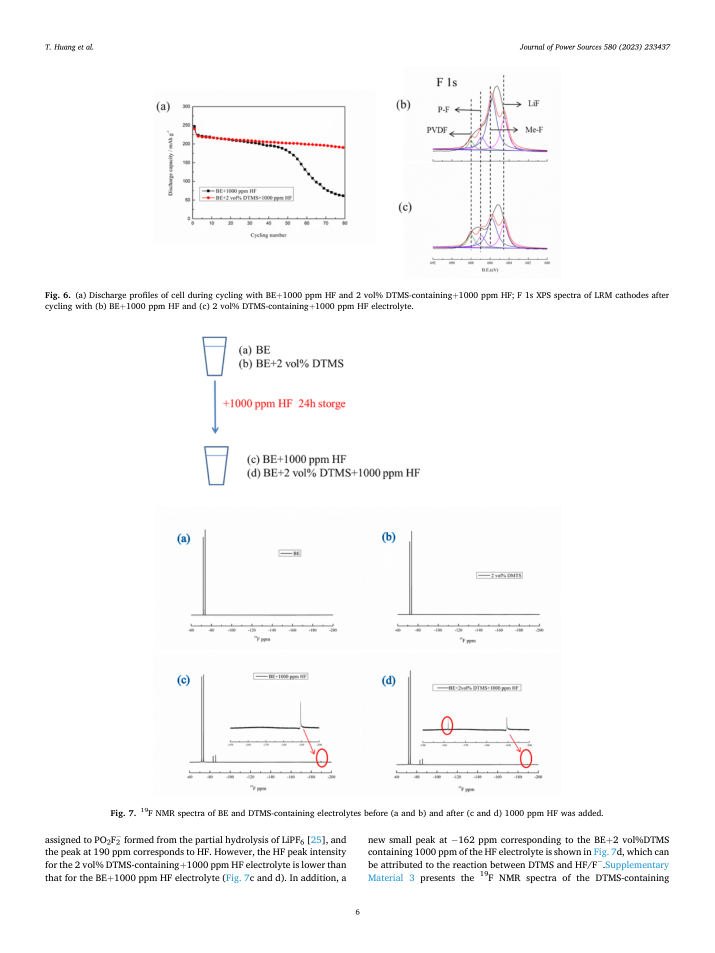
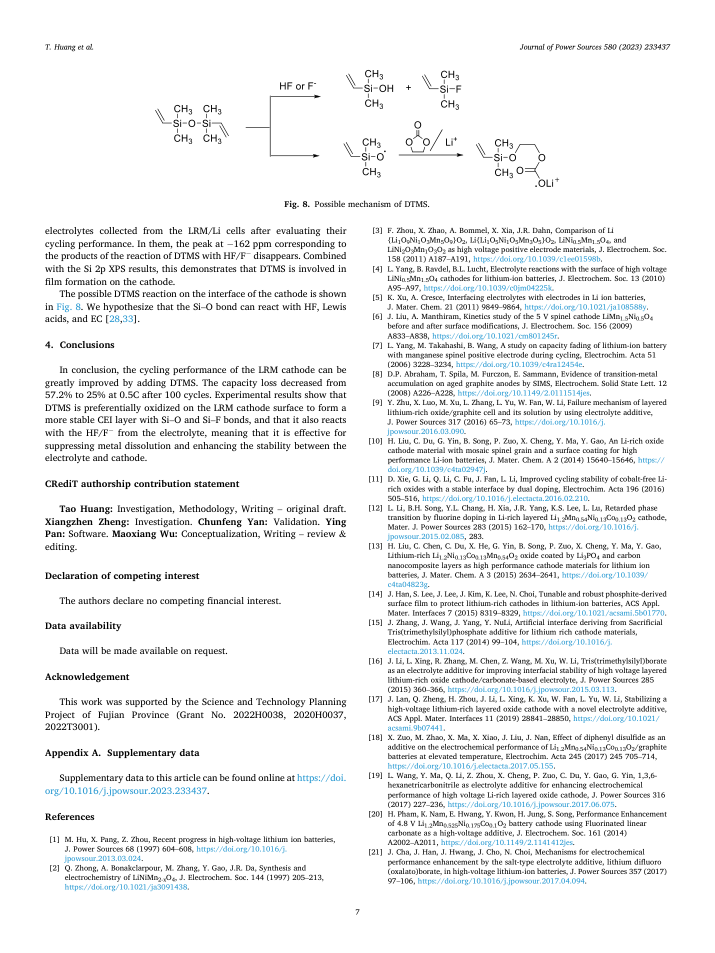
| low | 6 | 79 | caption | caption | outside_body_flow_caption | outside_body_flow_caption | p6:page_body:column_1_of_2:white | [255, 255, 255] white | [37.59, 243.16, 522.15, 16.16] | Fig. 6. (a) Discharge profiles of cell during cycling with BE + 1000 ppm HF and 2 vol% DTMS-containing + 1000 ppm HF; F 1s XPS spectra of LRM cathodes after cycling with (b) BE + 1000 ppm HF and (c) 2 vol% DTMS-containing + 1000 ppm HF electrolyte. | Fig. 6. (a) Discharge profiles of cell during cycling with BE + 1000 ppm HF and 2 vol% DTMS-containing + 1000 ppm HF; F 1s XPS spectra of LRM cathodes after cycling with (b) BE + 1000 ppm HF and (c) 2 vol% DTMS-containing + 1000 ppm HF electrolyte. | |||
| low | 6 | 83 | page_footer | page_footer | docling_page_footer | docling_page_footer | p6:bottom_margin:column_2_of_2:white | [255, 255, 255] white | [296.21, 754.45, 3.59, 10.42] | 6 | 6 | |||
| low | 7 | 84 | page_header | page_header | docling_page_header | docling_page_header | p7:top_margin:column_2_of_2:white | [255, 255, 255] white | [433.38, 33.65, 124.91, 10.42] | Journal of Power Sources 580 (2023) 233437 | Journal of Power Sources 580 (2023) 233437 | |||
| low | 7 | 85 | text | page_margin_header | page_margin_header | page_margin_header | p7:body_region:0 | p7:top_margin:column_1_of_2:white | [255, 255, 255] white | [37.59, 36.99, 463.07, 5.85] | T. Huang et al. | T. Huang et al. | ||
| low | 7 | 88 | section_header | body_heading | body_heading | body_heading | p7:body_region:0 | p7:body_zone:column_1_of_2:white | [255, 255, 255] white | [37.59, 284.81, 60.27, 7.31] | 4. Conclusions | 4. Conclusions | ||
| low | 7 | 90 | section_header | back_matter_heading | back_matter_heading | back_matter_heading | stop_trigger | p7:body_region:0 | p7:body_zone:column_1_of_2:white | [255, 255, 255] white | [37.59, 400.63, 164.27, 7.31] | CRediT authorship contribution statement | CRediT authorship contribution statement | |
| low | 7 | 91 | text | affiliation | after_back_matter_stop | after_back_matter_stop | after_stop | p7:body_region:0 | p7:body_zone:column_1_of_2:white | [255, 255, 255] white | [37.59, 421.55, 253.42, 38.66] | Tao Huang: Investigation, Methodology, Writing -original draft. Xiangzhen Zheng: Investigation. Chunfeng Yan: Validation. Ying Pan: Software. Maoxiang Wu: Conceptualization, Writing -review & editing. | Tao Huang: Investigation, Methodology, Writing -original draft. Xiangzhen Zheng: Investigation. Chunfeng Yan: Validation. Ying Pan: Software. Maoxiang Wu: Conceptualization, Writing -review & editing. | |
| low | 7 | 92 | section_header | back_matter_heading | after_back_matter_stop | after_back_matter_stop | after_stop | p7:body_region:0 | p7:body_zone:column_1_of_2:white | [255, 255, 255] white | [37.59, 476.94, 130.92, 7.31] | Declaration of competing interest | Declaration of competing interest | |
| low | 7 | 93 | text | unknown_text | after_back_matter_stop | after_back_matter_stop | after_stop | p7:body_region:0 | p7:body_zone:column_1_of_2:white | [255, 255, 255] white | [49.55, 497.86, 187.21, 7.31] | The authors declare no competing financial interest. | The authors declare no competing financial interest. | |
| low | 7 | 94 | section_header | back_matter_heading | after_back_matter_stop | after_back_matter_stop | after_stop | p7:body_region:0 | p7:body_zone:column_1_of_2:white | [255, 255, 255] white | [37.59, 518.78, 65.84, 7.31] | Data availability | Data availability | |
| low | 7 | 95 | text | unknown_text | after_back_matter_stop | after_back_matter_stop | after_stop | p7:body_region:0 | p7:body_zone:column_1_of_2:white | [255, 255, 255] white | [49.55, 539.7, 142.71, 7.31] | Data will be made available on request. | Data will be made available on request. | |
| low | 7 | 96 | section_header | back_matter_heading | after_back_matter_stop | after_back_matter_stop | after_stop | p7:body_region:0 | p7:body_zone:column_1_of_2:white | [255, 255, 255] white | [37.59, 561.35, 72.63, 7.31] | Acknowledgement | Acknowledgement | |
| low | 7 | 97 | text | back_matter_text | after_back_matter_stop | after_back_matter_stop | after_stop | p7:body_region:0 | p7:body_zone:column_1_of_2:white | [255, 255, 255] white | [37.59, 582.27, 253.44, 28.23] | This work was supported by the Science and Technology Planning Project of Fujian Province (Grant No. 2022H0038, 2020H0037, 2022T3001). | This work was supported by the Science and Technology Planning Project of Fujian Province (Grant No. 2022H0038, 2020H0037, 2022T3001). | |
| low | 7 | 98 | section_header | unknown_text | after_back_matter_stop | after_back_matter_stop | after_stop | p7:body_region:0 | p7:body_zone:column_1_of_2:white | [255, 255, 255] white | [37.59, 624.85, 130.96, 7.31] | Appendix A. Supplementary data | Appendix A. Supplementary data | |
| low | 7 | 99 | text | reference | after_back_matter_stop | after_back_matter_stop | after_stop | p7:body_region:0 | p7:body_zone:column_1_of_2:white | [255, 255, 255] white | [37.59, 645.77, 253.41, 17.74] | Supplementary data to this article can be found online at https://doi. org/10.1016/j.jpowsour.2023.233437. | Supplementary data to this article can be found online at org/10.1016/j.jpowsour.2023.233437. | |
| low | 7 | 100 | section_header | back_matter_heading | after_back_matter_stop | after_back_matter_stop | after_stop | p7:body_region:0 | p7:body_zone:column_1_of_2:white | [255, 255, 255] white | [37.59, 677.86, 43.55, 7.31] | References | References | |
| low | 7 | 101 | list_item | reference | after_back_matter_stop | after_back_matter_stop | after_stop | p7:body_region:0 | p7:body_zone:column_1_of_2:white | [255, 255, 255] white | [40.99, 697.3, 240.3, 21.78] | M. Hu, X. Pang, Z. Zhou, Recent progress in high-voltage lithium ion batteries, J. Power Sources 68 (1997) 604 -608, https://doi.org/10.1016/j. jpowsour.2013.03.024. | M. Hu, X. Pang, Z. Zhou, Recent progress in high-voltage lithium ion batteries, J. Power Sources 68 (1997) 604 -608, | |
| low | 7 | 102 | list_item | reference | after_back_matter_stop | after_back_matter_stop | after_stop | p7:body_region:0 | p7:bottom_margin:column_1_of_2:white | [255, 255, 255] white | [40.99, 721.22, 230.83, 21.78] | Q. Zhong, A. Bonakclarpour, M. Zhang, Y. Gao, J.R. Da, Synthesis and electrochemistry of LiNiMn2-xO4, J. Electrochem. Soc. 144 (1997) 205 -213, https://doi.org/10.1021/ja3091438. | Q. Zhong, A. Bonakclarpour, M. Zhang, Y. Gao, J.R. Da, Synthesis and electrochemistry of LiNiMn2-xO4, J. Electrochem. Soc. 144 (1997) 205 -213, | |
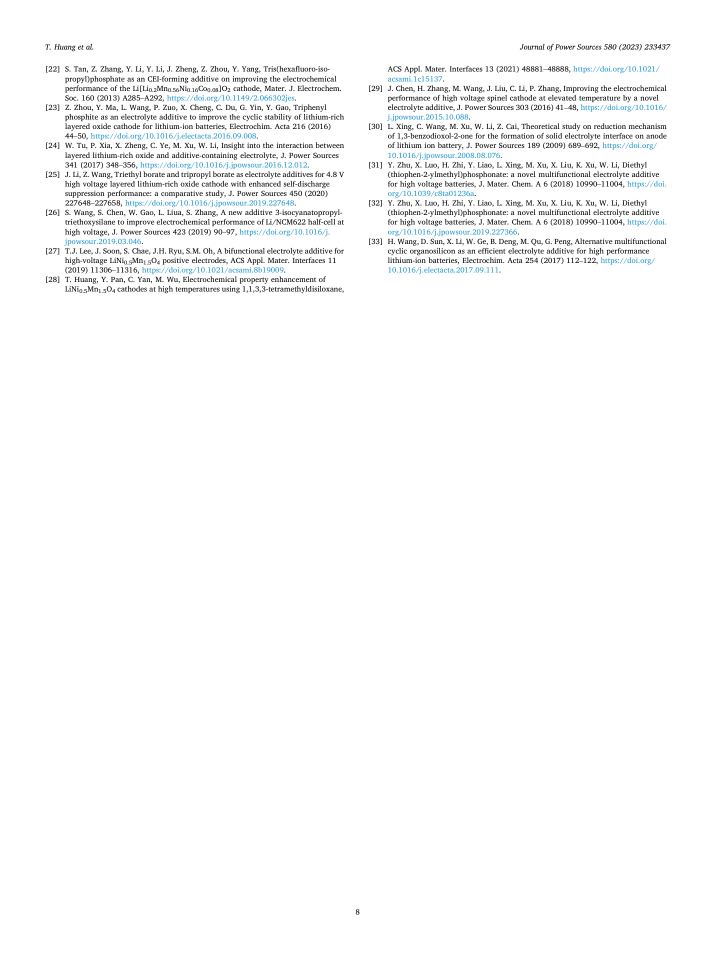
| low | 7 | 103 | caption | caption | after_back_matter_stop | after_back_matter_stop | after_stop | p7:front_matter:column_2_of_2:white | [255, 255, 255] white | [236.98, 168.04, 125.53, 6.58] | Fig. 8. Possible mechanism of DTMS. | Fig. 8. Possible mechanism of DTMS. | ||
| low | 7 | 104 | list_item | reference | after_back_matter_stop | after_back_matter_stop | after_stop | p7:front_matter:column_2_of_2:white | [255, 255, 255] white | [309.99, 189.96, 247.56, 29.71] | F. Zhou, X. Zhao, A. Bommel, X. Xia, J.R. Dahn, Comparison of Li {Li1O9Ni1O3Mn5O9}O2, Li{Li1O5Ni1O5Mn3O5}O2, LiNi0.5Mn1.5O4, and LiNi2O3Mn1O3O2 as high voltage positive electrode materials, J. Electrochem. Soc. 158 (2011) A187 -A191, https://doi.org/10.1039/c1ee01598b. | F. Zhou, X. Zhao, A. Bommel, X. Xia, J.R. Dahn, Comparison of Li {Li1O9Ni1O3Mn5O9}O2, Li{Li1O5Ni1O5Mn3O5}O2, LiNi0.5Mn1.5O4, and LiNi2O3Mn1O3O2 as high voltage positive electrode materials, J. Electrochem. Soc. 158 (2011) A187 -A191, | ||
| low | 7 | 105 | list_item | reference | after_back_matter_stop | after_back_matter_stop | after_stop | p7:front_matter:column_2_of_2:white | [255, 255, 255] white | [310.0, 221.81, 247.56, 21.78] | L. Yang, B. Ravdel, B.L. Lucht, Electrolyte reactions with the surface of high voltage LiNi0.5Mn1.5O4 cathodes for lithium-ion batteries, J. Electrochem. Soc. 13 (2010) A95 -A97, https://doi.org/10.1039/c0jm04225k. | L. Yang, B. Ravdel, B.L. Lucht, Electrolyte reactions with the surface of high voltage LiNi0.5Mn1.5O4 cathodes for lithium-ion batteries, J. Electrochem. Soc. 13 (2010) A95 -A97, | ||
| low | 7 | 106 | list_item | reference | after_back_matter_stop | after_back_matter_stop | after_stop | p7:front_matter:column_2_of_2:white | [255, 255, 255] white | [310.0, 245.74, 232.46, 13.79] | K. Xu, A. Cresce, Interfacing electrolytes with electrodes in Li ion batteries, J. Mater. Chem. 21 (2011) 9849 -9864, https://doi.org/10.1021/ja108588y. | K. Xu, A. Cresce, Interfacing electrolytes with electrodes in Li ion batteries, J. Mater. Chem. 21 (2011) 9849 -9864, | ||
| low | 7 | 107 | list_item | reference | after_back_matter_stop | after_back_matter_stop | after_stop | p7:front_matter:column_2_of_2:white | [255, 255, 255] white | [310.0, 261.67, 235.46, 21.78] | J. Liu, A. Manthiram, Kinetics study of the 5 V spinel cathode LiMn1.5Ni0.5O4 before and after surface modifications, J. Electrochem. Soc. 156 (2009) A833 -A838, https://doi.org/10.1021/cm801245r. | J. Liu, A. Manthiram, Kinetics study of the 5 V spinel cathode LiMn1.5Ni0.5O4 before and after surface modifications, J. Electrochem. Soc. 156 (2009) A833 -A838, | ||
| low | 7 | 108 | list_item | reference | after_back_matter_stop | after_back_matter_stop | after_stop | p7:body_zone:column_2_of_2:white | [255, 255, 255] white | [310.0, 285.59, 247.56, 21.78] | L. Yang, M. Takahashi, B. Wang, A study on capacity fading of lithium-ion battery with manganese spinel positive electrode during cycling, Electrochim. Acta 51 (2006) 3228 -3234, https://doi.org/10.1039/c4ra12454e. | L. Yang, M. Takahashi, B. Wang, A study on capacity fading of lithium-ion battery with manganese spinel positive electrode during cycling, Electrochim. Acta 51 (2006) 3228 -3234, | ||
| low | 7 | 109 | list_item | reference | after_back_matter_stop | after_back_matter_stop | after_stop | p7:body_zone:column_2_of_2:white | [255, 255, 255] white | [310.0, 309.46, 247.55, 21.78] | D.P. Abraham, T. Spila, M. Furczon, E. Sammann, Evidence of transition-metal accumulation on aged graphite anodes by SIMS, Electrochem. Solid State Lett. 12 (2008) A226 -A228, https://doi.org/10.1149/2.0111514jes. | D.P. Abraham, T. Spila, M. Furczon, E. Sammann, Evidence of transition-metal accumulation on aged graphite anodes by SIMS, Electrochem. Solid State Lett. 12 (2008) A226 -A228, | ||
| low | 7 | 110 | list_item | reference | after_back_matter_stop | after_back_matter_stop | after_stop | p7:body_zone:column_2_of_2:white | [255, 255, 255] white | [310.0, 333.38, 247.56, 29.77] | Y. Zhu, X. Luo, M. Xu, L. Zhang, L. Yu, W. Fan, W. Li, Failure mechanism of layered lithium-rich oxide/graphite cell and its solution by using electrolyte additive, J. Power Sources 317 (2016) 65 -73, https://doi.org/10.1016/j. jpowsour.2016.03.090. | Y. Zhu, X. Luo, M. Xu, L. Zhang, L. Yu, W. Fan, W. Li, Failure mechanism of layered lithium-rich oxide/graphite cell and its solution by using electrolyte additive, J. Power Sources 317 (2016) 65 -73, | ||
| low | 7 | 111 | list_item | reference | after_back_matter_stop | after_back_matter_stop | after_stop | p7:body_zone:column_2_of_2:white | [255, 255, 255] white | [306.6, 365.25, 249.07, 29.77] | H. Liu, C. Du, G. Yin, B. Song, P. Zuo, X. Cheng, Y. Ma, Y. Gao, An Li-rich oxide cathode material with mosaic spinel grain and a surface coating for high performance Li-ion batteries, J. Mater. Chem. A 2 (2014) 15640 -15646, https:// doi.org/10.1039/c4ta02947j. | H. Liu, C. Du, G. Yin, B. Song, P. Zuo, X. Cheng, Y. Ma, Y. Gao, An Li-rich oxide cathode material with mosaic spinel grain and a surface coating for high performance Li-ion batteries, J. Mater. Chem. A 2 (2014) 15640 -15646, https:// doi.org/10.1039/c4ta02947j. | ||
| low | 7 | 112 | list_item | reference | after_back_matter_stop | after_back_matter_stop | after_stop | p7:body_zone:column_2_of_2:white | [255, 255, 255] white | [306.6, 397.16, 250.96, 21.78] | D. Xie, G. Li, Q. Li, C. Fu, J. Fan, L. Li, Improved cycling stability of cobalt-free Lirich oxides with a stable interface by dual doping, Electrochim. Acta 196 (2016) 505 -516, https://doi.org/10.1016/j.electacta.2016.02.210. | D. Xie, G. Li, Q. Li, C. Fu, J. Fan, L. Li, Improved cycling stability of cobalt-free Lirich oxides with a stable interface by dual doping, Electrochim. Acta 196 (2016) 505 -516, | ||
| low | 7 | 113 | list_item | reference | after_back_matter_stop | after_back_matter_stop | after_stop | p7:body_zone:column_2_of_2:white | [255, 255, 255] white | [306.6, 421.03, 250.96, 29.77] | L. Li, B.H. Song, Y.L. Chang, H. Xia, J.R. Yang, K.S. Lee, L. Lu, Retarded phase transition by fluorine doping in Li-rich layered Li1.2Mn0.54Ni0.13Co0.13O2 cathode, Mater. J. Power Sources 283 (2015) 162 -170, https://doi.org/10.1016/j. jpowsour.2015.02.085, 283. | L. Li, B.H. Song, Y.L. Chang, H. Xia, J.R. Yang, K.S. Lee, L. Lu, Retarded phase transition by fluorine doping in Li-rich layered Li1.2Mn0.54Ni0.13Co0.13O2 cathode, Mater. J. Power Sources 283 (2015) 162 -170, | ||
| low | 7 | 114 | list_item | reference | after_back_matter_stop | after_back_matter_stop | after_stop | p7:body_zone:column_2_of_2:white | [255, 255, 255] white | [306.6, 452.95, 246.33, 37.71] | H. Liu, C. Chen, C. Du, X. He, G. Yin, B. Song, P. Zuo, X. Cheng, Y. Ma, Y. Gao, Lithium-rich Li1.2Ni0.13Co0.13Mn0.54O2 oxide coated by Li3PO4 and carbon nanocomposite layers as high performance cathode materials for lithium ion batteries, J. Mater. Chem. A 3 (2015) 2634 -2641, https://doi.org/10.1039/ c4ta04823g. | H. Liu, C. Chen, C. Du, X. He, G. Yin, B. Song, P. Zuo, X. Cheng, Y. Ma, Y. Gao, Lithium-rich Li1.2Ni0.13Co0.13Mn0.54O2 oxide coated by Li3PO4 and carbon nanocomposite layers as high performance cathode materials for lithium ion batteries, J. Mater. Chem. A 3 (2015) 2634 -2641, | ||
| low | 7 | 115 | list_item | reference | after_back_matter_stop | after_back_matter_stop | after_stop | p7:body_zone:column_2_of_2:white | [255, 255, 255] white | [306.6, 492.81, 250.92, 21.78] | J. Han, S. Lee, J. Lee, J. Kim, K. Lee, N. Choi, Tunable and robust phosphite-derived surface film to protect lithium-rich cathodes in lithium-ion batteries, ACS Appl. Mater. Interfaces 7 (2015) 8319 -8329, https://doi.org/10.1021/acsami.5b01770. | J. Han, S. Lee, J. Lee, J. Kim, K. Lee, N. Choi, Tunable and robust phosphite-derived surface film to protect lithium-rich cathodes in lithium-ion batteries, ACS Appl. Mater. Interfaces 7 (2015) 8319 -8329, | ||
| low | 7 | 116 | list_item | reference | after_back_matter_stop | after_back_matter_stop | after_stop | p7:body_zone:column_2_of_2:white | [255, 255, 255] white | [306.6, 516.73, 247.47, 29.72] | J. Zhang, J. Wang, J. Yang, Y. NuLi, Artificial interface deriving from Sacrificial Tris(trimethylsilyl)phosphate additive for lithium rich cathode materials, Electrochim. Acta 117 (2014) 99 -104, https://doi.org/10.1016/j. electacta.2013.11.024. | J. Zhang, J. Wang, J. Yang, Y. NuLi, Artificial interface deriving from Sacrificial Tris(trimethylsilyl)phosphate additive for lithium rich cathode materials, Electrochim. Acta 117 (2014) 99 -104, | ||
| low | 7 | 117 | list_item | reference | after_back_matter_stop | after_back_matter_stop | after_stop | p7:body_zone:column_2_of_2:white | [255, 255, 255] white | [306.6, 548.59, 250.97, 29.77] | J. Li, L. Xing, R. Zhang, M. Chen, Z. Wang, M. Xu, W. Li, Tris(trimethylsilyl)borate as an electrolyte additive for improving interfacial stability of high voltage layered lithium-rich oxide cathode/carbonate-based electrolyte, J. Power Sources 285 (2015) 360 -366, https://doi.org/10.1016/j.jpowsour.2015.03.113. | J. Li, L. Xing, R. Zhang, M. Chen, Z. Wang, M. Xu, W. Li, Tris(trimethylsilyl)borate as an electrolyte additive for improving interfacial stability of high voltage layered lithium-rich oxide cathode/carbonate-based electrolyte, J. Power Sources 285 (2015) 360 -366, | ||
| low | 7 | 118 | list_item | reference | after_back_matter_stop | after_back_matter_stop | after_stop | p7:body_zone:column_2_of_2:white | [255, 255, 255] white | [306.6, 580.45, 250.95, 29.77] | J. Lan, Q. Zheng, H. Zhou, J. Li, L. Xing, K. Xu, W. Fan, L. Yu, W. Li, Stabilizing a high-voltage lithium-rich layered oxide cathode with a novel electrolyte additive, ACS Appl. Mater. Interfaces 11 (2019) 28841 -28850, https://doi.org/10.1021/ acsami.9b07441. | J. Lan, Q. Zheng, H. Zhou, J. Li, L. Xing, K. Xu, W. Fan, L. Yu, W. Li, Stabilizing a high-voltage lithium-rich layered oxide cathode with a novel electrolyte additive, ACS Appl. Mater. Interfaces 11 (2019) 28841 -28850, | ||
| low | 7 | 119 | list_item | reference | after_back_matter_stop | after_back_matter_stop | after_stop | p7:body_zone:column_2_of_2:white | [255, 255, 255] white | [306.6, 612.37, 250.93, 29.72] | X. Zuo, M. Zhao, X. Ma, X. Xiao, J. Liu, J. Nan, Effect of diphenyl disulfide as an additive on the electrochemical performance of Li1.2Mn0.54Ni0.13Co0.13O2/graphite batteries at elevated temperature, Electrochim. Acta 245 (2017) 245 705 -714, https://doi.org/10.1016/j.electacta.2017.05.155. | X. Zuo, M. Zhao, X. Ma, X. Xiao, J. Liu, J. Nan, Effect of diphenyl disulfide as an additive on the electrochemical performance of Li1.2Mn0.54Ni0.13Co0.13O2/graphite batteries at elevated temperature, Electrochim. Acta 245 (2017) 245 705 -714, | ||
| low | 7 | 120 | list_item | reference | after_back_matter_stop | after_back_matter_stop | after_stop | p7:body_zone:column_2_of_2:white | [255, 255, 255] white | [306.6, 644.23, 249.78, 29.77] | L. Wang, Y. Ma, Q. Li, Z. Zhou, X. Cheng, P. Zuo, C. Du, Y. Gao, G. Yin, 1,3,6hexanetricarbonitrile as electrolyte additive for enhancing electrochemical performance of high voltage Li-rich layered oxide cathode, J. Power Sources 316 (2017) 227 -236, https://doi.org/10.1016/j.jpowsour.2017.06.075. | L. Wang, Y. Ma, Q. Li, Z. Zhou, X. Cheng, P. Zuo, C. Du, Y. Gao, G. Yin, 1,3,6hexanetricarbonitrile as electrolyte additive for enhancing electrochemical performance of high voltage Li-rich layered oxide cathode, J. Power Sources 316 (2017) 227 -236, | ||
| low | 7 | 121 | list_item | reference | after_back_matter_stop | after_back_matter_stop | after_stop | p7:body_zone:column_2_of_2:white | [255, 255, 255] white | [306.6, 676.09, 250.92, 29.77] | H. Pham, K. Nam, E. Hwang, Y. Kwon, H. Jung, S. Song, Performance Enhancement of 4.8 V Li1.2Mn0.525Ni0.175Co0.1O2 battery cathode using Fluorinated linear carbonate as a high-voltage additive, J. Electrochem. Soc. 161 (2014) A2002 -A2011, https://doi.org/10.1149/2.1141412jes. | H. Pham, K. Nam, E. Hwang, Y. Kwon, H. Jung, S. Song, Performance Enhancement of 4.8 V Li1.2Mn0.525Ni0.175Co0.1O2 battery cathode using Fluorinated linear carbonate as a high-voltage additive, J. Electrochem. Soc. 161 (2014) A2002 -A2011, | ||
| low | 7 | 122 | list_item | reference | after_back_matter_stop | after_back_matter_stop | after_stop | p7:bottom_margin:column_2_of_2:white | [255, 255, 255] white | [306.6, 708.01, 250.96, 29.72] | J. Cha, J. Han, J. Hwang, J. Cho, N. Choi, Mechanisms for electrochemical performance enhancement by the salt-type electrolyte additive, lithium difluoro (oxalato)borate, in high-voltage lithium-ion batteries, J. Power Sources 357 (2017) 97 -106, https://doi.org/10.1016/j.jpowsour.2017.04.094. | J. Cha, J. Han, J. Hwang, J. Cho, N. Choi, Mechanisms for electrochemical performance enhancement by the salt-type electrolyte additive, lithium difluoro (oxalato)borate, in high-voltage lithium-ion batteries, J. Power Sources 357 (2017) 97 -106, | ||
| low | 7 | 123 | page_footer | page_footer | after_back_matter_stop | after_back_matter_stop | after_stop | p7:bottom_margin:column_2_of_2:white | [255, 255, 255] white | [296.21, 754.45, 3.59, 10.42] | 7 | 7 | ||
| low | 8 | 124 | page_header | page_header | after_back_matter_stop | after_back_matter_stop | after_stop | p8:top_margin:column_2_of_2:white | [255, 255, 255] white | [433.38, 33.65, 124.91, 10.42] | Journal of Power Sources 580 (2023) 233437 | Journal of Power Sources 580 (2023) 233437 | ||
| low | 8 | 125 | text | page_margin_header | after_back_matter_stop | after_back_matter_stop | after_stop | p8:top_margin:column_1_of_2:white | [255, 255, 255] white | [37.59, 37.0, 463.07, 5.85] | T. Huang et al. | T. Huang et al. | ||
| low | 8 | 126 | list_item | reference | after_back_matter_stop | after_back_matter_stop | after_stop | p8:top_margin:column_1_of_2:white | [255, 255, 255] white | [37.59, 55.48, 249.05, 29.77] | S. Tan, Z. Zhang, Y. Li, Y. Li, J. Zheng, Z. Zhou, Y. Yang, Tris(hexafluoro-isopropyl)phosphate as an CEI-forming additive on improving the electrochemical performance of the Li[Li0.2Mn0.56Ni0.16Co0.08]O2 cathode, Mater. J. Electrochem. Soc. 160 (2013) A285 -A292, https://doi.org/10.1149/2.066302jes. | S. Tan, Z. Zhang, Y. Li, Y. Li, J. Zheng, Z. Zhou, Y. Yang, Tris(hexafluoro-isopropyl)phosphate as an CEI-forming additive on improving the electrochemical performance of the Li[Li0.2Mn0.56Ni0.16Co0.08]O2 cathode, Mater. J. Electrochem. Soc. 160 (2013) A285 -A292, | ||
| low | 8 | 127 | list_item | reference | after_back_matter_stop | after_back_matter_stop | after_stop | p8:page_body:column_1_of_2:white | [255, 255, 255] white | [37.59, 87.34, 250.97, 29.77] | Z. Zhou, Y. Ma, L. Wang, P. Zuo, X. Cheng, C. Du, G. Yin, Y. Gao, Triphenyl phosphite as an electrolyte additive to improve the cyclic stability of lithium-rich layered oxide cathode for lithium-ion batteries, Electrochim. Acta 216 (2016) 44 -50, https://doi.org/10.1016/j.electacta.2016.09.008. | Z. Zhou, Y. Ma, L. Wang, P. Zuo, X. Cheng, C. Du, G. Yin, Y. Gao, Triphenyl phosphite as an electrolyte additive to improve the cyclic stability of lithium-rich layered oxide cathode for lithium-ion batteries, Electrochim. Acta 216 (2016) 44 -50, | ||
| low | 8 | 128 | list_item | reference | after_back_matter_stop | after_back_matter_stop | after_stop | p8:page_body:column_1_of_2:white | [255, 255, 255] white | [37.59, 119.25, 250.96, 21.78] | W. Tu, P. Xia, X. Zheng, C. Ye, M. Xu, W. Li, Insight into the interaction between layered lithium-rich oxide and additive-containing electrolyte, J. Power Sources 341 (2017) 348 -356, https://doi.org/10.1016/j.jpowsour.2016.12.012. | W. Tu, P. Xia, X. Zheng, C. Ye, M. Xu, W. Li, Insight into the interaction between layered lithium-rich oxide and additive-containing electrolyte, J. Power Sources 341 (2017) 348 -356, | ||
| low | 8 | 129 | list_item | reference | after_back_matter_stop | after_back_matter_stop | after_stop | p8:page_body:column_1_of_2:white | [255, 255, 255] white | [37.59, 143.18, 250.97, 29.72] | J. Li, Z. Wang, Triethyl borate and tripropyl borate as electrolyte additives for 4.8 V high voltage layered lithium-rich oxide cathode with enhanced self-discharge suppression performance: a comparative study, J. Power Sources 450 (2020) 227648 -227658, https://doi.org/10.1016/j.jpowsour.2019.227648. | J. Li, Z. Wang, Triethyl borate and tripropyl borate as electrolyte additives for 4.8 V high voltage layered lithium-rich oxide cathode with enhanced self-discharge suppression performance: a comparative study, J. Power Sources 450 (2020) 227648 -227658, | ||
| low | 8 | 130 | list_item | reference | after_back_matter_stop | after_back_matter_stop | after_stop | p8:page_body:column_1_of_2:white | [255, 255, 255] white | [37.59, 175.04, 250.94, 29.77] | S. Wang, S. Chen, W. Gao, L. Liua, S. Zhang, A new additive 3-isocyanatopropyltriethoxysilane to improve electrochemical performance of Li/NCM622 half-cell at high voltage, J. Power Sources 423 (2019) 90 -97, https://doi.org/10.1016/j. jpowsour.2019.03.046. | S. Wang, S. Chen, W. Gao, L. Liua, S. Zhang, A new additive 3-isocyanatopropyltriethoxysilane to improve electrochemical performance of Li/NCM622 half-cell at high voltage, J. Power Sources 423 (2019) 90 -97, | ||
| low | 8 | 131 | list_item | reference | after_back_matter_stop | after_back_matter_stop | after_stop | p8:page_body:column_1_of_2:white | [255, 255, 255] white | [37.59, 206.9, 250.96, 21.78] | T.J. Lee, J. Soon, S. Chae, J.H. Ryu, S.M. Oh, A bifunctional electrolyte additive for high-voltage LiNi0.5Mn1.5O4 positive electrodes, ACS Appl. Mater. Interfaces 11 (2019) 11306 -11316, https://doi.org/10.1021/acsami.8b19009. | T.J. Lee, J. Soon, S. Chae, J.H. Ryu, S.M. Oh, A bifunctional electrolyte additive for high-voltage LiNi0.5Mn1.5O4 positive electrodes, ACS Appl. Mater. Interfaces 11 (2019) 11306 -11316, | ||
| low | 8 | 132 | list_item | affiliation | after_back_matter_stop | after_back_matter_stop | after_stop | p8:page_body:column_1_of_2:white | [255, 255, 255] white | [37.59, 230.83, 250.97, 13.84] | T. Huang, Y. Pan, C. Yan, M. Wu, Electrochemical property enhancement of LiNi0.5Mn1.5O4 cathodes at high temperatures using 1,1,3,3-tetramethyldisiloxane, | T. Huang, Y. Pan, C. Yan, M. Wu, Electrochemical property enhancement of LiNi0.5Mn1.5O4 cathodes at high temperatures using 1,1,3,3-tetramethyldisiloxane, | ||
| low | 8 | 133 | list_item | page_margin_header | after_back_matter_stop | after_back_matter_stop | after_stop | p8:top_margin:column_2_of_2:white | [255, 255, 255] white | [323.15, 55.48, 228.32, 13.84] | ACS Appl. Mater. Interfaces 13 (2021) 48881 -48888, https://doi.org/10.1021/ acsami.1c15137. | ACS Appl. Mater. Interfaces 13 (2021) 48881 -48888, acsami.1c15137. | ||
| low | 8 | 134 | list_item | reference | after_back_matter_stop | after_back_matter_stop | after_stop | p8:page_body:column_2_of_2:white | [255, 255, 255] white | [306.59, 71.41, 250.94, 29.77] | J. Chen, H. Zhang, M. Wang, J. Liu, C. Li, P. Zhang, Improving the electrochemical performance of high voltage spinel cathode at elevated temperature by a novel electrolyte additive, J. Power Sources 303 (2016) 41 -48, https://doi.org/10.1016/ j.jpowsour.2015.10.088. | J. Chen, H. Zhang, M. Wang, J. Liu, C. Li, P. Zhang, Improving the electrochemical performance of high voltage spinel cathode at elevated temperature by a novel electrolyte additive, J. Power Sources 303 (2016) 41 -48, | ||
| low | 8 | 135 | list_item | reference | after_back_matter_stop | after_back_matter_stop | after_stop | p8:page_body:column_2_of_2:white | [255, 255, 255] white | [306.59, 103.33, 250.96, 29.72] | L. Xing, C. Wang, M. Xu, W. Li, Z. Cai, Theoretical study on reduction mechanism of 1,3-benzodioxol-2-one for the formation of solid electrolyte interface on anode of lithium ion battery, J. Power Sources 189 (2009) 689 -692, https://doi.org/ 10.1016/j.jpowsour.2008.08.076. | L. Xing, C. Wang, M. Xu, W. Li, Z. Cai, Theoretical study on reduction mechanism of 1,3-benzodioxol-2-one for the formation of solid electrolyte interface on anode of lithium ion battery, J. Power Sources 189 (2009) 689 -692, 10.1016/j.jpowsour.2008.08.076. | ||
| low | 8 | 136 | list_item | reference | after_back_matter_stop | after_back_matter_stop | after_stop | p8:page_body:column_2_of_2:white | [255, 255, 255] white | [306.59, 135.19, 250.95, 29.77] | Y. Zhu, X. Luo, H. Zhi, Y. Liao, L. Xing, M. Xu, X. Liu, K. Xu, W. Li, Diethyl (thiophen-2-ylmethyl)phosphonate: a novel multifunctional electrolyte additive for high voltage batteries, J. Mater. Chem. A 6 (2018) 10990 -11004, https://doi. org/10.1039/c8ta01236a. | Y. Zhu, X. Luo, H. Zhi, Y. Liao, L. Xing, M. Xu, X. Liu, K. Xu, W. Li, Diethyl (thiophen-2-ylmethyl)phosphonate: a novel multifunctional electrolyte additive for high voltage batteries, J. Mater. Chem. A 6 (2018) 10990 -11004, org/10.1039/c8ta01236a. | ||
| low | 8 | 137 | list_item | reference | after_back_matter_stop | after_back_matter_stop | after_stop | p8:page_body:column_2_of_2:white | [255, 255, 255] white | [306.59, 167.05, 250.95, 29.77] | Y. Zhu, X. Luo, H. Zhi, Y. Liao, L. Xing, M. Xu, X. Liu, K. Xu, W. Li, Diethyl (thiophen-2-ylmethyl)phosphonate: a novel multifunctional electrolyte additive for high voltage batteries, J. Mater. Chem. A 6 (2018) 10990 -11004, https://doi. org/10.1016/j.jpowsour.2019.227366. | Y. Zhu, X. Luo, H. Zhi, Y. Liao, L. Xing, M. Xu, X. Liu, K. Xu, W. Li, Diethyl (thiophen-2-ylmethyl)phosphonate: a novel multifunctional electrolyte additive for high voltage batteries, J. Mater. Chem. A 6 (2018) 10990 -11004, org/10.1016/j.jpowsour.2019.227366. | ||
| low | 8 | 138 | list_item | reference | after_back_matter_stop | after_back_matter_stop | after_stop | p8:page_body:column_2_of_2:white | [255, 255, 255] white | [306.59, 198.97, 250.92, 29.72] | H. Wang, D. Sun, X. Li, W. Ge, B. Deng, M. Qu, G. Peng, Alternative multifunctional cyclic organosilicon as an efficient electrolyte additive for high performance lithium-ion batteries, Electrochim. Acta 254 (2017) 112 -122, https://doi.org/ 10.1016/j.electacta.2017.09.111. | H. Wang, D. Sun, X. Li, W. Ge, B. Deng, M. Qu, G. Peng, Alternative multifunctional cyclic organosilicon as an efficient electrolyte additive for high performance lithium-ion batteries, Electrochim. Acta 254 (2017) 112 -122, 10.1016/j.electacta.2017.09.111. | ||
| low | 8 | 139 | page_footer | page_footer | after_back_matter_stop | after_back_matter_stop | after_stop | p8:bottom_margin:column_2_of_2:white | [255, 255, 255] white | [296.21, 754.45, 3.59, 10.42] | 8 | 8 |